Next: Linear chain Up: Applications Previous: Applications Contents
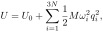
 the mass of the particles,
  a set of normal coordinates, and
  the energy of the system in its ground state. This approximation is known as the harmonic approximation and the form of the potential in
 ![[*]](crossref.png) is known as a quadratic form.
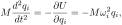
The Newton's equations of motion for the normal coordinates are:
which have the general solution
where
is known as a quadratic form.
The Newton's equations of motion for the normal coordinates are:
which have the general solution
where  is an arbitrary phase. 7.1
In the particular case of the potential of one can easily obtain  (for a classical system), as the integral factorises:
 . For a large enough volume, the range of integration over the variables can be extended from
  to
to  , because of the exponential decay of the integrand, which makes the integrals easy to compute using :
from which we obtain:
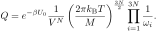
Combining this with we obtain the total partition function:
where
, because of the exponential decay of the integrand, which makes the integrals easy to compute using :
from which we obtain:
Combining this with we obtain the total partition function:
where
 is the reduced Plank's constant and we have omitted the internal partition function
  as we are dealing with structureless particles. Note that in we have not included a
  factor, as the oscillators are uniquely identified by the positions of their parabolic potentials in the space of the normal modes and by their frequencies
  . The Helmholtz free energy is
These expressions for the partition function and the Helmholtz free energy are consequence of us taking the classical limit.
If the oscillators cannot be described as classical particles, then the integrals in have to be replaced by sums over the quantum energies, which are the eigenvalues of the time independent Schrödinger equation. For a system described by a sum of harmonic potentials they are given by
. The Helmholtz free energy is
These expressions for the partition function and the Helmholtz free energy are consequence of us taking the classical limit.
If the oscillators cannot be described as classical particles, then the integrals in have to be replaced by sums over the quantum energies, which are the eigenvalues of the time independent Schrödinger equation. For a system described by a sum of harmonic potentials they are given by
 . For a system of independent harmonic oscillator the partition function is still obtained by a product of single particle partition functions,
with each term in the product having the form:
The Helmholtz free energy is:
The classical limit can be easily be obtained from a Taylor expansion with
. For a system of independent harmonic oscillator the partition function is still obtained by a product of single particle partition functions,
with each term in the product having the form:
The Helmholtz free energy is:
The classical limit can be easily be obtained from a Taylor expansion with
 7.2. The first term on the r.h.s. in does not have a classical analog. Note that this term does not depend on temperature and so it is present also at
  . For this reason it is called zero point energy.