


Next: Alternative derivation of the Up: Harmonic crystalline solids Previous: Harmonic crystalline solids Contents
![\includegraphics[width=4.in]{chain.pdf}](img968.svg)
|
 , so we can compute the partition function, but before tackling a three dimensional crystal it is useful to discuss a simpler system, made of a linear chain of particles connected by harmonic springs with spring constant
  . The chain has
  elements and closes on itself with period boundary conditions (PBC), so that the first element of the chain is also the last. If the number of elements in the chain is large enough it does not matter if it is left open or closed with PBC, but the latter is mathematically convenient, as we shall see.
The potential energy is:
where
elements and closes on itself with period boundary conditions (PBC), so that the first element of the chain is also the last. If the number of elements in the chain is large enough it does not matter if it is left open or closed with PBC, but the latter is mathematically convenient, as we shall see.
The potential energy is:
where  is the potential energy of the system when all springs are un-stretched, which without loss of generality we can set equal to zero, and
  is the displacement of the
  element in the chain from its equilibrium position. Eq.
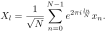
 ![[*]](crossref.png) is not in the form of Eq. , however, with a proper transformation of coordinates it can be reduced to that form, and when this is achieved the new coordinates are called the normal modes of the system. Consider the following transformation:
The transformed variables have the property:
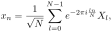
We can express by inverting :
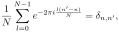
which can be easily verified using the orthogonality relation:
where
is not in the form of Eq. , however, with a proper transformation of coordinates it can be reduced to that form, and when this is achieved the new coordinates are called the normal modes of the system. Consider the following transformation:
The transformed variables have the property:
We can express by inverting :
which can be easily verified using the orthogonality relation:
where
 if
if
 and zero otherwise. We see therefore that the
  represent collective excitations, in the form of
waves on the chain with wavelength
represent collective excitations, in the form of
waves on the chain with wavelength
 , where
  is the distance between the particles on the chain. This can be seen by assigning a value to for a particular value of
  and zero for all other values and noting that, as a result of , is displaced by
 , and so the displacement
 , with
 , is the same as the displacement whenever
  is an integer.
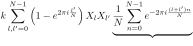
If we now substitute into we obtain:
, the sum in can be extended over any consecutive integers, and for example for
 , so we also have
where the last equality is obtained by replacing with
, so we also have
where the last equality is obtained by replacing with  . By summing and we obtain:
Now we use the trigonometry identity
and so
which gives
where
. By summing and we obtain:
Now we use the trigonometry identity
and so
which gives
where  is the mass of the particles and we have defined:
From this we get the dispersion relation:
where we have taken only the positive solution of the square root in .
In the term
is the mass of the particles and we have defined:
From this we get the dispersion relation:
where we have taken only the positive solution of the square root in .
In the term  is already a normal mode. Using we see that the displacements are all equal:
and therefore the mode corresponds to a rigid shift of the whole chain. This means that the springs are not compressed or elongated, and if the chain is not attached to any external spring the mode has zero frequency. If is even, also the mode
is already a normal mode. Using we see that the displacements are all equal:
and therefore the mode corresponds to a rigid shift of the whole chain. This means that the springs are not compressed or elongated, and if the chain is not attached to any external spring the mode has zero frequency. If is even, also the mode
 is already a normal mode. It corresponds to particles vibrating with the same amplitude but alternating directions:
It is a stationary wave on the chain, and it is the mode with the largest possible frequency, equal to
is already a normal mode. It corresponds to particles vibrating with the same amplitude but alternating directions:
It is a stationary wave on the chain, and it is the mode with the largest possible frequency, equal to
 . For the other values of we need to further consider the real and the imaginary part of .
Let us define
. For the other values of we need to further consider the real and the imaginary part of .
Let us define  and
and  through:
which gives
Noting we can re-write the potential energy (for even) as:
This expression has the same form as Eq. , and
through:
which gives
Noting we can re-write the potential energy (for even) as:
This expression has the same form as Eq. , and
 with
with
 , are the normal coordinates.
They represent oscillations of the type of Eq. ,
, are the normal coordinates.
They represent oscillations of the type of Eq. ,
 and
and
 , with the frequency
  determined by the dispersion relation and
  some constant phases. Since
 (Eq. ), we have
 and
and
 , and with no loss of generality we can take
 and
and
 , so that
 .
For a particular mode , the displacement of the particle at position
.
For a particular mode , the displacement of the particle at position  on the chain is given by:
and therefore these displacements oscillate with a time dependent phase given by
on the chain is given by:
and therefore these displacements oscillate with a time dependent phase given by
 and a phase shift
 , determined by their position on the chain. Eq. represents a travelling wave with phase velocity
 .
.
![\includegraphics[width=4.in]{dispersion.pdf}](img1027.svg)
|
, for a quantum system, or by Eq. in the classical limit. Indeed, all that it is needed to compute the partition function is knowledge of the frequencies .
Defining the wavenumber
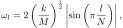
 , we can re-express the dispersion relation as:
which is plotted in Fig. . as function of wavenumber
, we can re-express the dispersion relation as:
which is plotted in Fig. . as function of wavenumber  . We see that this is a periodic function of , which therefore only needs to be defined over one period. For convenience, it is useful to plot it in the range
 , which is known as the first Brillouin zone. The number of points defined in the dispersion relation is equal to the number of particles in the chain, and so the longer the chain the shorter the distance between the corresponding points in reciprocal space.
The derivative of the frequency w.r.t. the wavenumber gives the group velocity of a wave packet travelling on the chain,
 . In the long wavelength limit
 the system behaves as if it were a continuum medium. The waves have frequencies that are proportional to the wavenumber, and the constant of proportionality is their speed. As the wavelength is reduced the system starts to depart from the continuum picture, and the direct proportionality between frequency and wavenumber breaks down. At the shortest possible wavelength, equal to two times the inter-particle distance, the waves have zero velocity. These are described by the zone boundary modes,
 , which represent stationary waves.
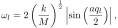
Note that expression is not limited to the case of nearest neighbour interactions. Suppose we add a second spring, with spring constant  , connecting each oscillator on the chain with its second nearest neighbours, then the potential energy function becomes:
again, but now with:
Note that at zone boundary  the second term on the r.h.s. in the expression above does not contribute to the dispersion relation. This is not surprising, of course, because that is the mode with the shortest wavelength in the system, and corresponds to a standing wave in which second nearest neighbours particles move in phase. The distance between these particles therefore does not change, and the presence or otherwise of the spring does not make any difference to the dynamics of the system, as that spring remains unstretched.
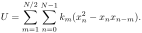
The result can easily be generalised to coupled harmonic interactions between any of the possible  neighbours (for even), each with spring constant
  , for which the potential energy function reads:
and this transforms into a sum of independent harmonic oscillators of the type with







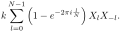


![$\displaystyle k\sum_{l =0}^{N-1} \left [1 - \cos \left (2\pi \frac{l}{N} \right ) \right ] X_l X_{-l}.$](img994.svg)
![$\displaystyle \cos(\alpha) = \left [ \cos \left(\frac{\alpha }{2}\right ) \right ]^2 - \left [ \sin \left(\frac{\alpha}{2}\right ) \right ]^2,$](img995.svg)
![$\displaystyle 1 - \cos \left (2\pi \frac{l}{N} \right ) = 2 \left [ \sin \left(\pi \frac{l}{N}\right ) \right ]^2,$](img996.svg)
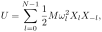
![$\displaystyle \omega_l^2 = 4\left (\frac{k}{M} \right ) \left [\sin\left(\pi \frac{l}{N}\right) \right ]^2.$](img998.svg)







![$\displaystyle \omega_l^2 = \frac{4}{M}\left [k \sin\left(\pi \frac{l}{N}\right) + k_2 \sin\left(2\pi \frac{l}{N}\right) \right ]^2.$](img1037.svg)
![$\displaystyle \omega_l^2 = \sum_ {m=1}^{N/2} \frac{4}{M}\left [k_m \sin\left(m \pi \frac{l}{N}\right) \right ]^2.$](img1041.svg)