Next: Physical constants Up: [remember picture,overlay] [fill,blue!20] (current Previous: Stirling approximation Contents
 any positive integer. To compute
  we first make a change of variable
 , and then we define:
Now consider:
This integral can be easily calculated in polar coordinates:
from which we obtain:
The integral
, and then we define:
Now consider:
This integral can be easily calculated in polar coordinates:
from which we obtain:
The integral  is straightforwardly computed:
Using Eqs.
is straightforwardly computed:
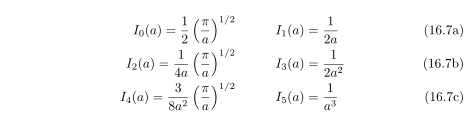
Using Eqs. ![[*]](crossref.png) , we can summarise the first few integrals:
The integrals and can also be written as:
with the
, we can summarise the first few integrals:
The integrals and can also be written as:
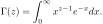
with the  function defined by:
Integrating by parts Eq. we obtain
function defined by:
Integrating by parts Eq. we obtain
 , which makes the connection with the factorial for integer numbers:
 .
Substituting
.
Substituting
 in Eq. , for
  we obtain:




![$\displaystyle I^2 = \frac{1}{a} \int_{0}^{2\pi} d\phi \int_{0}^\infty r e^{- r^...
...rac{1}{a} 2\pi \frac{1}{2} \left [ e^{- r^2} \right ]_0^\infty = \frac{\pi}{a},$](img1657.svg)

![$\displaystyle I_1(a) = \int_0^\infty x e^{-a x^2} dx = \frac{1}{a} \int_0^\inft...
... = -\frac{1}{a} \frac{1}{2} \left [ e^{- y^2} \right ]_0^\infty = \frac{1}{2a}.$](img1660.svg)