


Next: Three dimensional crystals Up: Linear chain Previous: Linear chain Contents
We have seen in the previous section that, if the system is excited into a particular normal mode, the general time dependent solution for the displacement  of a particle on the chain can be expressed as:
 is the position of the particle on the chain, and
  is some wavenumber that together with
  needs to be determined.
We now use Newton's equation of motion:
which for the potential energy function
needs to be determined.
We now use Newton's equation of motion:
which for the potential energy function ![[*]](crossref.png) gives
and so
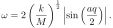
from which we obtain again the dispersion relation:
This has the same form as . To determine the allowed wavenumbers we impose the boundary condition
gives
and so
from which we obtain again the dispersion relation:
This has the same form as . To determine the allowed wavenumbers we impose the boundary condition
 , which requires
with
, which requires
with  any integer, which gives
where we have placed limits on to restrict
any integer, which gives
where we have placed limits on to restrict  to the first Brillouin zone, as we only need to define over one period.


![$\displaystyle -M \omega^2 x_n = - k [ 2 x_n - x_{n-1} - x_{n+1}],$](img1046.svg)
![$\displaystyle M \omega^2 = k [ 2 - e^{iq a} - e^{-iq a} ] = 2k [ 1 - \cos (q a) ],$](img1047.svg)
![$\displaystyle q [N+n] a = qna + 2l \pi,$](img1050.svg)
