Next: Anharmonicity Up: Harmonic crystalline solids Previous: Three dimensional crystals Contents
 and the forces, given by
 ![[*]](crossref.png) . Let us consider the crystal in the ground state and displace only one particle from its equilibrium position, say the one in the origin. Let the displacement be along the
. Let us consider the crystal in the ground state and displace only one particle from its equilibrium position, say the one in the origin. Let the displacement be along the  -axis, for simplicity,
 . The forces acting on all other particles in the system are given by , and they are:
from which we obtain:
This is the first column of the force constant matrix. To obtain the other two columns we simply need to repeat the procedure, but this time with displacements
. The forces acting on all other particles in the system are given by , and they are:
from which we obtain:
This is the first column of the force constant matrix. To obtain the other two columns we simply need to repeat the procedure, but this time with displacements  and
and  . A set of three forces calculations, one for each displacement, is therefore all that is needed to compute the full force constant matrix. However, in high symmetry systems the number of displacements can be reduced. For example, if the system has a symmetry that makes the and the
  axis equivalent, the forces induced by a displacement along the -axis can simply be obtained by applying the symmetry operation to the forces induced by the first displacement along the -axis. For cubic systems for example, only a single displacement is ever needed.
In a practical calculation it is not possible to include all (infinite) particles and therefore it is not possible to compute the forces on all particles and obtain the full force constant matrix. The usual approach is similar to the one described for the linear chain in the previous section, i.e. we consider a supercell, which is a multiple
 of the primitive cell. The periodicity is now described by new lattice vectors:
 the volume of the supercell.
This means that if we displace one particle by an amount
the volume of the supercell.
This means that if we displace one particle by an amount  in the origin, we also displace all its periodic images at positions
 with
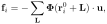
with  any three integers. These displacements are all equal to and therefore the forces that we are obtaining are:
where the sum runs over all possible superlattice vectors
any three integers. These displacements are all equal to and therefore the forces that we are obtaining are:
where the sum runs over all possible superlattice vectors  . It is clear, therefore, that we do not have access to the single elements of
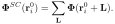
 , but only the supercell force constant matrix, defined as:
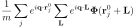
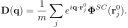
This also implies that it is impossible to obtain the exact dynamical matrix, which requires knowledge of every element of the force constant matrix. Let us rewrite as:
with the sum over
, but only the supercell force constant matrix, defined as:
This also implies that it is impossible to obtain the exact dynamical matrix, which requires knowledge of every element of the force constant matrix. Let us rewrite as:
with the sum over  running over the lattice sites
 belonging to the supercell.
Now consider the term
belonging to the supercell.
Now consider the term
 and compare with Eq. . For every
  such that
 we have
Since
we have
Since
 can be calculated, at these particular vectors the dynamical matrix is exact. These are the vectors that are linear combinations of the reciprocal vectors of the supercell, because if
 then for any
we have
then for any
we have
 , which gives
.
, which gives
.
To illustrate this property, let us consider a simple cubic system, with lattice and reciprocal vectors given by:
Let us build a supercell:
With these settings, using the procedure described above we obtain exact phonon frequencies at
supercell:
With these settings, using the procedure described above we obtain exact phonon frequencies at
 , for example, which is a zone boundary phonon. We also have an exact phonon at
 , which is another zone boundary phonon and all other combinations along the other axis.
If we made a
 supercell, then we would still have one wave-vector (for any cartesian direction) between zero (the
  point) and zone boundary at which the phonons are exact:
 , but note that there would be no zone-boundary phonons. This is equivalent to the statement in where we had the
  term only for
  even. Another way of saying this is that an 'odd' supercell cannot accommodate stationary modes.
For a
 supercell the exact phonons are at
 and so on. We recover the zone boundary phonons and, in addition, we get exact phonons also in between and zone boundary. Of course, every supercell, including the primitive cell, has exact (and trivial) phonons at .
The property described above is quite useful, because it allows for an independent check on the consistency of the calculations. If we repeat them with both a
and a
supercells, the two sets of calculations must produce the same phonons at zone boundary.
We see that as we increase the size of the supercell we populate the BZ with more and more exact phonons and in between those points we obtain a Fourier interpolation, which becomes more and more accurate as we increase the size of the supercell. Eventually the supercell is so large that the force constant matrix is negligible at its edges. When this happens, the only term contributing in the sum in is that with
 , and
, and
 , with the
  sign becoming an equal sign in the limit of the size of the supercell going to infinity. In this limit the Fourier interpolation is accurate everywhere. Note that the sum in may include vectors on the edges of the Wigner-Seitz cell, and therefore only one of these terms has to be included in the sum. Alternatively, one can divide the value of
 by the number of equivalent vectors on the edges of the WS cell and include all of them in the sum .