Next: The Fermi-Dirac distribution Up: Classical and quantum distributions Previous: The Maxwell-Boltzman distribution Contents
In the previous section, and in Sec. ![[*]](crossref.png) , we discussed the partition function for a system of independent classical particles and, we argued, that its validity required
, we discussed the partition function for a system of independent classical particles and, we argued, that its validity required
 . This condition is satisfied in a regime for which the average distance between the particles is much larger than their de Broglie wavelength, which represents the extent to which the particle position is de-localised because of its quantum nature. According to quantum mechanics, the position of a particle in space is described by a wavefunction, whose square modulus gives the probability density of being found in a particular position in space. When the distance between particles becomes comparable to their de Broglie wavelengths the wavefunctions start to overlap, and the particles lose their identity. They cannot be treated as separate objects anymore and one needs to construct a many-particle wavefunction that describes the system as a whole. 5.2 This wavefunction is a solution of the Schrödinger equation:
 is the hamiltonian operator, being the sum of the kinetic energy and potential energy operators
  and
and  , respectively, and
  is the eigenvalue. For a system containing
  identical particles
  is invariant w.r.t. any permutation of the particles and so if
 is a solution so is
 , where
  is any operator that causes any permutation or particles in the list. Any linear combination of wavefunctions with permutated arguments is also acceptable. Out of all possibilities, we can build two special combinations:
and
where
is any operator that causes any permutation or particles in the list. Any linear combination of wavefunctions with permutated arguments is also acceptable. Out of all possibilities, we can build two special combinations:
and
where  is the number of two-particle permutations to obtain the total permutation , also known as the order of the permutation, and the sum runs over all possible permutations. The wavefunction
  is called symmetric, and
  anti-symmetric. They live in two portions of the Hilbert space that are disjoint and cannot be turned into one another. It turns out that different particles obey either one or the other condition, depending on the value of their spin. In particular, particles with integer spin – such as alpha particles, photons etc. – have symmetric wavefunctions and particle with half integer spin – electrons, protons, neutrons, etc.. – have anti-symmetric wavefunctions.
Note that we are dealing with a single state here, or , despite these being realised as a linear combination of up to  of them. If we compare with the situation in the classical limit, we see that the multiplicity due to particle exchange is dealt with from the outset: there is just a single state. We do not treat states that differ by a permutation of the (identical) particles as potentially distinct and therefore we do not run into the issue of the Gibbs paradox.
The hamiltonian in is the sum of the kinetic energy and the potential energy operators. The kinetic energy operator is
 . If the potential energy operator is also the sum of single particle operators
 , meaning that the particles do not interact amongst themselves, then the solution of factorises into a product of single particle wavefunctions. For example, let us consider again the example of Sec. in which we have two particles that can occupy two different states,
  and
and  . We can build 4 separate wavefunctions:
 |
|
 |
|
 |
|
 |
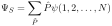
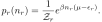
, but in that case we ended up with the problem of underweighting the two states with both particles in them, as we divided all terms in the sum by 2. We had to assume then that that particular expression of the partition function could only be justified if the probability of occupying one state with more than one particle were negligible, so that it wouldn't matter if those states were weighted wrongly. We found that the condition for this assumption to be valid was that the average distance between the particles should be much larger than their de Broglie wavelength, i.e that the particles behaved classically. In the quantum mechanics picture we do not run into the problem of underweighting any state. Any distribution of the particles with occupation numbers
 is a single microstate, obtained by forming a linear combination of all possible distributions of the particles in the single particle states, this linear combination being either symmetric or anti-symmetric. The probability therefore is:
with
is a single microstate, obtained by forming a linear combination of all possible distributions of the particles in the single particle states, this linear combination being either symmetric or anti-symmetric. The probability therefore is:
with
 , and we have:
with
The total probability factorises:
with
Note that the probability differ from only by a factor
, and we have:
with
The total probability factorises:
with
Note that the probability differ from only by a factor  in the denominator, therefore the two expressions are identical for
  . This means that if the probabilities for occupation numbers
  are small, these states contribute little to the average occupation number
 , which is therefore the same when computed with either or . This condition is verified when
 , which is once again the limit in which the average distance between the particles is much larger than their de Broglie wavelength, and tells us that the MB distribution only becomes a good approximation for the statistics of the occupation numbers
  when the particles behave classically.