Next: The Bose-Einstein distribution Up: Quantum distributions Previous: Quantum distributions Contents
To work out the distribution of the occupation numbers and the single state grand partition function
we can take over the results obtained in Sec. ![[*]](crossref.png) for the probability distributions of the single state occupation numbers, and we have:
for the probability distributions of the single state occupation numbers, and we have:
 over all the allowed values of
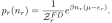
  , which in this case are only 0 and 1, which gives:
and the average occupation number is:
This is conveniently written as:
which is the usual form of the FD distribution, plotted in Fig. for two different values of
, which in this case are only 0 and 1, which gives:
and the average occupation number is:
This is conveniently written as:
which is the usual form of the FD distribution, plotted in Fig. for two different values of  . At very large (low temperature), the exponential at the denominator is very large for
 , and very low for
 . This results in
  changing very quickly from one to zero around
  . The single particle energy states are therefore fully occupied for energies lower than the chemical potential, and they are empty for energies larger than (for
 we always have
 ). For small values of (high temperature) the occupation numbers change less abruptly around and their thermal energy causes occupation of states with energy higher than the chemical potential.
![\includegraphics[width=8cm]{fd.pdf}](img749.svg) |
At energies that are large compared to
 the average occupation numbers are small and the FD distribution can be approximated by the MB distribution:
 |
The FD distribution applies to a gas of non-interacting fermions, which is sometimes a good approximation to describe conduction electrons in metals, especially for alkaline metals such as Na (see below). The fact that electrons are fermions and are described by antisymmetric wavefunctions is the very reason why matter exists in extended form, as it would otherwise collapse all particles in the ground state. By forcing different particles in different wavefunctions, the spacial distribution of these particles is forced to be different.
![\includegraphics[width=8cm]{dos.pdf}](img752.svg) |
At zero temperature, a gas of  non-interacting fermions fills the lowest states and the chemical potential is therefore equal to the highest energy amongst the occupied states. This defines the Fermi energy of the gas
 . The fermions fill the states one by one, starting with the one at the lowest energy and working their way up. If the gas is enclosed in a volume
  , we know from Appendix that each state occupies a volume of phase space equal to
  . If a particle has spin
  , then for each state in phase space there are
  available spin states, and so there are
 states in the volume that have momentum between
  and
and  . Since
 , and
, and
 , it follows that the number of states with energy between
  and
and
 is given by:
 (in this particular case for
  ). To obtain the energy of the highest occupied state
, we need to integrate form 0 to
and set it equal to . If we refer to fermions with
). To obtain the energy of the highest occupied state
, we need to integrate form 0 to
and set it equal to . If we refer to fermions with  , such as electrons, then we have:
which gives:
For fermions with
, such as electrons, then we have:
which gives:
For fermions with  the Fermi energy
is reduced by the factor
the Fermi energy
is reduced by the factor
 , which is the number of extra available states.
To get a feeling of the physical significance of the Fermi energy let us calculate it for a typical metal with one conduction electron per atom, for example sodium. At ambient conditions, the volume per electron is
, which is the number of extra available states.
To get a feeling of the physical significance of the Fermi energy let us calculate it for a typical metal with one conduction electron per atom, for example sodium. At ambient conditions, the volume per electron is
 Å
Å and so we get
 eV. This is a large energy, equivalent to a temperature
 K, or to a velocity
 m/s. The confinement of the crystal structure causes the electrons to occupy a relatively small space for their mass, which in turns makes them whizzing around at breakneck velocities. In Fig. we compare the actual density of states of Na, calculated using density functional theory (DFT, see Chapter ), with the expression for the Fermi gas . Notwithstanding the approximate character of the DFT density of states, the comparison shows how good the free electron approximation is for such a metal.
![\includegraphics[width=8cm]{fdocc.pdf}](img773.svg) |
A Fermi gas at zero temperature is called completely degenerate. Since the Fermi temperature  is often very large, it turns out that deviation from completely degenerate bahaviour are usually very small, even for iron at Earth's core conditions, where temperatures can reach 6,000 K.
Nevertheless, we now need to study the behaviour of a Fermi gas at temperatures
is often very large, it turns out that deviation from completely degenerate bahaviour are usually very small, even for iron at Earth's core conditions, where temperatures can reach 6,000 K.
Nevertheless, we now need to study the behaviour of a Fermi gas at temperatures
 . In this case, the average occupation number of the states is not either one or zero, but it is given by the FD distribution (Fig. ), and so the average number of occupied states with energy between and
,
. In this case, the average occupation number of the states is not either one or zero, but it is given by the FD distribution (Fig. ), and so the average number of occupied states with energy between and
,
 , is the product of the average occupation number times the number of available states (Fig. ):
over all possible values of the energy and it is determined by the value of the chemical potential . Conversely, if we know that the gas has particles, then this integral implicitly defines the chemical potential: