Next: Bose-Einstein condensation Up: Quantum distributions Previous: The Fermi-Dirac distribution Contents
 times is:
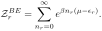
from which we get the Bose-Einstein (BE) single state grand partition function
This sum can only converge if
times is:
from which we get the Bose-Einstein (BE) single state grand partition function
This sum can only converge if
 , and since the grand partition function of the gas is equal to the product of the single state partition functions,
 , then we must have
 , where
 is the energy of the ground state. For a gas of non-interacting bosons the energy is the kinetic energy and so
 , which means that we must have
  . If this is the case,
 ![[*]](crossref.png) can be summed, and the result is:
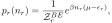
The average occupation number is:
which we write as:
Note that the ground state occupation number for the BE distribution becomes very large as the chemical potential approaches zero.
Similarly to the FD distribution, at energies that are large compared to
can be summed, and the result is:
The average occupation number is:
which we write as:
Note that the ground state occupation number for the BE distribution becomes very large as the chemical potential approaches zero.
Similarly to the FD distribution, at energies that are large compared to
 the average occupation numbers are small and the BE distribution can be approximated by the MB distribution:
 |