


Next: Equilibrium between phases Up: Quantum distributions Previous: The Bose-Einstein distribution Contents
 of each state:
Of these, the ground state is particularly interesting. Since there is no limit to the number of particles that can fall into any state, at zero temperature all particles will be in the ground state. Here the particles have zero energy and zero momentum, and so they contribute zero to the pressure and to the viscosity (which depends on momentum). They are in a superfluid state, known as Bose-Einstein condensate.
If the temperature is very close to zero, but not exactly zero, some particles will be in excited states, and the fraction of the number of particles in the ground state decreases as the temperature increases up to some critical temperature
of each state:
Of these, the ground state is particularly interesting. Since there is no limit to the number of particles that can fall into any state, at zero temperature all particles will be in the ground state. Here the particles have zero energy and zero momentum, and so they contribute zero to the pressure and to the viscosity (which depends on momentum). They are in a superfluid state, known as Bose-Einstein condensate.
If the temperature is very close to zero, but not exactly zero, some particles will be in excited states, and the fraction of the number of particles in the ground state decreases as the temperature increases up to some critical temperature  , above which this fraction becomes negligible. For
 the gas is formed by a mixture of two fluids, a superfluid condensate and a standard gas of bosons. The two fluids are not spatially separated, as the particles have no identity.
![\includegraphics[width=8cm]{becond.pdf}](img798.svg) |
 , which gives the number of available states per unit energy. This is a useful quantity because, under the assumption that the number of states in the temperature range
 is large, we can turn the sum
 ![[*]](crossref.png) into an integral using the density of states :
The chemical potential is defined implicitly by , subject to the constraint
into an integral using the density of states :
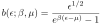
The chemical potential is defined implicitly by , subject to the constraint  . To see how this constraint comes into play, let us consider the integrand
in more details. This is plotted in Fig. for three values of
. To see how this constraint comes into play, let us consider the integrand
in more details. This is plotted in Fig. for three values of  . We see that, for fixed
  , the area under the curve
 decreases for increasing (decreasing temperature). We also see that for the highest two temperatures this decrease in
  can be reversed by decreasing
  , and in this case it is possible to adjust in order to satisfy the constraint that the total number of particle, which is proportional to , is actually equal to
  . However, at the lowest temperature (highest ) even setting
  is not enough to restore to the value required to satisfy the constraint. This would suggest that either there is a limit to how low the temperature can go, or some particles start to disappear. Both hypothesis are obviously non physical. In fact, what is actually happening is that below a critical temperature , defined by with
  : 5.3
the particles will start to populate the ground state with
: 5.3
the particles will start to populate the ground state with
 . This state is not present in because, as the states are weighted with
 , the ground state is given zero weight and contributes nothing to the integral. This shortcoming is a consequence of our approximation of the sum with the integral . We have come across this difficulty already, when we have derived expressions for the equation of state of the perfect gas, and found that also in that case problems appeared because of the replacement of a sum over states with an integral to compute the partition function. We must therefore go back to the sum and include the ground state explicitly, so Eq. needs to be replaced by:
which we can rewrite as
with
the number of particles in the ground state and
the remaining particles.
The number of particles in the ground state
, the ground state is given zero weight and contributes nothing to the integral. This shortcoming is a consequence of our approximation of the sum with the integral . We have come across this difficulty already, when we have derived expressions for the equation of state of the perfect gas, and found that also in that case problems appeared because of the replacement of a sum over states with an integral to compute the partition function. We must therefore go back to the sum and include the ground state explicitly, so Eq. needs to be replaced by:
which we can rewrite as
with
the number of particles in the ground state and
the remaining particles.
The number of particles in the ground state  cannot be determined using Eq. , because the chemical potential is not known. All we know is that it must be very close to zero, but we cannot set it exactly equal to zero. However, we can obtain as difference, by combining Eqs. and with . This may appear as an inconsistency at first sight, but in fact it isn't, because the integral in Eq. does not really change much if or if but very small. On the contrary, the expression for in is singular for , and so it is very sensitive to the actual value of . The fraction of particles in the ground state is therefore given by:
with
cannot be determined using Eq. , because the chemical potential is not known. All we know is that it must be very close to zero, but we cannot set it exactly equal to zero. However, we can obtain as difference, by combining Eqs. and with . This may appear as an inconsistency at first sight, but in fact it isn't, because the integral in Eq. does not really change much if or if but very small. On the contrary, the expression for in is singular for , and so it is very sensitive to the actual value of . The fraction of particles in the ground state is therefore given by:
with
 . The integral
 is proportional to
 , as it can be easily verified with a change of variable
 , and so:
for
, and so:
for  . For
. For  the number of particles in the ground state is a negligible fraction of the total. This fraction is shown in Fig. .





![$\displaystyle N = (2s+1)\left [\frac{1}{e^{-\beta\mu}-1} + \frac{2\pi V}{h^3} (...
...t_0^\infty \frac{\epsilon^{1/2}}{e^{\beta(\epsilon-\mu)}-1} d\epsilon \right ],$](img809.svg)






![\includegraphics[width=8cm]{befrac.pdf}](img822.svg)