Next: Quantum distributions Up: Classical and quantum distributions Previous: Classical and quantum distributions Contents
If we have a total of  particles then we must have
 . The Boltzmann probability is:
The multiplicity factor
 is equal to the number of possibilities that we can realise with the set of occupation numbers
 . This is equal to the number ways of arranging distinct particles with
  having energy
 ,
,  having energy
 and so on, which is equal to
 ). We now impose the condition that, if the particles are indistinguishable, then any permutation of them would not produce a different state, and so we divide by
  . Again, this only gives the correct weights for
  , and otherwise we underweight the states by
 , as discussed in Secs.
 ![[*]](crossref.png) and . We might ask why not setting the weights to their correct values, and indeed this is what we will do in the following sections, but there is an advantage in developing the argument as we are, because we will arrive at an expression for the distribution of the
and . We might ask why not setting the weights to their correct values, and indeed this is what we will do in the following sections, but there is an advantage in developing the argument as we are, because we will arrive at an expression for the distribution of the  from which it will be easy to determine the chemical potential, and the perfect gas equation of state. The distribution we will arrive at also converges to the correct one in the limit
 , as in this limit it is very unlikely to obtain
  , and so it does not matter if these terms are weighted wrongly, they simply do not appear. With these premises, the total probability is given by:
and the partition function is:
Expression is useful, however the condition
prevents a full factorisation because the
, and so it does not matter if these terms are weighted wrongly, they simply do not appear. With these premises, the total probability is given by:
and the partition function is:
Expression is useful, however the condition
prevents a full factorisation because the  's are all related to each other by the constraint. To make progress, let us consider the case in which the total number of particle is not fixed. We are looking for the probability that the system has exactly particles and an energy
 , but the number of particles in the system is allowed to vary (in principle between 0 and infinity). This probability is given by the Gibbs distribution , which we express here as:
where the last equality follows from
, but the number of particles in the system is allowed to vary (in principle between 0 and infinity). This probability is given by the Gibbs distribution , which we express here as:
where the last equality follows from
 . We therefore obtain:
To obtain the gran partition function
. We therefore obtain:
To obtain the gran partition function
 we use the usual normalisation condition
 , where the sum is over all possible states. Since now can assume any value, this is the same as summing over any value of
:
This has, unsurprisingly, the same form as , but now the sums over the occupation numbers have no restrictions, because the total number of particles in the system is not limited to . This means that we can rewrite the gran partition function as the product of single state gran partition functions:
with 5.1
The result of this factorisation is that also the probability factorises into a product of single state probabilities and we can write
with
which is correctly normalised:
The gran partition functions
, where the sum is over all possible states. Since now can assume any value, this is the same as summing over any value of
:
This has, unsurprisingly, the same form as , but now the sums over the occupation numbers have no restrictions, because the total number of particles in the system is not limited to . This means that we can rewrite the gran partition function as the product of single state gran partition functions:
with 5.1
The result of this factorisation is that also the probability factorises into a product of single state probabilities and we can write
with
which is correctly normalised:
The gran partition functions
 are all different, because they depend on the value of the single particle energy
 , and so are the single state probabilities
  . As a result, the average number of particles in each energy state is also different. This is obtained from
which gives the Maxwell-Boltzmann (MB) distribution:
Note that we could have obtained also from:
The MB distribution offers a simple interpretation for the chemical potential
. As a result, the average number of particles in each energy state is also different. This is obtained from
which gives the Maxwell-Boltzmann (MB) distribution:
Note that we could have obtained also from:
The MB distribution offers a simple interpretation for the chemical potential  , as the value of the energy for which the average occupation number is exactly equal to one. States with
 have higher average occupation numbers and, conversely, states with
 have occupation numbers smaller than one.
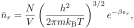
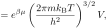
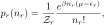
We can now make the connection with the classical limit for a perfect gas discussed in Sec. and . As pointed out in the chemical potential is also equal to the Gibbs free energy per particle, which for a perfect gas with no internal degrees of freedom is obtained from :
into we obtain:
which is the same expression obtained in for a system with a fixed number of particles .
Alternatively, we can also obtain by summing over all microstates:
which gives , and we can obtain the perfect gas equation of state from that.
















![$\displaystyle \mu = -k_{\rm B}T \ln \left [\frac{V}{N}\left(\frac{2\pi mk_{\rm B}T}{h^2}\right )^{3/2} \right ].$](img696.svg)