


Next: Maxwell velocity distribution Up: The Perfect Classical gas Previous: The Gibbs paradox Contents
 factor of the previous section only works if the particles are all in different single particle microstates, but what happens if two or more particles are in the same one? For example, imagine the limiting case in which all particles are in the same single particle microstate, then there is a single way to realise that particular configuration. However, when we compute the partition function
 ![[*]](crossref.png) we divide each term contributing to it by , and so these terms would be counted wrongly. To see this more explicitly, let us consider a system with two particles, 1 and 2, and let us assume that the system only has two single particle microstates with energies
we divide each term contributing to it by , and so these terms would be counted wrongly. To see this more explicitly, let us consider a system with two particles, 1 and 2, and let us assume that the system only has two single particle microstates with energies
 and
and
 . We have 4 possible arrangements: 1) both particles in state
  ; 2) both in state
  ; 3) particle 1 in state and particle 2 in state ; 4) particle 1 in state and particle 2 in state . Arrangements 3) and 4) have identical total energies and therefore, according to , the partition function is:
The
; 3) particle 1 in state and particle 2 in state ; 4) particle 1 in state and particle 2 in state . Arrangements 3) and 4) have identical total energies and therefore, according to , the partition function is:
The  at the denominator in correctly cancels the 2 in third term, because 3) and 4) should only be counted once since they do not correspond to distinct global microstates, but it should not be included in the first and the second term. This shows that Eq. is not correct either in the general case. The problem appears because of those terms with more than one particle in the same single particle microstate, or in the language of Eq. terms with
  . How likely is it that two or more particles are in the same single particle microstate?
To answer this question let us consider the simple case in which the particles of gas have no internal structure, so that the only energy they have is kinetic energy
. How likely is it that two or more particles are in the same single particle microstate?
To answer this question let us consider the simple case in which the particles of gas have no internal structure, so that the only energy they have is kinetic energy
 , where
  is the modulus of the particle momentum and
  its mass.
The Boltzmann distribution tells us that maximum probability for a particular energy level is obtained for the lowest possible energy, which with our assumption of structureless particles would mean zero momentum,
its mass.
The Boltzmann distribution tells us that maximum probability for a particular energy level is obtained for the lowest possible energy, which with our assumption of structureless particles would mean zero momentum,  . There is a single possibility for that to happen, and that is for the particle to be at rest 4.3.
If the momentum is not zero, then the Boltzmann factor is lower, but there are more energy levels with that particular value of momentum and so the probability of the state will be increased by the degeneracy factor. Specifically, if the momentum of the particle is between and
. There is a single possibility for that to happen, and that is for the particle to be at rest 4.3.
If the momentum is not zero, then the Boltzmann factor is lower, but there are more energy levels with that particular value of momentum and so the probability of the state will be increased by the degeneracy factor. Specifically, if the momentum of the particle is between and  , then any momentum vector in the shell delimited by spheres of radius and would give the particle the same energy,
(or, more precisely, energy between
, then any momentum vector in the shell delimited by spheres of radius and would give the particle the same energy,
(or, more precisely, energy between  and
and
 ) and so the number of states with those particular values of momentum must be proportional to the volume of the shell
 . This means that the probability of finding a particle with energy between
and
. This means that the probability of finding a particle with energy between
and
 must be proportional to
 . However, in a purely classical description the phase space is continuous and so the number of states for any range of momenta is infinite. This means that it is not possible to obtain the partition function, which is a sum over a discrete set of energy levels. This is a fundamental difficulty for classical statistical physics, that Boltzmann, Maxwell and Gibbs had to face. The solution is only available in a quantum picture, following the proposal by Plank at the beginning of the 20th century to divide the phase space into elementary cells, in connection with his theory of back-body radiation.
To work out how to enumerate the states we solve the Schrödinger equation for a particle in a box of volume
. However, in a purely classical description the phase space is continuous and so the number of states for any range of momenta is infinite. This means that it is not possible to obtain the partition function, which is a sum over a discrete set of energy levels. This is a fundamental difficulty for classical statistical physics, that Boltzmann, Maxwell and Gibbs had to face. The solution is only available in a quantum picture, following the proposal by Plank at the beginning of the 20th century to divide the phase space into elementary cells, in connection with his theory of back-body radiation.
To work out how to enumerate the states we solve the Schrödinger equation for a particle in a box of volume  (see Appendix ), from which we find that the number of states for which the particle has momentum between and is given by:
where
(see Appendix ), from which we find that the number of states for which the particle has momentum between and is given by:
where  is Plank's constant. Using
  defined in we can think of dividing momentum space in elementary cells, each containing a single state, and obtain the partition function by summing the individual probabilities. We will work this out below.
The probability of finding a particle with momentum in the range  is therefore proportional to
 , which is zero for and also quickly goes to zero for
 . It is only appreciably different from zero for
 and so these would be the typical energies of the particles in the system, distributed around this value by a factor of order
 . The question of how likely it is to find two particles in the same microstate then becomes: how many single particle microstates are there in the range of energy
? If it is only a few, then in a system with a large number of particles it would be very likely that each energy level is occupied by more than one particle. If, on the other hand, the number of states in the range
is very large, i.e. much larger than the number of particles, then most of them will be empty, some will be occupied by one particle and it would be very unlikely that any state is occupied by two or more particles. In this situation, then Eq. becomes fully justified. We will work out later in Sec. what are the conditions for this to be satisfied.
. The question of how likely it is to find two particles in the same microstate then becomes: how many single particle microstates are there in the range of energy
? If it is only a few, then in a system with a large number of particles it would be very likely that each energy level is occupied by more than one particle. If, on the other hand, the number of states in the range
is very large, i.e. much larger than the number of particles, then most of them will be empty, some will be occupied by one particle and it would be very unlikely that any state is occupied by two or more particles. In this situation, then Eq. becomes fully justified. We will work out later in Sec. what are the conditions for this to be satisfied.
In general the particles of gas are not points, but they have internal structure. The energy of the particles can be written as
 , where
 is the translational component, given by the kinetic energy of the centre of mass, and
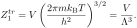
 the internal energy, due to internal vibrations, rotations, electronic excitations, etc. We write the total energy as the sum of the two as we assume that the state of motion of the centre of mass is not affected by the state of the internal degrees of freedom 4.4. The single particle partition function then takes the form:
 and
and  are the translational and the internal partition functions. The translational part of the partition function has the same structure for every gas and can be calculated once and for all, while the internal partition function depends of the internal properties and needs to be calculated for every different gas. We note that, since the internal energies do not depend on the volume of the system, the internal partition function is also independent on the volume .
The translational part of the single particle partition function is obtained by summing over all possible translational energy levels, each element in the sum multiplied by its degeneracy factor [proportional to the density of states ]. If the temperature is sufficiently high, a convenient way to do that is to approximate the sum over states into an integral over  :
:
). Note, however, that turning the sum over states into the integral would not be accurate if the probability of occupying the ground state is not negligible, because in the ground state () is given zero weight. We shall come back to this point later.
This integral can be easily calculated (see Appendix ) and gives:
The quantity
 has the dimension of a length and it is called the thermal wavelength, so the partition function is adimensional.
Substituting Eqs. and in the total partition function we obtain:
If the number of particles is large we can use the Stirling approximation for
and obtain for example for the Helmholtz free energy
has the dimension of a length and it is called the thermal wavelength, so the partition function is adimensional.
Substituting Eqs. and in the total partition function we obtain:
If the number of particles is large we can use the Stirling approximation for
and obtain for example for the Helmholtz free energy
 :
Note that this is an extensive quantity, which is
the result of the presence of the factorial term in the partition function .
Also note that quantities that only depend on logarithmic derivatives of the partition function, such as the energy, are unaffected by the presence of the term (or indeed any other constant term).
:
Note that this is an extensive quantity, which is
the result of the presence of the factorial term in the partition function .
Also note that quantities that only depend on logarithmic derivatives of the partition function, such as the energy, are unaffected by the presence of the term (or indeed any other constant term).
The expression for the Gibbs free energy is:
where we have used .
.
It is useful at this point to reflect on our discussion that led to the calculation of the translational part of the single particle partition function. Notwithstanding the evaluation of the integral in Eq. to work out numerically the value of the partition function, the argument that led us to that point relied on the necessity of being able to sum over a discrete number of states. The whole statistical physics machinery is build on the enumerability of the states. The sum was then approximated with the integral , as if the states were continuous, but this was simply for numerical convenience. It is important to keep this distinction in place, because if we now write the probability to find a particle with momentum between and , we have:
for , we obtain:
and the Plank's constant has disappeared, which seems to contradict our earlier statement that this probability must be proportional to a density of states that includes the Plank's constant.
Note that the volume as also disappeared. The reason for the disappearance of and is that they are contained both in the density of states and in the partition function , and so they are not required to define a continuous probability density. They would reappear if we wanted to compute the probability to obtain one particular state, as to obtain this quantity we would need to integrate over the volume of momentum space including one state, which is proportional to  . Only probabilities of obtaining a finite number of states are meaningful, and so these would all contain factors of .
![$\displaystyle Z = \frac{1}{2!} [ e^{-2\epsilon_r/k_{\rm B}T} + e^{-2\epsilon_s/k_{\rm B}T} + 2e^{-(\epsilon_r+\epsilon_s)/k_{\rm B}T} ]$](img446.svg)




![$\displaystyle Z(N,V,T) = \frac{1}{N!} V^N\left(\frac{2\pi mk_{\rm B}T}{h^2}\right)^{3N/2}\left [Z_{int}(T) \right]^N.$](img476.svg)




