Next: Perturbative expansion Up: Applications Previous: The small displacement method Contents
![[*]](crossref.png) may not be accurate enough and higher order terms would be needed (see Fig. ).
In general it is difficult to take into account these terms, and in any case eventually every term included in the expansion becomes inaccurate for large enough displacements. In addition, for large displacements the assumption of constant underlying potential also breaks down, and so its Taylor expansion becomes meaningless.
may not be accurate enough and higher order terms would be needed (see Fig. ).
In general it is difficult to take into account these terms, and in any case eventually every term included in the expansion becomes inaccurate for large enough displacements. In addition, for large displacements the assumption of constant underlying potential also breaks down, and so its Taylor expansion becomes meaningless.
An alternative procedure to compute the full free energy of the system goes under the name of thermodynamic integration. To explain how this works, let us consider the total potential energy of a crystal, and write it as:
where is the harmonic potential, defined as the sum of the first two terms in , and
  is the reminder. Note that here
  is the total potential energy function, which is not necessarily the one determined by the atoms in their equilibrium positions
 . As a consequence, is not necessarily equal to the
  term in .
In general we do not have an analytic expression of , but we might be able to sample it at some values of
 . Now define:
 is a parameter that we let vary between zero and one. For
 we have
 and for
 we have
 . By switching the parameter between zero and one we can therefore switch the potential energy function from , which we know analytically, to , which we may not fully know. The full free energy of the system can be written as:
where
. By switching the parameter between zero and one we can therefore switch the potential energy function from , which we know analytically, to , which we may not fully know. The full free energy of the system can be written as:
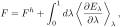
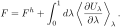
where  is the free energy of the harmonic system. The difference
  can be written as:
where
can be written as:
where
 is the free energy of the system with potential energy
  and
and  is the partition function, given by the usual sum of Boltzmann factors over the available microstates
  :
where
:
where
 are the corresponding energies of the microstates.
We therefore obtain:
where
are the corresponding energies of the microstates.
We therefore obtain:
where
 denotes the (thermal) average over the canonical ensemble generated by the system with potential energy .
If the system is classical the partition function can be separated into a kinetic and a potential energy part,
 , with
 as a shorthand for
 .
Since only the potential energy term depends on , we have:
We see that the canonical average in a classical system only depends on the space of configurations, as the momenta are integrated out and do not contribute. We can therefore write our final expression for and :
which for the classical case simplifies to:
Because of the simple form that we chose for this simply amounts to calculating the canonical average of .
If we do not have an analytic expression for we cannot compute its average exactly, however, if we have some means to compute for some values of
.
Since only the potential energy term depends on , we have:
We see that the canonical average in a classical system only depends on the space of configurations, as the momenta are integrated out and do not contribute. We can therefore write our final expression for and :
which for the classical case simplifies to:
Because of the simple form that we chose for this simply amounts to calculating the canonical average of .
If we do not have an analytic expression for we cannot compute its average exactly, however, if we have some means to compute for some values of
 distributed according to the canonical ensemble, then we can can obtain its average with a sampling error. As we mentioned in Sec. , for large systems it does not matter much if the average is taken in the canonical or the microcanonical ensemble, and so for simplicity we will discuss the latter first.
Note that although we described the thermodynamics integration procedure in the context of the anharmonic contribution to the free energy of a crystal, the procedure is completely general, and can be used to compute free energy differences between any two systems. The only requirement is that we must be able to integrate the quantity
 in the range
 .
.

![\includegraphics[width=8cm]{harm.pdf}](img1155.svg)