Next: The Clausius-Clapeyron relation Up: [remember picture,overlay] [fill,blue!20] (current Previous: Bose-Einstein condensation Contents
 will choose the physical state that minimises its Helmholtz free energy. If the system were kept at constant
  then it would be its Gibbs free energy to be minimum.
These statements lead us naturally to the discussion of equilibrium between different phases. For example, we know that liquid water at ambient pressure freezes at a temperature of zero Celsius. This is a consequence of the Gibbs free energy of the system becoming lower if all liquid transforms into solid. The total free energy of the system is
then it would be its Gibbs free energy to be minimum.
These statements lead us naturally to the discussion of equilibrium between different phases. For example, we know that liquid water at ambient pressure freezes at a temperature of zero Celsius. This is a consequence of the Gibbs free energy of the system becoming lower if all liquid transforms into solid. The total free energy of the system is
 , with
  and
and  the Gibbs free energies of solid and liquid. The equilibrium condition is therefore expressed by
  :
If the system is kept at constant
:
If the system is kept at constant  and constant
  , and if the total number of particles is kept constant so that we have
 , we have:
which implies
which we can also write:
where
, we have:
which implies
which we can also write:
where
 and
and
 . The chemical potentials
 , or Gibbs free energies per particle
  , depend on pressure and temperature.
In Fig.
, depend on pressure and temperature.
In Fig. ![[*]](crossref.png) we show an example of how
we show an example of how  and
and  vary with temperature at some fixed value of pressure. The temperature
  for which
 is the melting temperature at that value of pressure. The derivative of the chemical potential w.r.t. temperature is the negative of the entropy (per particle):
![\includegraphics[width=7cm]{chem.pdf}](img844.svg) |
. Moreover, the requirement for the system to be solid below the melting temperature and liquid above it means that the entropy of the liquid must be larger than that of the solid at and near the melting point. The difference of the two slopes means that, as the system transforms from one phase to the other, the entropy changes in a discontinuous way and the transformation is called first order phase transition, where first indicates that there is a discontinuity in the first derivative. The entropy change on melting is
 , computed at the melting temperature. At this temperature
 , which implies
 , where
 is the enthalpy change on melting, with
  and
and  the enthalpies of the two phases. The enthalpy change on melting is therefore
 . This quantity is usually called
  and known as the latent heat of fusion, which is the amount of heat that has to be provided to the system to change its phase from solid to liquid at the melting temperature. Conversely, in a crystallisation process the latent heat has to be extracted from the system to allow it to crystallise.
![\includegraphics[width=7cm]{pt.pdf}](img853.svg) |
and as function of temperature at some fixed pressure, we could just as well plot them as function of pressure at some fixed temperature, as in Fig. . For this particular temperature we can then obtain the melting pressure from the point where
. The derivative of the chemical potential w.r.t to pressure at constant temperature is equal to the volume per particle  :
which therefore must be positive, as displayed in Fig. . However, the volume change on melting is not required to be of a particular sign, because there is no need for the system to be either necessarily solid or necessarily liquid below the melting pressure. Most system have a larger volume in the liquid phase, such as the one showed in Fig. , so that the volume change on melting is positive, but there are notable exceptions, e.g. water. This has interesting consequences for how the melting temperature depends on pressure, as we shall see in the next section.
:
which therefore must be positive, as displayed in Fig. . However, the volume change on melting is not required to be of a particular sign, because there is no need for the system to be either necessarily solid or necessarily liquid below the melting pressure. Most system have a larger volume in the liquid phase, such as the one showed in Fig. , so that the volume change on melting is positive, but there are notable exceptions, e.g. water. This has interesting consequences for how the melting temperature depends on pressure, as we shall see in the next section.
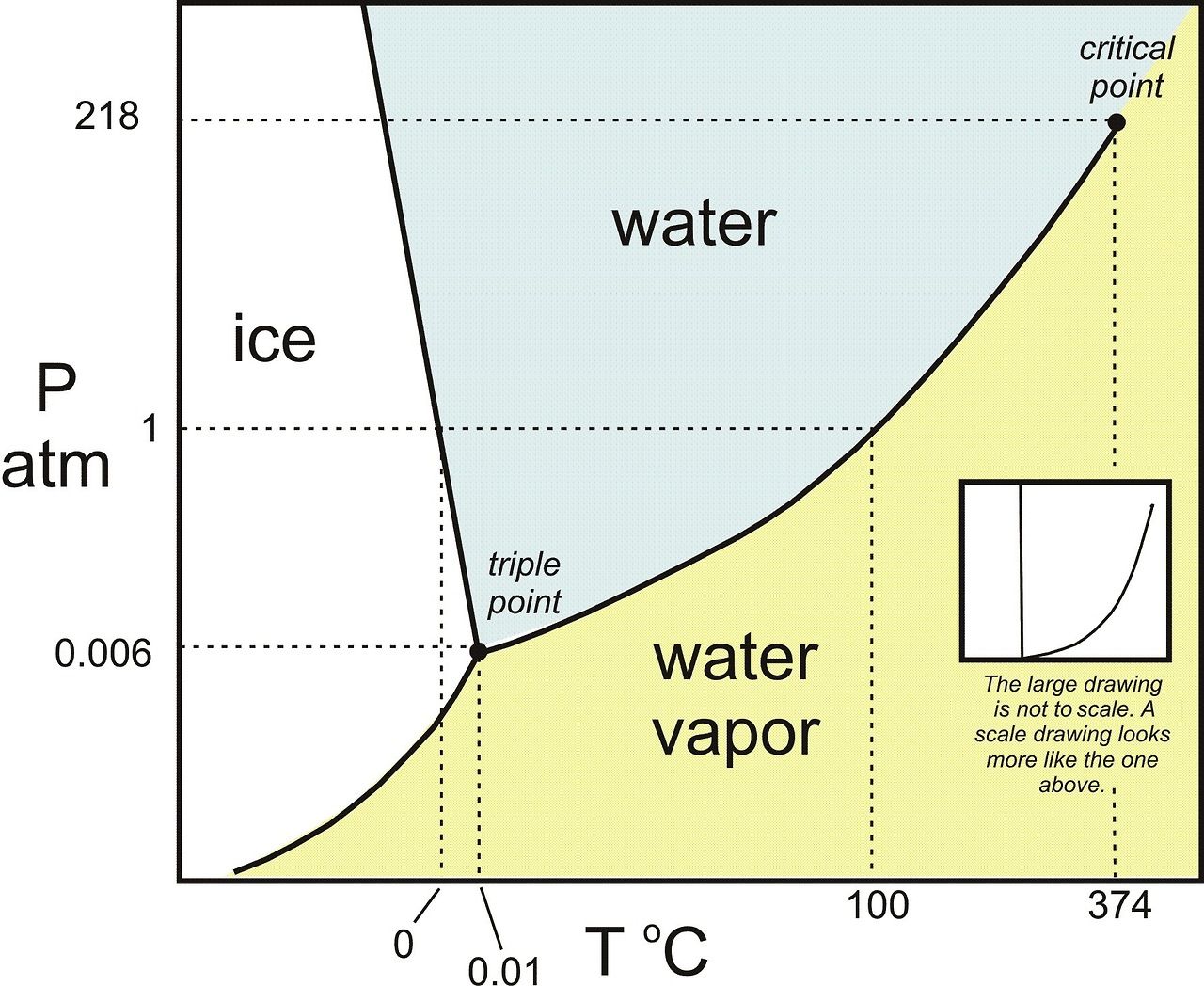
The condition of equilibrium between two phases defines a one-dimensional locus of points (a line) in  space. For example, for a melting transition this locus of points is known as the melting line, or melting curve. If we also consider the vapour phase we can introduce two additional equilibrium conditions, the sublimation line, defined by
  , with
  the chemical potential of the vapour phase, and the vapour line, defined by
  . It is also possible to find equilibrium between all three phases at once
 , which defines a zero-dimensional triple point. This unique point in
  space for water is used to define the Kelvin temperature scale (see Fig. ), as we mentioned in Chapter 1.