Next: The vapour pressure Up: Equilibrium between phases Previous: The Clausius-Clapeyron relation Contents
In Sec. ![[*]](crossref.png) we noted that the condition
we noted that the condition  at equilibrium (or rather the absence of internal constraints that impede particle exchanges between the two systems) implies that the distribution of the particles in the two systems is such that their chemical potentials, defined in , are equal. If there is more than one specie in the system, then the discussion in Sec. can be repeated separately for each specie, removing the constraint of impermeability to particle transfer one specie at a time. This leads to the definition of a different chemical potential for each specie, and to a generalisation of the fundamental thermodynamic relation to:
 running over the different species in the system, and
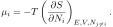
  the chemical potential of specie , defined by:
As a result, the fundamental thermodynamic relation for the Gibbs free energy becomes:
The chemical potentials are also obtained as:
and we have:
For constant temperature and constant pressure variations, combining Eqs. and gives the Gibbs-Duhem relation:
which shows that the chemical potentials of the various species are not all independent from each other.
the chemical potential of specie , defined by:
As a result, the fundamental thermodynamic relation for the Gibbs free energy becomes:
The chemical potentials are also obtained as:
and we have:
For constant temperature and constant pressure variations, combining Eqs. and gives the Gibbs-Duhem relation:
which shows that the chemical potentials of the various species are not all independent from each other.
Let us consider now chemical equilibrium between two phases, for example a solid and a liquid. The second law states that if we fix the pressure and the temperature the Gibbs free energy of the system must be minimum and so, using , we obtain a generalisation of :
 and
and  are the chemical potentials of specie in the solid and in the liquid, respectively, and
  and
and  are the number of particles in the two phases. Since particles of any specie cannot be created or destroyed but can only move from one phase to another, we must have
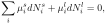
 and so:
and since this has to be satisfied for any variation
and so:
and since this has to be satisfied for any variation  , at equilibrium we must have
Suppose that the system is out of equilibrium and, for example,
, at equilibrium we must have
Suppose that the system is out of equilibrium and, for example,
 for one particular value of . For any change that drives the system to equilibrium we must have
  , implying that must be negative, i.e. particles move form the solid to the liquid phase, where the chemical potential is lower.