


Next: Applications Up: The vapour pressure Previous: The vapour pressure Contents
 in equilibrium with MgH
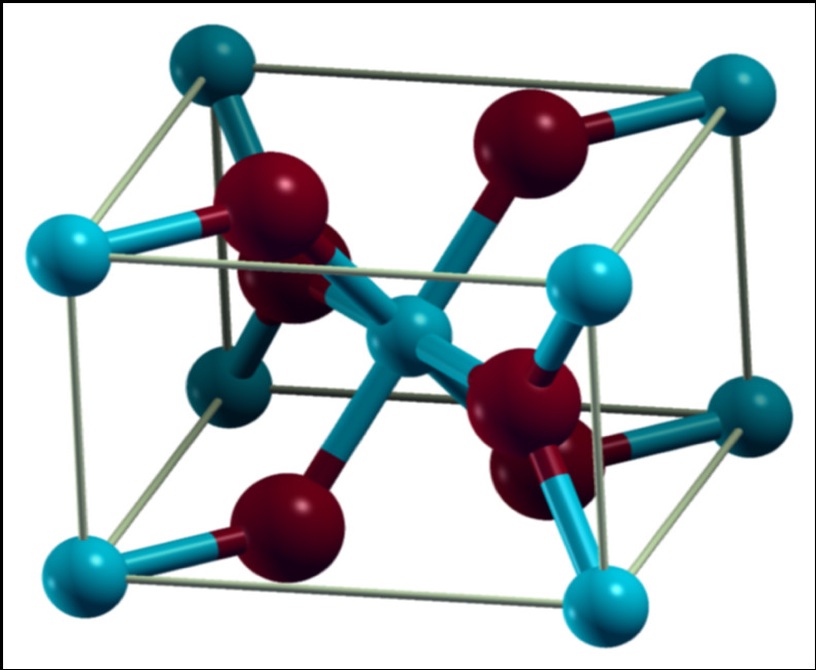
Let us study a specific example, namely equilibrium between the MgH crystal with H gas and the Mg crystal:
![[*]](crossref.png) must be equal:
We have:
where
must be equal:
We have:
where
 is the number of molecules,
 the volume of the gas and
 the Helmholtz free energy 6.2:
|
molecule:
given by
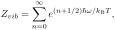
with  the H stretching frequency 6.3 and
where
the H stretching frequency 6.3 and
where
 is the moment of inertia of the molecule, with
  the mass of the hydrogen atom,
  the distance between the two atoms in the molecule 6.4, and
 K. The factor
  in front of the r.h.s of Eq. is due to the identity of the two atoms in the molecule, which reduces by a factor of two the number of distinct available microstates.
We can therefore write the Helmholtz free energy of the H molecule as:
we have:
If the temperature is large compared to the separation between the rotational energy levels we can approximate the sum in Eq. using the Euler-MacLaurin identity 6.5, and we obtain:
The stretching frequency of the hydrogen molecule is
 THz, meaning that at room temperature only the ground state has significant probability of being occupied 6.6, and therefore we can approximate the vibrational partition function as:
and so the vapour pressure is:
If we ignore the
THz, meaning that at room temperature only the ground state has significant probability of being occupied 6.6, and therefore we can approximate the vibrational partition function as:
and so the vapour pressure is:
If we ignore the  terms for the solid phases, which contribute very little to the total chemical potential at reasonable conditions, then their chemical potentials are simply given by Helmholtz free energies per formula unit, and we can write our final expression for the vapour pressure:
This expression shows how the vapour pressure decreases exponentially with the free energy of the MgH
terms for the solid phases, which contribute very little to the total chemical potential at reasonable conditions, then their chemical potentials are simply given by Helmholtz free energies per formula unit, and we can write our final expression for the vapour pressure:
This expression shows how the vapour pressure decreases exponentially with the free energy of the MgH crystal, reduced by the free energy of the Mg crystal and the zero point energy of the H molecule. Therefore, if MgH is more stable than Mg + H, this provides a mechanism to store H at a reduced pressure compared with pure H gas. The vapour pressure can then be tuned by changing the temperature, on which it depends as
  , and so H gas can be released as needed by increasing
  to sufficiently high values.


![$\displaystyle \mu_{\rm H_2} = \frac{1}{N_{\rm H_2}} \left [ F_{\rm H_2} + PV_{\rm H_2}\right ],$](img914.svg)




![$\displaystyle F_{\rm H_2} = -N_{\rm H_2} k_{\rm B}T \left [ \ln \frac{eV_{\rm H...
...2\pi mk_{\rm B}T}{h^2}\right)^\frac{3}{2} + \ln Z_{rot} + \ln Z_{vib} \right ],$](img930.svg)
![$\displaystyle \mu_{\rm H_2} = - k_{\rm B}T \left [ \ln \frac{k_{\rm B}T}{P}\lef...
...2\pi mk_{\rm B}T}{h^2}\right)^\frac{3}{2} + \ln Z_{rot} + \ln Z_{vib} \right ].$](img931.svg)

![$\displaystyle Z_{rot} = \frac{1}{2} \left [ \frac{T}{\Theta_r} + \frac{1}{3} + \frac{1}{15} \frac{\Theta_r}{T} + \dots \right ].$](img934.svg)

![$\displaystyle P \simeq k_{\rm B}T \left ( \frac{2\pi mk_{\rm B}T}{h^2}\right)^\...
...heta_r} + \frac{1}{3} + \frac{1}{15} \frac{\Theta_r}{T} + \dots \right ] \times$](img940.svg)

![$\displaystyle P \simeq k_{\rm B}T \left ( \frac{2\pi mk_{\rm B}T}{h^2}\right)^\...
...heta_r} + \frac{1}{3} + \frac{1}{15} \frac{\Theta_r}{T} + \dots \right ] \times$](img943.svg)
