


Next: Vapour pressure of H Up: Equilibrium between phases Previous: Chemical equilibrium in a Contents
Let us consider a condensed phase (solid or liquid) in equilibrium with its vapour. The equilibrium is dynamic, and we are interested in the steady state, where the average number of molecules that evaporate is the same as the average number of molecules that condensate. During this exchange the number of molecules in the gas phase  fluctuates around some average value, and if the vapour is contained in a volume
  and it behaves as a perfect gas, then its pressure is
 , and its chemical potential is:
 is equal to the chemical potential in the condensed phase
  :
and therefore we have:
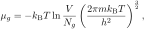
The chemical potential is equal to:
Substituting now
:
and therefore we have:
The chemical potential is equal to:
Substituting now
 and using the perfect gas equation of state we obtain:
where
and using the perfect gas equation of state we obtain:
where
 is the entropy per molecule in the gas phase. This can be re-expressed in terms of the heat of vaporisation
with
is the entropy per molecule in the gas phase. This can be re-expressed in terms of the heat of vaporisation
with  and
and  the enthalpy per molecule in the gas and the condensed phase respectively, and the last equality holds because of
 ![[*]](crossref.png) ,
,
 . Inverting Eq. we have
which substituted into Eq. gives:
This relates the vapour pressure directly to the heat of vaporisation.
. Inverting Eq. we have
which substituted into Eq. gives:
This relates the vapour pressure directly to the heat of vaporisation.
Equilibrium between a gas and a condensed phase means that bubbles of vapour should form in the condensed phase. If the condensed phase is solid these bubbles would cause local stresses with a resulting large elastic energy, and so they will not form. On the other hand, in a liquid they will form, and the liquid boils.
As we have seem in the previous section, if the system is formed by more than one specie then the chemical potentials of each specie must be equal at equilibrium, and therefore each specie contributes its own partial pressures to the total pressure. For example, consider water and air. The total atmospheric pressure is equal to
where is the partial pressure due to water vapour, and
 , with
  the remaining gases in the atmosphere (e.g. oxygen, nitrogen, CO
 , etc.). At some temperature
  the partial pressure of water is given by Eq. , and if the actual value of is lower than this equilibrium value then more water can enter the atmosphere if there is some condensed phase available, and so there is an imbalance that favours evaporation. On the other hand, if the partial pressure is close to equilibrium (100% humidity), then evaporation becomes more difficult, and it stops altogether at equilibrium 6.1. This is the reason why at high humidity it is more difficult to use evaporation (for example of sweat) as cooling mechanism.





![$\displaystyle \mu_g = \frac{1}{N_g} \left [ E_g + PV - TS_g \right ].$](img897.svg)




