Next: Regime of validity classical Up: The Perfect Classical gas Previous: The classical limit Contents
 in Eq.
 ![[*]](crossref.png) we obtain at once the distribution of the translational velocities of the particles of a perfect gas:
we obtain at once the distribution of the translational velocities of the particles of a perfect gas:
We can also obtain the distribution of each single component of the velocity:
and similarly for and
and  . The normalisation constant
  is obtained by integrating Eq. over all possible values of
  :
:
We see from that the most probable value for any component of the velocity is zero. This means that if we consider an element of volume
 in velocity space, then the most probable velocity will be found when this volume is centred around zero, or in other words it is more probable to find a particle at rest than with any other velocity. However, if we are not interested in the direction of the velocity but only in its modulus, then this is not the case, because a zero velocity can only be realised with all components of the velocity equal to zero but any other finite value
  can be obtained by any vector lying on a sphere of radius . The number of these vectors is proportional to the area of the sphere,
  , and so the probability of finding a particle with velocity is given by the Maxwell distribution .
Eqs. and can be expressed also in terms of the energy
 :
:
 is proportional to
  . Fig. shows the probability density
  and its decomposition in the density of states and Boltzmann factor. The increase in the density of states with increasing energy is the reason why has a maximum at a value of the energy greater than zero. To find this maximum we take the derivative of and set it to zero. We have:
and setting
and its decomposition in the density of states and Boltzmann factor. The increase in the density of states with increasing energy is the reason why has a maximum at a value of the energy greater than zero. To find this maximum we take the derivative of and set it to zero. We have:
and setting
 gives:
![\includegraphics[width=3.5in]{maxwell.pdf}](img502.svg) |
Let us calculate the average energy:
We make a change of variable and the integral becomes
With similar manipulations we can obtain the average velocity and the most probable velocity.
We want to work out now the probability distribution for the energy of a system of  identical, non-interacting particles. We are interested in the distribution of the total energy, rather than the energies of each single particles, because this is a quantity that is more easily accessible experimentally (for example, via its connection to the specific heat). In order to do that it is useful to go back to the distribution of momenta, and rewrite Eq. in cartesian rather than polar coordinates. To do that we replace the volume of the shell with radii
  and
and  , equal to
 , with the element of volume
 , and we write the probability for the system to have total energy
 as the product of probabilities:
To work out the density of states
 we use dimensional analysis and the condition of normalisation of the probability density. Each factor
in has the dimensions of
we use dimensional analysis and the condition of normalisation of the probability density. Each factor
in has the dimensions of  , and so must contain a factor
 . The condition of normalisation requires:
which gives
and so
We can now calculate the average energy:
which is simply times the average energy of a single particle as obtained in , as expected. This result, and the one in , could also have been obtained in a much more direct way as
. The condition of normalisation requires:
which gives
and so
We can now calculate the average energy:
which is simply times the average energy of a single particle as obtained in , as expected. This result, and the one in , could also have been obtained in a much more direct way as
 , but it was instructive to compute it also from .
To obtain the typical fluctuations of the energy we can calculate
, but it was instructive to compute it also from .
To obtain the typical fluctuations of the energy we can calculate
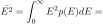
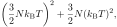
 . We have:
from which we obtain
. We have:
from which we obtain
 . The relative fluctuations are therefore
 , which for large are completely negligible and the total energy is effectively constant. We found this result already in Eq. .