Next: The equation of state Up: The Perfect Classical gas Previous: Maxwell velocity distribution Contents
![[*]](crossref.png) is for the occupation numbers
is for the occupation numbers  to be either one or zero. This condition will be satisfied if the average occupation number
 , as in this case the 's would be mostly zero, occasionally one, and almost never greater than one. We will work out this condition for the translational degrees of freedom of the particles of gas.
The probability that a particle is in a particular translational state with energy
 is given by the Boltzmann distribution:
 of this state in a system containing
  particles is
  , which is equal to:
We see that is maximum for the ground state
, which is equal to:
We see that is maximum for the ground state
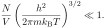
 , and so if we satisfy the condition for this state we satisfy it for any other state. It will therefore be sufficient to have:
This can be written as:
where
, and so if we satisfy the condition for this state we satisfy it for any other state. It will therefore be sufficient to have:
This can be written as:
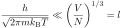
where  is the average distance between the particles. We argued in the previous section that most particles will have energies comparable to
 and so momentum
 . Therefore we can rewrite Eq. as:
In the above equation we recognise the de Broglie wavelenght
. Therefore we can rewrite Eq. as:
In the above equation we recognise the de Broglie wavelenght
 , which is the typical distance over which a particle is de-localised in a quantum mechanical picture. If we ignore the unimportant
 factor we see that the condition of validity for the partition function is that the average distance between the particles must be much larger than
 . Incidentally, this is also the condition that ensures that the system behaves classically and quantum effects can be ignored. For this reason this is called the classical limit.
As an example, let us consider air at standard pressure and temperature conditions (1 bar, zero Celsius). The de Broglie wavelength of a nitrogen molecule is
 Å and their average distance is
  Å, i.e. about 100 times larger. Under these conditions the classical partition function is expected to be quite accurate. Even at the nitrogen boiling temperature of 77 K the distance between the molecules in the gas phase would be
  Å, still much larger than the de Broglie wavelength
 Å, although of course at these conditions the gas condensates and does not behave as perfect anymore. To lower the boiling point and regain perfect gas behaviour one could reduce the pressure, which would have no effect on the de Broglie wavelength (which only depends on temperature) but would increase even more the average distance between the molecules.
Another useful example to consider is that of electrons in metals, which in many circumstances can be treated as a perfect gas. For materials with just one electron per atom in conduction the typical distance between the electrons is the same as that of the atoms, which is of order 2.5 Å. Compared with molecular nitrogen, the electron is
 times lighter and so at standard temperature its de Broglie wavelength is
 times longer, i.e
 Å. Even at
 K the de Broglie wavelength is still larger than the average distance between the electrons and therefore we cannot use the classical partition function .