Next: The Gibbs distribution Up: Equilibrium, heat bath Previous: The Boltzmann distribution Contents
 , defined as:
This can be obtained from
where
, defined as:
This can be obtained from
where  is the heat capacity at constant volume (as we are holding the volume constant). The energy is extensive and so is , meaning that they are both proportional to
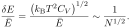
  . Therefore the relative fluctuations of the energy are given by:
For a macroscopic system we have
 and so the relative fluctuations of the energy are of order
  , i.e. negligible for all practical purposes. Moreover, these are instantaneous fluctuations, that is, the energy differences from the one that on average one would find as the system visits its microstates. Any experimental attempt to measure these fluctuations would inevitably average over a large number of microstates, as the measurement would take place over a finite interval of time during which the system would hop over a large number of microstates. Therefore, the actual measured energy would be averaged over all these microstates, and the expected fluctuations would be even smaller. As a result, we can consider a macroscopic system held at constant temperature to also have a well defined energy, and in the following we will drop the average sign and simply write
  . A corollary of this statement is that for a macroscopic system there is little difference between the microcanonical and the canonical ensembles and they become identical in the thermodynamic limit (infinite size). As a consequence, the average of any physical property taken in the two ensembles is also the same, in the thermodynamic limit.