Next: The partition function Up: [remember picture,overlay] [fill,blue!20] (current Previous: Maxwell relations Contents
We have introduced the perfect gas in Chapter 1, and wrote down its equation of state in Section ![[*]](crossref.png) . This is a relation between pressure, volume, temperature and number of particles, which is valid whenever the gas is in a state of equilibrium, that is when these macroscopic variables are well defined, meaning that they are uniform throughout the gas. The perfect gas is an idealisation, but a good one for real gases at low enough density, when the potential energy due to the interactions between the particles is much lower than their kinetic energy.
. This is a relation between pressure, volume, temperature and number of particles, which is valid whenever the gas is in a state of equilibrium, that is when these macroscopic variables are well defined, meaning that they are uniform throughout the gas. The perfect gas is an idealisation, but a good one for real gases at low enough density, when the potential energy due to the interactions between the particles is much lower than their kinetic energy.
Under the assumption of no interaction, each particle of gas is independent from every other particle and so we can think of the gas as a collection of particles, each having its own private energy from the list of allowed values
 4.1. This list of energies is the same for every particle and it depends on the volume of the enclosure containing the gas. There will be
  particles in single particle microstate 1 with energy
 ,
,  particles in single particle microstate 2 with energy
 and so on, and each of the
  's can vary between 0 and the total number of particles
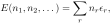
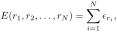
  , so we can write the energy of a particular microstate of the gas:
 is the energy of particle
  in single particle microstate
  .
.