Next: Classical and quantum distributions Up: The Perfect Classical gas Previous: General form of the Contents
In Sec. ![[*]](crossref.png) we found that the average of the kinetic energy in a perfect gas of
we found that the average of the kinetic energy in a perfect gas of  particles is proportional to
 , which is due to the contributions of the
  degrees of freedom, each one giving
 . We will now prove that this statement is much more general, and that in any classical system the contribution to the total energy of degrees of freedom that enter the hamiltonian as squares are always equal to
. An important corollary of this statement is that the average translational kinetic energy is equal to
for any system, regardless of the interactions between the particles.
. We will now prove that this statement is much more general, and that in any classical system the contribution to the total energy of degrees of freedom that enter the hamiltonian as squares are always equal to
. An important corollary of this statement is that the average translational kinetic energy is equal to
for any system, regardless of the interactions between the particles.
Consider the hamiltonian of a system that contains one or more degrees of freedom that enter as a square, so that we can write:
where does not depend on
  , but may depend on the other degrees of freedom, and
 is the remainder of the hamiltonian which depends on the other degrees of freedom. In the limit in which the degree of freedom behaves classically, the probability density for the system to have a particular value , with all the other variables fixed, is:
where the last equality follows from the fact that we are holding
constant. Since may depend on the other degrees of freedom,
is the remainder of the hamiltonian which depends on the other degrees of freedom. In the limit in which the degree of freedom behaves classically, the probability density for the system to have a particular value , with all the other variables fixed, is:
where the last equality follows from the fact that we are holding
constant. Since may depend on the other degrees of freedom,  may too, and we will consider this dependence later. For now we will only focus on the dependence on . We are interested in the average value of
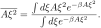
  , which is equal to:
The extremes of the integral depend on the range that is allowed to explore. If this range is such that the maximum value of is much larger than
, which is equal to:
The extremes of the integral depend on the range that is allowed to explore. If this range is such that the maximum value of is much larger than
 , then the exponentials are very close to zero at that point, and it would make no difference to evaluate the integrals for varying between
  and
and  instead. In this case we can easily compute the integrals using , which gives:
This result is independent of , and therefore independent of the values of the other degrees of freedom, it would be the same whatever values we chose to keep fixed. As a consequence, the average of is equal to
over the full probability distribution. Each such degree of freedom therefore contributes a factor
instead. In this case we can easily compute the integrals using , which gives:
This result is independent of , and therefore independent of the values of the other degrees of freedom, it would be the same whatever values we chose to keep fixed. As a consequence, the average of is equal to
over the full probability distribution. Each such degree of freedom therefore contributes a factor
 to the heat capacity of the system.
As we mentioned, the above discussion is only valid in the classical limit, where the probability distribution for the variable is given by . If this is not the case then the above integrals have to be replaced with sums over the available microstates, and the equipartition of the energy found in is not warranted. Indeed, in the limit in which
is much smaller than the separation between the lowest value  and the first excited state
  , then
 is independent on
  (it is effectively equal to ) and, as discussed in Sec. , its contribution to the heat capacity is zero because
 . Note that different degrees of freedom may behave differently, depending on the size of the separation of their respective energy levels. Consider a gas of diatomic molecules confined in a box, for example. Each molecule has three translational, two rotational and one vibrational degrees of freedom. All these degrees of freedom enter as squares in the hamiltonian. If the sides of the box are much larger than the de Broglie wavelength of the particles, the translational degrees of freedom lie much closer together than the rotational degrees of freedom, which in turn have much smaller spacing than the vibrational degree of freedom. At very low temperature no degree of freedom can be excited, and the equipartition theorem is invalid. As temperature is increased to the point that
is larger than the spacing between the translational kinetic energy levels, these degrees of freedom start to acquire energy, which eventually becomes equal to
per degree of freedom when the temperature is large enough. If at this point the temperature is still lower than the spacing between the rotational energy levels, these remain frozen, as well as the vibrational degree of freedom that has even more widely spaced energy levels. However, as we increase the temperature further, these degrees of freedom eventually spring to life, and when the temperature becomes high enough they also contribute
to the total energy of the system. The heat capacity is therefore equal to
. Note that different degrees of freedom may behave differently, depending on the size of the separation of their respective energy levels. Consider a gas of diatomic molecules confined in a box, for example. Each molecule has three translational, two rotational and one vibrational degrees of freedom. All these degrees of freedom enter as squares in the hamiltonian. If the sides of the box are much larger than the de Broglie wavelength of the particles, the translational degrees of freedom lie much closer together than the rotational degrees of freedom, which in turn have much smaller spacing than the vibrational degree of freedom. At very low temperature no degree of freedom can be excited, and the equipartition theorem is invalid. As temperature is increased to the point that
is larger than the spacing between the translational kinetic energy levels, these degrees of freedom start to acquire energy, which eventually becomes equal to
per degree of freedom when the temperature is large enough. If at this point the temperature is still lower than the spacing between the rotational energy levels, these remain frozen, as well as the vibrational degree of freedom that has even more widely spaced energy levels. However, as we increase the temperature further, these degrees of freedom eventually spring to life, and when the temperature becomes high enough they also contribute
to the total energy of the system. The heat capacity is therefore equal to
 at high enough temperature, but as temperature is reduced it first drops to
 , then to
 , and eventually to zero.