
| Home | Research | Techniques | Team | Papers | Lab openings | Resources | Contact |
|
Dynamics of DNA repair
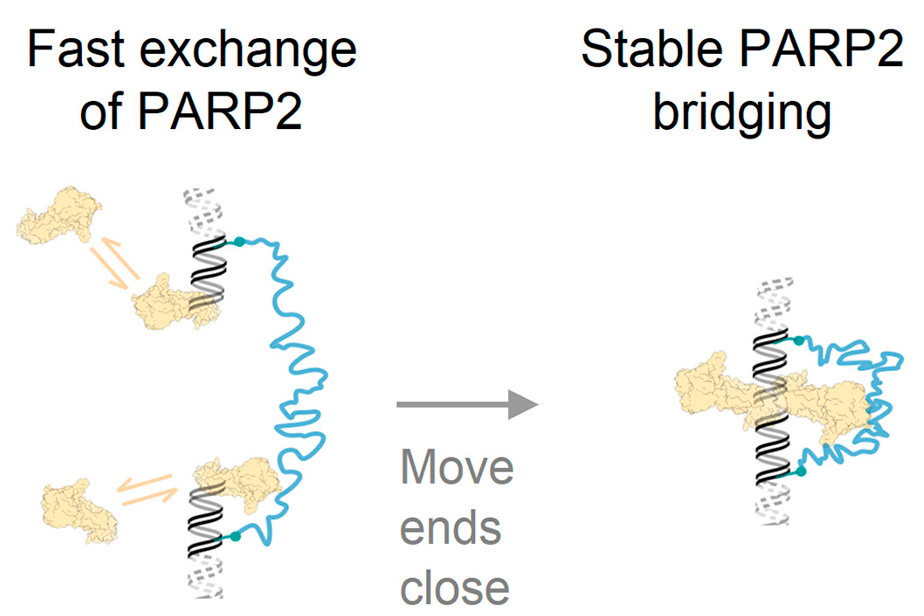
In an average human cell, approximately 100000 DNA damage events occur
each day. Our cells contain fascinating machines, called DNA damage
repair proteins, which act to repair the diverse different types of
chemical modifications which arise when DNA is damaged. We are
interested in understanding the molecular mechanisms of how these
proteins assemble at sites of DNA damage – particularly strand breaks in
the DNA double-helix which are recognized by proteins such as the PARP
and Ku families. To study these proteins at high-resoltuion, we develop single-molecule techniques including
magnetic tweezers and fluorescence imaging.
Relevant publications: Bell, N. A. W. & Molloy,
J. E. Single-molecule force spectroscopy reveals binding and bridging
dynamics of PARP1 and PARP2 at DNA double-strand breaks. Proc. Natl. Acad. Sci. U.S.A.
120,
e2214209120 (2023). Bell, N. A. W. et al.
Single-molecule measurements reveal that PARP1 condenses DNA by loop
stabilization. Sci. Adv.
7, eabf3641
(2021).
|
 |
|
Biophysics of DNA
DNA forms a canonical double-helical structure called B-DNA. It can
also form so-called alternative DNA structures such
as cruciforms and Z-DNA depending on parameters such as force and
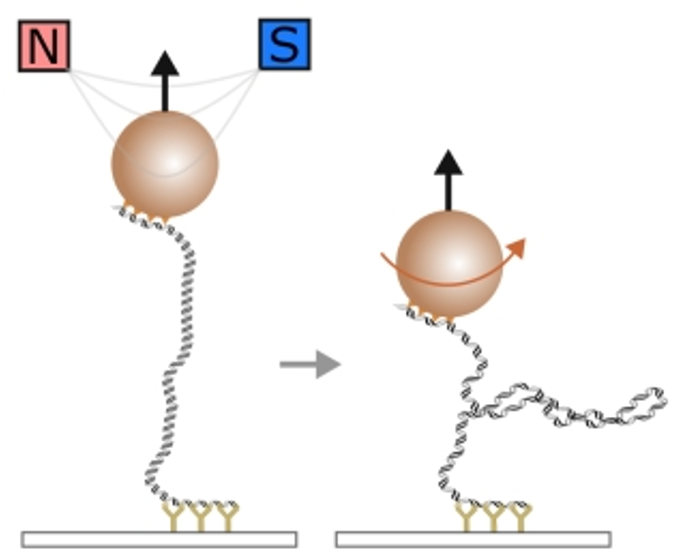
supercoiling. We are using force spectroscopy techniques, such as
magnetic tweezers and nanopores, together with biochemical methods to
study these structural transitions as well as the polymer physics
properties of DNA under micromechanical forces.
Relevant publications: Chen, K. et al. Dynamics of driven polymer
transport through a nanopore. Nat. Phys.
17, 1043–1049
(2021). Bell, N. A. W., Chen, K., Ghosal, S., Ricci, M. &
Keyser, U. F. Asymmetric dynamics of DNA entering and exiting a strongly
confining nanopore. Nat Commun
8, 380 (2017). Bell, N. A. W., Muthukumar, M. & Keyser, U. F.
Translocation frequency of double-stranded DNA through a solid-state
nanopore. Phys. Rev. E
93, 022401 (2016). |
 |
