Next: Fundamental thermodynamic relation Up: The entropy Previous: Temperature Contents
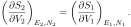
 and
and  . However, it may be difficult to realise a situation in which moving the wall keeps the energies
  and
and  constant, because changing the volumes involves work in the system and one would have to realise a situation in which this work is exactly balanced by a heat flow. However, we could realise a situation in which we allow both energy and volume to change, and we maximise the entropy w.r.t both of these variations. We obtain:
Since this has to be valid for any variation of energy and volume, we obtain again
constant, because changing the volumes involves work in the system and one would have to realise a situation in which this work is exactly balanced by a heat flow. However, we could realise a situation in which we allow both energy and volume to change, and we maximise the entropy w.r.t both of these variations. We obtain:
Since this has to be valid for any variation of energy and volume, we obtain again ![[*]](crossref.png) , but with the additional condition:
The wall will not move if the pressures are the same in the two sub-volumes,
, but with the additional condition:
The wall will not move if the pressures are the same in the two sub-volumes,  , and therefore pressure must be related to
 . We shall see that by setting:
we obtain a definition of pressure which is identical to the conventional one (i.e. force divided by an area).
. We shall see that by setting:
we obtain a definition of pressure which is identical to the conventional one (i.e. force divided by an area).
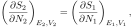
The final condition of equilibrium w.r.t. exchange of particles is obtained by adding variations w.r.t. to  and
and  to , which results in