Next: Pressure and chemical potential Up: The entropy Previous: The entropy Contents
 plays the role of determining the direction of the heat flow between two systems when they are put in contact with each other. This provides a way to define temperature,
  , based on the functions of state
  and
and  . In order to make contact with the notion of heat and temperature in standard thermodynamics, where heat flow from system 1 to system 2 is only possible if
  , with
  and
and  the temperatures of two systems, we define:
The product
the temperatures of two systems, we define:
The product  must have the dimensions of an energy, and together with our choice of units for the entropy in Eq.
 ![[*]](crossref.png) , we will see that with this definition is equivalent to the perfect gas temperature scale discussed between Eqs. and (see Sec. ).
, we will see that with this definition is equivalent to the perfect gas temperature scale discussed between Eqs. and (see Sec. ).
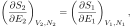
Relation refers to the expected change of entropy as the constraint is removed. After its removal the entropy becomes maximum and for any changes we have that its first order variation must be equal to zero:
is obviously equivalent to  , because of .
We see therefore that temperature can simply be interpreted as the measure by which the number of microstates available to the system changes as the system changes its energy. In a case of competition, i.e. two system in contact with each other, energy will adjust in such a way that the totality of microstates is maximum, simply because this is the most probable arrangement. This happens when the change of the number of the available states w.r.t. a change in energy is the same in the two systems, because that is the point where the total number of states is maximum. The fact that energy flows from a hot system to a cold one is nothing but a manifestation of this concept: the reduction of the number of microstates in the hot system as it loses energy is overcompensated by a correspondingly increase of this number in the cold system as it gains energy, in such a way that the product of the number of microstates in the two systems increases 3.6. In fact, although there is nothing preventing the energy from partitioning entirely in one system (or indeed any other partition that satisfies conservation of the total energy), in other words nothing preventing energy flowing from the cold to the hot system, for a macroscopic system any distribution of the energy that does not correspond to the maximum of the total number of microstates (equal temperatures) will only be observed for a negligibly short amount of time. This purely probabilistic interpretation is the fundamental concept of statistical physics.