Next: Temperature Up: The second law Previous: Equilibrium in isolated systems Contents
 is a function of state. Since
  is a monotonic function of the statistical weight , the principle of being maximum w.r.t. any internal constraint extends to the entropy too. This makes the connection with the second law of thermodynamics.
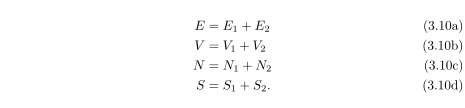
Let us see now what are the implications of this principle. Imagine to divide our system by introducing a partitioning wall in a way that does not change the total energy of the system, so that we have 3.4 : The last equality arises because of the above definition of the entropy, which is an extensive function under the conditions that surface effects can be neglected. This partitioning acts as a constraint and so it may decrease the entropy of the system
by reducing the number of available microstates. It is, in fact, a triple constraint, as it imposes partitions on  ,
,  and
and  and each of these constraints decreases the entropy, if it causes a distribution of those variables that are different from what they would be in absence of the constraint.
Now we ask: what would happen if we lifted one of the constraints, for example by allowing transfer of energy across the partitioning wall? Since the system is isolated from the outside and since we are not allowing the partitioning wall to move, no work is being performed, then from the first law we have that any energy transfer between the two subsystems is due to heat flow. If the constraint causes the energies to be only infinitesimally different from what they would be without it, say by an amount  in system 1 and
 in system 2 (because of
 ![[*]](crossref.png) a), then upon its removal the change of entropy would also be infinitesimal, but positive (because removal of a constraint increases the number of microstates available to the system and so it increases its entropy):
a), then upon its removal the change of entropy would also be infinitesimal, but positive (because removal of a constraint increases the number of microstates available to the system and so it increases its entropy):
are positive. This means that if heat flows from system 1 to system 2, we have  and so
  , i.e the entropy decreases in a system that loses heat at constant volume and constant number of particles. The viceversa is also true, i.e. we have
  and so
  . Overall the entropy must increase and so the increase in system 2 must overcompensate the decrease in system 1, which means that we must have
 .
.

![\includegraphics[width=5cm,angle=90]{V1V2.pdf}](img160.svg)