Antiserum specificity
 Although
the antisera were raised against oestradiol covalently bound to serum albumin,
each antibody in the antiserum will be specific for a different epitope in the
oestradiol molecule (i.e., only a small region of the molecule). Other steroids
that are likely to be present in the plasma samples that you wish to assay may
also bind to one or more of the antibodies present, and so displace radioactive
oestradiol from protein binding. This will give a falsely high value for oestradiol.
Although
the antisera were raised against oestradiol covalently bound to serum albumin,
each antibody in the antiserum will be specific for a different epitope in the
oestradiol molecule (i.e., only a small region of the molecule). Other steroids
that are likely to be present in the plasma samples that you wish to assay may
also bind to one or more of the antibodies present, and so displace radioactive
oestradiol from protein binding. This will give a falsely high value for oestradiol.
The usual way of ensuring that the antiserum you plan to use has adequate specificity
is to incubate with the tracer labelled ligand and a range of concentrations
of not only the analyte of interest, but also other possibly interfering compounds
that may be present in the samples you plan to analyse.
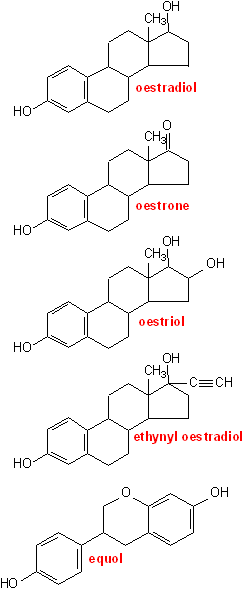
If we plan to measure oestradiol, then we have to be sure that our antiserum
does not cross-react significantly with other physiological oestrogens that
may be present in the plasma samples (e.g. oestrone and oestriol), as well as
synthetic oestrogens that may be used on contraceptives or as menopausal hormone
replacement therapy (e.g. ethynyl oestradiol).
In addition, a variety of non-steroidal compounds have oestrogenic activity
because they have hydroxyl groups that (in the three dimensional structure)
are in the sam e positions as those of oestradiol, so that they can bind to,
and activate, oestrogen receptors. Many of these can also cross-react with anti-oestradiol
antibodies. Some of these non-steroidal oestrogens are used therapeutically,
others are found in a variety of plant foods - the phyto-oestrogens. An example
of a non-steroidal oestrogen is equol.
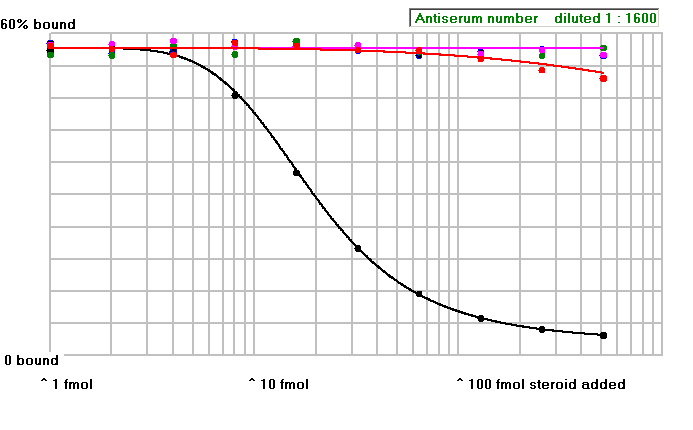
In the graph below, the black line shows the binding of radioactive oestradiol
with increasing amounts of non-radioactive oestradiol, and the coloured lines
the effect of adding increasing amounts of the other steroids. This is an antiserum
with good specificity; none of the other steroids that were added caused any
significant displacement of bound radioactive oestradiol.
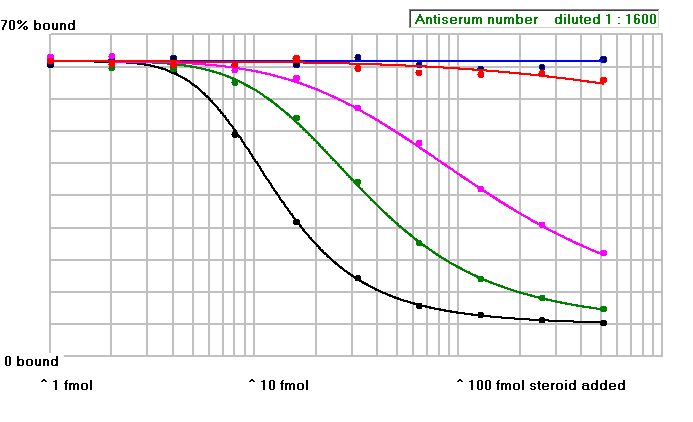
By contrast, the graph below shows the results for an antiserum that cross-reacts
significantly with two of the other steroids added, so that it would not provide
adequate specificity for use in measurement of oestradiol in plasma samples.
Incubation conditions
For each of the antisera that you think will be useful (based on your screening
of the antisera), you will determine the percentage of radioactive oestradiol
that is bound to protein in the presence of a range of concentrations of oestradiol,
oestrone, oestriol, ethynyl oestradiol and equol.
All solutions are prepared in, and diluted with, phosphate buffered saline
(pH 7.4) containing 1 g/L bovine serum albumin (PBS+BSA). The incubations at
4C overnight are prepared as:
100 µL of the steroid solution (a range of dilutions from 5120 to 10
fmol /mL)
100 µL tritiated oestradiol (50,000 dpm per assay)
100 µL diluted antiserum (using the dilution that you found from screening
gave ~ 50% binding of the tracer)
At the end of the incubation 200 µL of charcoal suspension in PBS+BSA
is added and the mixture is centrifuged.
200 µL aliquots of the supernatant (= bound ligand) are used for liquid
scintillation counting