Next: Functionals Up: [remember picture,overlay] [fill,blue!20] (current Previous: Time reversal Contents
Let us consider a function of  variables,
 . If the variables
 are all independent, the extreme of
  w.r.t. their variations is obtained from the condition:
 has to be taken with all the other variables
 , held constant. If, however, the variables
are subject to a constraint, e.g.
, held constant. If, however, the variables
are subject to a constraint, e.g.
 , with
  some constant, then their variations are not all independent. Let us define the function
If the constraint is satisfied we have
some constant, then their variations are not all independent. Let us define the function
If the constraint is satisfied we have  . The gradient of
  is:
and the partial derivatives mean that the variation is done by holding all the other variables constant.
If
is:
and the partial derivatives mean that the variation is done by holding all the other variables constant.
If
 we must also have
 . This is clear, because if was not at an extreme a variation of (at least one of) the would produce a variation of , but the condition
 , implied by
 , would mean that also would have to change. The condition
then implies that
and
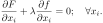
, meaning that is at an extreme and it satisfies the constraint. This condition then reads:
This can be generalised to an extremisation with
, would mean that also would have to change. The condition
then implies that
and
, meaning that is at an extreme and it satisfies the constraint. This condition then reads:
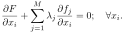
This can be generalised to an extremisation with  constraints, expressed by the conditions
 , which give:
The parameters
, which give:
The parameters  are known as Lagrange multipliers.

![$\displaystyle G(x_1,\dots,x_N,\lambda) = F(x_1,\dots,x_N) + \lambda [ f(x_1,\dots,x_N) - k ].$](img1601.svg)