Next: The density of states Up: [remember picture,overlay] [fill,blue!20] (current Previous: Anharmonicity Contents
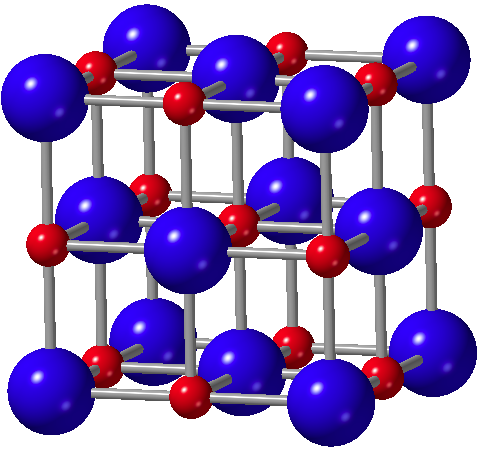
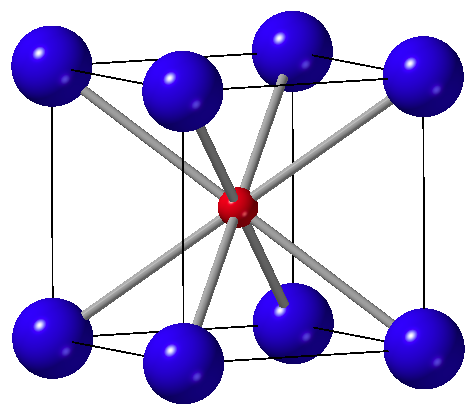
Magnesium oxide (MgO) is one of the main constituents of the Earth's mantle, and probably also of the mantle of super-Earths –Earth's like planets in other planetary systems with masses up to 10 Earth masses–. In the Earth it is found as ferropericlase, which is a cubic structure with alternating Mg and O atoms similar to the structure of NaCl (see Fig. 1), and the term ferro indicates that some of the Mg atoms are replaced by Fe atoms. Here will will study pure MgO, for simplicity, but the study could be extended to ferropericlase. As pressure is increased, a second cubic structure becomes competitive. This is the CsCl structure, formed by two interpenetrating simple cubes of Mg and O, with one O atom at the centre of a Mg cube and viceversa (see Fig. 1).
In this tutorial we will compute the transition pressure between the B1 (NaCl structure) and B2 (CsCl structure) phases of MgO. At zero temperature, the stable structure is the one with the lowest enthalpy, and so we will need to compute both the energy  and the pressure
  , so that we can build the enthalpy
 . We will have to do this for both the B1 (NaCl) and the B2 (CsCl) structures, and search for the pressure where the two enthalpies are equal.
The techniques that we are going to use are very similar to those employed in the tutorial described in the previous chapter, with the main difference being that now the primitive cells contain a basis of two atoms, one Mg and one O, and we have to build two different crystals. The POSCAR for the two structures are as follows (try to build them on your own first).
The POSCAR for the NaCl structure:
NaCl
4.0
0.5 0.0 0.5
0.5 0.5 0.0
0.0 0.5 0.5
1 1
Direct
0.0 0.0 0.0
0.5 0.5 0.5
and the POSCAR for the CsCl structure:
CsCl
2.7
1.0 0.0 0.0
0.0 1.0 0.0
0.0 0.0 1.0
1 1
Direct
0.0 0.0 0.0
0.5 0.5 0.5
Now compute energies and pressures for the two structures and build the enthalpies. Note that the pressures are in units of kB, and so you need to convert the  term appropriately so that you obtain eV, which are the units used for the energy .
What transition pressure do you obtain and is it relevant for the Earth? What would you have to do if you wanted to compute the transition pressure at temperature above zero?
term appropriately so that you obtain eV, which are the units used for the energy .
What transition pressure do you obtain and is it relevant for the Earth? What would you have to do if you wanted to compute the transition pressure at temperature above zero?