


Next: Tutorial thermal expansion Up: Crystals Previous: Crystals Contents
For a periodic system such as a crystal, plane-waves (PW) of the type:
where is a reciprocal lattice vector and
  is the volume of the repeating unit cell, are particularly useful, because they naturally encode the periodicity of the crystal. Any function can be represented with arbitrary accuracy using enough PW's, and so they form an unbiased and systematically improvable basis set. One starts by including PW's with the lowest
  's (
's (
 ), which are usually the most important, and works its way up by including PW's with progressively larger 's. The systematic way of doing this is to define a maximum value
  , and include PW's with
 . For convenience, rather than specifying
  , one defines a PW energy cutoff
 , and then use
  as a knob to drive the system to the desired convergence. A Bloch function expanded in PW's therefore assumes the simple form:
If the
as a knob to drive the system to the desired convergence. A Bloch function expanded in PW's therefore assumes the simple form:
If the  hamiltonian is real then
 , and so at
 the wavefunctions can be chosen to be real. The plane wave expansion reads:
The wavevectors in the sum in
the wavefunctions can be chosen to be real. The plane wave expansion reads:
The wavevectors in the sum in ![[*]](crossref.png) run inside a sphere of radius which can be split in the sum over two hemispheres, one of which includes the wavevectors with
run inside a sphere of radius which can be split in the sum over two hemispheres, one of which includes the wavevectors with  , indicated with
 below:
Consider now the complex conjugate of
below:
Consider now the complex conjugate of
 :
Since this can be chosen to be equal to
, we have
:
Since this can be chosen to be equal to
, we have
 . As a result, only the coefficients at vectors in one hemisphere are needed, and both storage and number of operations are reduced by a factor of two.


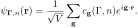
![$\displaystyle \psi_{{\bf\Gamma},n}({\bf r}) = \frac{1}{\sqrt{V}}\left [ \sum_{{...
... + \sum_{{\bf g} < 0} c_{\bf g}(\Gamma,n) e^{i {\bf g}\cdot {\bf r}} \right ] =$](img1413.svg)
![$\displaystyle \frac{1}{\sqrt{V}}\left [ \sum_{{\bf g} > 0} c_{\bf g}(\Gamma,n) ...
...+ \sum_{{\bf g} > 0} c_{\bf -g}(\Gamma,n) e^{-i {\bf g}\cdot {\bf r}} \right ].$](img1414.svg)
![$\displaystyle \psi^*_{{\bf\Gamma},n}({\bf r}) = \frac{1}{\sqrt{V}}\left [ \sum_...
... \sum_{{\bf g} > 0} c^*_{\bf -g}(\Gamma,n) e^{i {\bf g}\cdot {\bf r}} \right ].$](img1416.svg)