Next: Density Functional theory Up: Molecular Dynamics Previous: Thermostats Contents
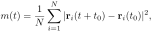
 is some initial reference time. In a system with no diffusing behaviour, such as a solid,
  is expected to rise first, and then reach a constant, which is related to the maximum displacement of the particles from their equilibrium positions. By contrast, in a fluid is expected to rise with time. If the motion of the particles is random, which is a good approximation for a system in thermal equilibrium, then increases linearly with time, and its slope is related to the diffusion coefficient. To understand where the linear behaviour of comes from consider a random walk. This could be in any dimensions but for simplicity let us consider a one dimensional system. Let us associate a variable
  to the
  step in the walk, which can be either
  or
or  , depending on if the step is taken by going to the right or to the left. Let us also define the variable
 , which is the length of the walk after
  steps. The average value of
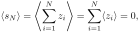
  is clearly zero, as:
but the average value of
is clearly zero, as:
but the average value of  is not:
because
is not:
because
 and
and
 since the and the
  steps are uncorrelated. This shows that in a random walk of step size 1 the mean square displacement from the origin of the walk is equal to the number of steps, and so it is linearly proportional to time, if the number of steps per unit time is constant. In systems with continuous displacements this translates into a linear dependence on time of the mean square displacement defined above.
Over a simulation of total length  one clearly only has access to with
 , and to improve on statistics
it is useful to compute
, and to improve on statistics
it is useful to compute ![[*]](crossref.png) by averaging over time origins :
by averaging over time origins :
 it is possible to average of the whole length of the simulation, but as
  increases the available length over which one can average is reduced to
  , and so the statistical error on increases with . For
  there is only one available configuration.