


Next: Thermostats Up: Ensemble averages Previous: Ensemble averages Contents
 is to use the reblocking procedure, which we now explain. Suppose we split our simulation into
  blocks of length
  and consider the averages:
The average of
and consider the averages:
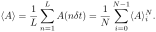
The average of  over the whole simulation is obviously unaffected by this reblocking procedure:
Now consider the root mean square fluctuations of the averages
over the whole simulation is obviously unaffected by this reblocking procedure:
Now consider the root mean square fluctuations of the averages
 's:
If the averages
are all statistically independent from each other, then the standard deviation on the average can be obtained as
independently on the value of , as long as is large enough to have a sufficient number of samples 7.3. By contrast, if the averages
are correlated we have:
's:
If the averages
are all statistically independent from each other, then the standard deviation on the average can be obtained as
independently on the value of , as long as is large enough to have a sufficient number of samples 7.3. By contrast, if the averages
are correlated we have:
![\includegraphics[width=5.5cm]{en.pdf}](img1240.svg)
![\includegraphics[width=5.5cm]{reb.pdf}](img1241.svg)
|
 : if we progressively increase the length of each block, at some point the averages
's become statistically independent. When this happens, the inequality in
: if we progressively increase the length of each block, at some point the averages
's become statistically independent. When this happens, the inequality in ![[*]](crossref.png) becomes an equality. Therefore, by computing
becomes an equality. Therefore, by computing
 using for a set of block length's we have a procedure to estimate
. Starting with
using for a set of block length's we have a procedure to estimate
. Starting with  (block length equal to one), and working our way up (reducing ) we find that
increases, and at some point it reaches a plateau. The value of
on the plateau provides an estimate of
.
An example of
for a simulation of MgO at Earth's mantle conditions is plotted in the right panel of Fig. . Here the quantity is the energy of the system (eV units), plotted in the left panel of Fig. in and the total length of the simulation is
(block length equal to one), and working our way up (reducing ) we find that
increases, and at some point it reaches a plateau. The value of
on the plateau provides an estimate of
.
An example of
for a simulation of MgO at Earth's mantle conditions is plotted in the right panel of Fig. . Here the quantity is the energy of the system (eV units), plotted in the left panel of Fig. in and the total length of the simulation is  steps.
We see that at the plateau the standard deviation of
steps.
We see that at the plateau the standard deviation of
 over this simulation length is equal to
 eV.
eV.

![$\displaystyle \sigma(\langle A \rangle^N) = \left[\frac{1}{N} \sum_{i=0}^{N-1} \left (\langle A \rangle_i^N\right )^2 - \langle A \rangle^2 \right]^{1/2}.$](img1235.svg)

