Next: The second law Up: [remember picture,overlay] [fill,blue!20] (current Previous: Introduction Contents
In this chapter we will introduce the relation between work and energy and the concept of heat via the first law of thermodynamics.
Let us consider a system in one particular state 1, characterised by specific values of  and
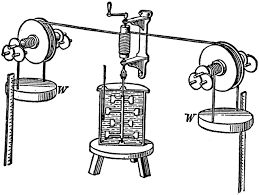
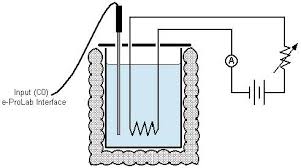
and  . We can change the state of the system, say to state 2, by performing work on it, for example by passing an electrical current (Fig.
 ![[*]](crossref.png) , right) or, it if is a fluid, by stirring it (Fig. , left). Experimental evidence tells us that if the system is thermally isolated from its surroundings, the amount of work to change the state of the system from 1 to 2 is always the same, regardless of the type of work. An alternative point of view is to say that the system is thermally isolated if the above condition is satisfied. We can therefore define a function of state variable
, right) or, it if is a fluid, by stirring it (Fig. , left). Experimental evidence tells us that if the system is thermally isolated from its surroundings, the amount of work to change the state of the system from 1 to 2 is always the same, regardless of the type of work. An alternative point of view is to say that the system is thermally isolated if the above condition is satisfied. We can therefore define a function of state variable  which only depends on the state of the system and not on how that state has been reached, and the change of as the system goes from state 1 to state 2 is equal to work done on the system. This is expressed by:
 and
and  are the energies of the system in state 1 and 2, respectively, and
  is the amount of work performed on the system. A change of this type is called adiabatic. Note that in principle work done on the system may change its state of motion, for example a fluid may be set in circular motion by a stirring paddle, or change its potential energy by changing its position in a gravitational field. These changes are accounted for by the laws of mechanics and are not of interest here. Our discussion will therefore be restricted to cases in which the only energy change is internal, or in other words the quantity in does not include a possible term that changes the overall mechanical energy of the system. For example, in the Joule experiment one usually uses more than one set of paddles, moving in opposite directions, so that they do not cause any macroscopic movement in the fluid and all the work done on the fluid increases its internal energy.
An other example of work is that of compression, which relates the pressure to the change of internal energy due to the change of volume. In the previous chapter we defined the pressure acting on a fluid confined in a box by a movable piston of area  as
as  , where
  is the force exerted on the piston. If the piston position is lowered by an amount
  , then the work done on the system is
 and the minus sign is there because we have defined as positive work done on the system, which involves a decrease of volume. If the system is isolated from the environment we have
 , which we write as
 indicating that there is no heat transfer in the process2.1
We can now imagine to obtain the same change from 1 to 2, but this time without keeping the system thermally isolated. In this case the work is not, in general, equal to the change of internal energy  and we define the deficit
 increases over the increase caused by . Eq. is the first law of thermodynamics, which basically expresses conservation of energy and establishes the equivalence between work and heat as two forms of energy flow.
From the above discussion it is clear that the same energy change can be obtained in different ways, i.e. with different combinations of and , depending on the experimental conditions. Therefore, although we can identify a state of the system with its internal energy ( or in the above examples), it is not possible to assign equivalent values for heat of the system or work of the system. The relation can be written for infinitesimal changes 2.2 and takes the form:
were we have used the notation
increases over the increase caused by . Eq. is the first law of thermodynamics, which basically expresses conservation of energy and establishes the equivalence between work and heat as two forms of energy flow.
From the above discussion it is clear that the same energy change can be obtained in different ways, i.e. with different combinations of and , depending on the experimental conditions. Therefore, although we can identify a state of the system with its internal energy ( or in the above examples), it is not possible to assign equivalent values for heat of the system or work of the system. The relation can be written for infinitesimal changes 2.2 and takes the form:
were we have used the notation
 to indicate that these are differentials of non-conserved quantities (inexact differentials). The sum
 is of course an exact differential, as it is equal to
  .
.
As we mentioned above, the work can be performed in a variety of ways, but without loss of generality we will mostly restrict ourselves to work performed on a fluid by changing its volume, so that we have in differential form:
 in Eq. , as in order to produce a change of volume there must be an imbalance between the internal and the external pressure. If the imbalance is large (i.e. not infinitesimal) there are other issues that come into play, such as the speed of the movement of the physical parameters that cause the change and how these affect the pressure distribution in the fluid. For this sort of situation we should presumably write:
because the work performed on the system is
 and if the external pressure
  is larger than the internal one to cause a compression then
 . Similarly, if there is an expansion we have
 which also implies
. However, note that in such a change the internal pressure would not be uniform, and so it is not entirely clear what is the meaning of in Eq. . For this reason a change of the type expressed by Eq. is often referred to as irreversible: it cannot be broken down into a series of steps, each of which with well defined values of macroscopic variables such as pressure, volume or temperature, and as such it cannot be discussed within the framework of equilibrium thermodynamics.
which also implies
. However, note that in such a change the internal pressure would not be uniform, and so it is not entirely clear what is the meaning of in Eq. . For this reason a change of the type expressed by Eq. is often referred to as irreversible: it cannot be broken down into a series of steps, each of which with well defined values of macroscopic variables such as pressure, volume or temperature, and as such it cannot be discussed within the framework of equilibrium thermodynamics.
For the most part, we shall deal with reversible changes, i.e. changes for which the system remains in a state of equilibrium during the change, so that its pressure is well defined and the difference in internal and external pressures is infinitesimal. In this case Eq. applies. However, we will also discuss an exception: the free expansion of a perfect gas. This will help us to understand how an irreversible (non equilibrium) transformation can be related to a reversible one.
We mentioned earlier that heat transfer is only possible between two systems that are at different temperature. This is therefore another example of a non equilibrium situation, which would involve non-equilibrium thermodynamics to be described properly. We can imagine, however, that the temperature difference between the two bodies is infinitesimal and so the transfer of heat happens during an infinitely long time with the two systems being, effectively, in equilibrium. In practice one would obtain this situation by realising small temperature differences and allowing the two systems to come in thermal equilibrium before changing the temperature again. If the temperature steps are small enough one can realise a situation of quasi-equilibrium for which the laws of equilibrium thermodynamics are a close approximation. In such a situation, the amount of heat transfer is proportional to the (infinitesimal) temperature difference  , with the constant of proportionality depending on the size and the physical properties of the body. This constant of proportionality is called heat capacity of the body and we write:
 , and we restrict ourselves to the case in which the volume is kept constant
  (and so no work is performed), then we have:
which defines the constant volume heat capacity:
Alternatively, we may want to keep the pressure constant (which is easier in an experimental situation) and after expressing:
and
we have:
which gives:
An equivalent form is obtained by expressing
which together with Eq. gives:
and therefore:
and using Eq. we also obtain:
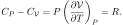
This quantity can be calculated analytically for a perfect gas. For this system the internal energy only depends on temperature,
(and so no work is performed), then we have:
which defines the constant volume heat capacity:
Alternatively, we may want to keep the pressure constant (which is easier in an experimental situation) and after expressing:
and
we have:
which gives:
An equivalent form is obtained by expressing
which together with Eq. gives:
and therefore:
and using Eq. we also obtain:
This quantity can be calculated analytically for a perfect gas. For this system the internal energy only depends on temperature,  , as the particles are assumed not interact amongst themselves and so their distance cannot matter. We therefore have, for a mole of gas:






![$\displaystyle {\mathchar'26\mkern-12mu d}Q = dE + PdV = \left [\left ( \frac{\p...
...} \right )_P + P \left ( \frac{\partial V}{\partial T} \right )_P \right ] dT +$](img69.svg)
![$\displaystyle \left [\left ( \frac{\partial E}{\partial P} \right )_T + P \left ( \frac{\partial V}{\partial P} \right )_T \right ] dP,$](img70.svg)


![$\displaystyle {\mathchar'26\mkern-12mu d}Q = \left \{\left ( \frac{\partial E}{...
..._T + P \right ] \left ( \frac{\partial V}{\partial T} \right )_P \right \} dT +$](img73.svg)
![$\displaystyle \left [\left ( \frac{\partial E}{\partial V} \right )_T \left ( \...
... P} \right )_T + P \left ( \frac{\partial V}{\partial P} \right )_T \right ] dP$](img74.svg)
![$\displaystyle C_P = \left ( \frac{\partial E}{\partial T} \right )_V + \left [ ...
...ial V} \right )_T + P \right ] \left ( \frac{\partial V}{\partial T} \right )_P$](img75.svg)
![$\displaystyle C_P - C_V = \left [ \left( \frac{\partial E}{\partial V} \right )_T + P \right ] \left ( \frac{\partial V}{\partial T} \right )_P.$](img76.svg)