Next: Maxwell relations Up: The second law Previous: Free expansion of perfect Contents
![[*]](crossref.png) the conditions that govern equilibrium between two systems that are otherwise isolated from the rest of the Universe. In particular, we have pointed out that the removal of any internal constraint causes the total entropy of the system to increase, simply because the number of states available to the system increases. Now we want to ask the question in a slightly different way.
the conditions that govern equilibrium between two systems that are otherwise isolated from the rest of the Universe. In particular, we have pointed out that the removal of any internal constraint causes the total entropy of the system to increase, simply because the number of states available to the system increases. Now we want to ask the question in a slightly different way.
Let us consider a system in contact with a heat bath and suppose that it is subject to some internal constraints. These constraints may or may not cause the system to have a different pressure or temperature from those of the heath bath. We know that upon the removal of the constraints the total entropy of the system increases:
where we use the usual notation of 1 for the system and 2 for the heat bath. The heat bath can be assumed to be in equilibrium whatever the interactions with the system, and so we have: where is the temperature of the bath and
 is the heat flowing from the bath to the system as the constraints are removed. If the only work on the system is done by the heat bath we have:
where
is the heat flowing from the bath to the system as the constraints are removed. If the only work on the system is done by the heat bath we have:
where  is the change of volume of the system. Using the first law for the system,
 , we have:
where the inequality follows from . Eq. can be re-arranged as:
Defining the availability
, we have:
where the inequality follows from . Eq. can be re-arranged as:
Defining the availability
 we can rewrite :
because and
we can rewrite :
because and  are constant. This inequality is particularly useful when one considers constant temperature (
 ) and constant volume (
 ) variations, or constant temperature and constant pressure (
 ) variations. In the former case we have:
and in the latter:
where
) variations. In the former case we have:
and in the latter:
where  and
and  are the Helmholtz and Gibbs free energy of the system. Eqs. and give the conditions for the direction of natural processes for the canonical and the isothermal-isobaric ensembles. A final condition may be expressed by considering constant entropy (
 ) and constant pressure variations:
which defines the Enthalpy,
) and constant pressure variations:
which defines the Enthalpy,
 , and gives the condition for equilibrium.
The fundamental thermodynamic relation for
, and gives the condition for equilibrium.
The fundamental thermodynamic relation for  is:
which gives
The conditions for the directions of natural processes, i.e. processes that follow the removal of internal constraints, can be thus summarised:
is:
which gives
The conditions for the directions of natural processes, i.e. processes that follow the removal of internal constraints, can be thus summarised:
 |
|
 |
|
 |
|
 |
|
 |
The fundamental thermodynamic relation for the Helmholtz free energy gives
 , which is equal to zero for constant temperature, constant volume and constant number of particles variations, so why does show a negative value instead? The reason is that Eq. refers to a system with fixed (or absence of) internal constaints, while states what would happen to a system when physical internal constraints are removed. Similar arguments apply for
  and .
Note how Eqs. , , , allow to express the differential of the thermodynamic potentials
and .
Note how Eqs. , , , allow to express the differential of the thermodynamic potentials  as functions of the differential of two specific thermodynamic variables amongst
  , with the coefficients being the other two variables (for simplicity, we assume constant number of particles, but the discussion can be generalised to variable number of particles with additional algebra). For example, we have
 and so we are considering variations of the energy in terms of explicit variations of the entropy and the volume,
 . Of course, there is nothing special with this choice and we could instead decide to consider explicitly the dependence of the energy on volume and temperature, for example, writing
  . With such a choice we would have:
 involves a combination of thermodynamic variables, and so
  and
and  are not natural variables for the energy, but and
  are. Similar arguments apply for the other thermodynamic potentials, with and being the natural variables for
  ; and
; and  the natural variables for ; and and the natural variables for .
To obtain the equivalence between the first terms on the right hand sides of Eq. we use the following procedure. Consider the fundamental thermodynamic relation for the entropy:
from which we get
If we now differentiate the first term in w.r.t to we obtain
the natural variables for ; and and the natural variables for .
To obtain the equivalence between the first terms on the right hand sides of Eq. we use the following procedure. Consider the fundamental thermodynamic relation for the entropy:
from which we get
If we now differentiate the first term in w.r.t to we obtain
 . Differentiating the second term w.r.t we obtain
 , and since
 we have:
and again with
we have:
and again with
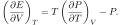
 we obtain:










![$\displaystyle dE = \left( \frac{\partial E}{\partial V} \right )_T dV + \left( ...
...left [T\left(\frac{\partial P}{\partial T} \right )_V - P \right ] dV + C_V dT.$](img399.svg)
![$\displaystyle dS = \frac{1}{T} dE + \frac{1}{T}P dV = \frac{1}{T}\left [ \left(...
...\left( \frac{\partial E}{\partial V} \right )_T dV \right ] + \frac{1}{T}P dV =$](img400.svg)
![$\displaystyle \frac{1}{T} \left( \frac{\partial E}{\partial T} \right )_V dT +\...
...{1}{T} \left [ \left( \frac{\partial E}{\partial V} \right )_T + P \right ] dV,$](img401.svg)
![$\displaystyle \left(\frac{\partial S}{\partial T} \right )_V = \frac{1}{T} \lef...
...rac{1}{T} \left [ \left( \frac{\partial E}{\partial V} \right )_T + P \right ].$](img402.svg)
![$\displaystyle \frac{\partial}{\partial V} \left [ \frac{1}{T} \left( \frac{\par...
...\left [ \left( \frac{\partial E}{\partial V} \right )_T + P \right ] \right\}_V$](img406.svg)
![$\displaystyle \frac{1}{T} \left( \frac{\partial^2 E}{\partial T\partial V} \rig...
...partial T} \right ) + \left (\frac{\partial P}{\partial T} \right )_V \right ],$](img407.svg)