| Dr Robert P. Apaya | ||
| |
||
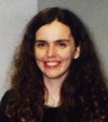
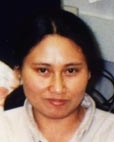
| Robert completed his Ph.D. thesis entitled "The Electrostatic Interactions of Protein-Binding Ligands" in 1996. Ligands which bind to a specific protein binding site are often expected to have a similar electrostatic environment which complements that of the binding site. This work assesses molecular electrostatic similarity by examining the possible overlay of maxima and minima in the electrostatic potential outside molecules and thereby matching the regions where strong electrostatic interactions, including hydrogen bonds, with the binding site residues may be possible. Despite the structural variation between different ligands, it is possible to match three or four extrema to produce relative orientations in which the inhibitors are sufficiently sterically and electrostatically similar to account for their affinity for a single binding site. | ||
| Robert is currently a member of the drug design group(led by Dr P. M. Dean) at the University of Cambridge Pharmacology Department. | ||
| to top |
| Dr David S. Coombes | ||
 |
||
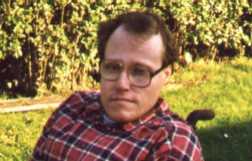
| David completed his
Ph.D. Thesis entitled "Towards the a priori
prediction of molecular crystal structures" in
1997. This work showed that the combination of an
accurate distributed multipole model for the
electrostatic forces together with a simple
repulsion-dispersion potential is able to reliably
predict the structures of a wide range of molecular
crystals. This provides a promising start to developing
methods of predicting polymorphism. David is currently working on applying computational techniques to modelling the hydrothermal synthesis of minerals with Professor CRA Catlow (The Royal Institution) and Professor G.D. Price (UCL) at the Royal Institution of Great Britain. |
||
| email: davidc@ri.ac.uk | ||
| to top |
| Dr Irene(Irilenia) Nobeli | ||
|
||
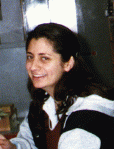
| Irene completed her Ph.D. in December 1998. Her thesis entitled "Characterising organic hydrogen bonds". She is currently a Medical Research Council Research Fellow in the Department of Biochemistry and Molecular Biology at UCL. | ||
| email: nobeli@biochem.ucl.ac.uk | ||
| to top |
| Dr Chitra Medhi | ||
|
||
| Dr. Medhi spent a year between September 1998 to September 1999 as a Commonwealth Research Fellow in the group. She is a lecturer in Chemistry at Gauhati University in India. Her research study in the group was on the DNA base acids biding using intermolecular model potentials. | ||
| to top |
| Jasbir Bhachoo | |
|
|
Jas completed her M.Sc. in Chemical Research in 1996. Her thesis, entitled "Stacking interactions in the intercalation of the anti-tumour agent aclacinomycin", describes the use of accurate computational methods (for the first time) to better understand the mode of action of an experimentally used and potent anti-tumor agent. The study involved verifying experimental observations, also undertaken at UCL medicinal chemistry with Dr A Tabor, and predicting electrostatic favourability of intercalation. Jas is currently in employment with Biofocus plc Sittingbourne Research Centre in Kent, a Pharmaceutical Contract Research Organisation in Combinatorial and Computational Chemistry, as a modeller and computational chemist. |
|
| to top | |
| Dr John B. O. Mitchell | |
 |
|
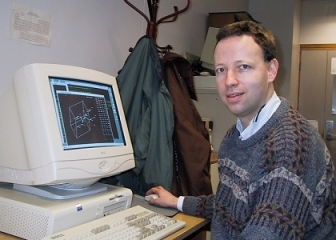
| John joined the group as a postdoctoral research scientist in December 1998. He is now a lecturer at the Unilever Centre for Molecular Informatics in the Chemistry department at the University of Cambridge. | |
| His main areas of
research are: (1) Development of accurate and physically realistic intermolecular potential functions. We are seeking to develop intermolecular potential functions, based on monomer properties, which will allow the intermolecular interaction energies to be calculated with an accuracy effectively equivalent to that of ab initio calculations. The potentials will be partitioned into (a) Electrostatic energy, based on distributed multipole analysis (DMA), and therefore incorporating atom-atom anisotropy. (b) Exchange-repulsion (i.e., the short range repulsive force arising from the Pauli exclusion principle). The functional form will be exponential. We may need to incorporate anisotropy into this term. (c) Dispersion (i.e., the universal attractive force arising from electron correlation). The representation of this is based on the leading term in R**-6. We hope to calculate the atom-atom co-efficients of this term (C6) from integrals of distributed polarizabilities at imaginary frequencies. (2) Prediction of crystal structures for small organic molecules. We use a DMA-based potential to calculate accurate lattice energies for putative crystal structures, which can be minimised using the program DMAREL. The total energy is approximated by the sum of the ab initio monomer energy and the lattice energy. Of particular interest is the problem of polymorphism, where a molecule is able to crystallise in a plurality of different forms. |
|
| email: jbom1@hermes.cam.ac.uk | homepage: www.ch.cam.ac.uk/CUCL/staff/jbom.html |
| to top | |
| Dr Tanja van Mourik | |
 |
|
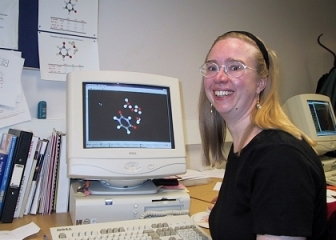
| Tanja joined the
group as a postdoctoral research scientist in November
1997. She was working under two research groups of Professor S.L. Price and Professor D.C. Clary. She is now a Royal Society Research Fellow in the Chemistry department at UCL. |
|
Her research areas in
the group were:
|
|
| email: t.vanmourik.ucl.ac.uk | homepage: www.chem.ucl.ac.uk/people/vanmourik/index.html |
| to top | |
| Dr Theresa Beyer | |
 |
|
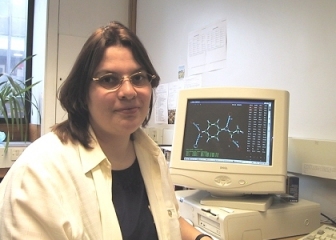
| Theresa completed her Ph.D. studies in May 2001. She is now pursuing a career in management consultancy in Germany. | |
| Her research
interests included - the development of accurate intermolecular potentials and - the investigation of additional factors to lattice energy for crystal structure prediction. This work was done in collaboration with the Cambridge Crystallographic Data Centre (CCDC). |
|
| email: theresa_beyer@web.de | |
| to top | |
| Dr Helen H. Y. Tsui | |
 |
|
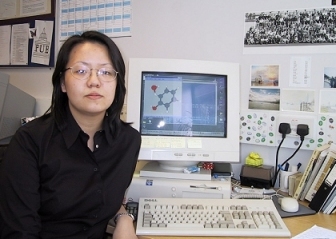
| Helen completed her Ph.D. in September 2001and wasjoint supervised by Professor S.L. Price and Professor D.C. Clary. Helen is hoping to pursue a career in management consultancy. | |
Her research was
based on:
|
|
| email: hhyt@hotmail.com | homepage: go.to/helen.tsui |
| to top | |
| Dr Graeme M. Day | |
 |
|
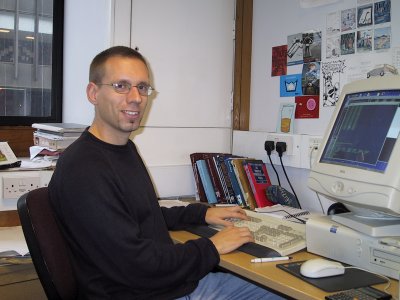
| Graeme completed his Ph.D. in December 2001. His currently doing a post-doc at the University of Cambridge. | |
His research was
based on :
|
|
| email: gmd27@cam.ac.uk | homepage: http://www.geocities.com/graeme_day |
| to top | |