Historical Explanation?
e.g. Biology B237 Vertebrate Structure and Evolution mainly historicalMechanistic Explanation?
How do we explain data?
Proving the truth? NO!!!FACT OF EVOLUTION
Karl Popper - Logic of Scientific Discovery
- most scientists agree
We scientists don't claim to discover the absolute "truth";
we merely hope to approach the truth!Instead, laws, theories are considered valid if they are useful, predict.
e.g. Newton's laws of motion have been proved wrong,
Einstein's theory of Relativity supersedes them.
But Newton's laws were useful, and still are, at low velocities and energies.Better theories by FALSIFICATION of other theories
Evolution is a fact. We know it happens (though not always how).
Science always deals in falsifiable theories; but some theories so
well-substantiated, it is hard to deny they are facts.
Arguments with which to impress creationist friends:
1) Recent evolution: House sparrows introduced to NY, now all over USA. In hotter areas, smaller.
Pesticide Resistance, Heavy Metal tolerance, Antibiotic Resistance, Industrial melanism.2) Geographic variation: Darwin - Galapagos finches
giant tortoises, talking to governor of islands, tortoises identifiable3) Common genetic material DNA & RNA
Lesser black-backed -> Siberian gulls -> Herring gull
Species continuous in space, not discrete; therefore contin. in time likely also.
Wallace's "Law of Creation of New Species": species come into existence at times and places with close relatives.
Common genetic code also; all of life4) Fossil record: speciation seen in some groups, major group evolution
Chimps & humans, share 99% of DNA sequence
DEFINITIONS:
EVOLUTION: Darwin: Descent with modification
GENETICISTS: Change of allelic proportions
(a.k.a. gene frequencies or p, q) over a number of generationsEVOLUTION - a change of gene frequencies
a) Natural selectionWhy not a change in numbers of genes? Why are we more interested in proportions, or frequencies? Because ecology, population dynamics, affect evolution, but are not themselves evolution (see later).
b) Mutation
c) Genetic drift
e) Migration or gene flow
NATURAL SELECTION: should be distinguished from evolution
GENETICISTS: Consistent differential survival or reproduction of genotypes
within generations. VIABILITY vs. FERTILITY selection.
Can have natural selection with no evolutionary change,
e.g. maintenance of polymorphism (three lectures time)
SELECTION AND POPULATION SIZE
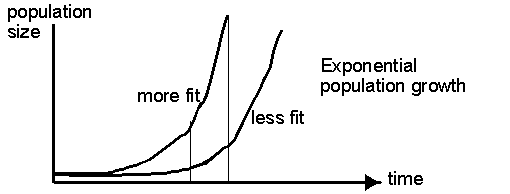
Simplest idea of natural selection: steadily increasing population,
the population with the highest rate of increase wins.
e.g. A fitter than a because has a higher rate of increase.
BUT: real populations do not grow for ever.
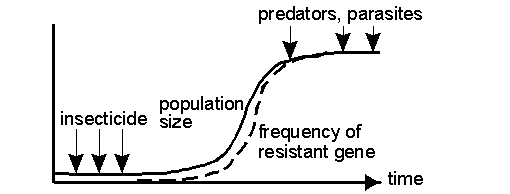
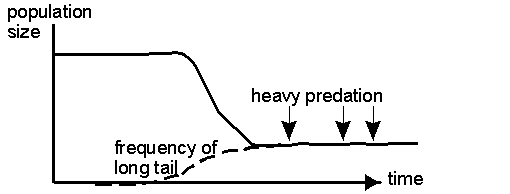
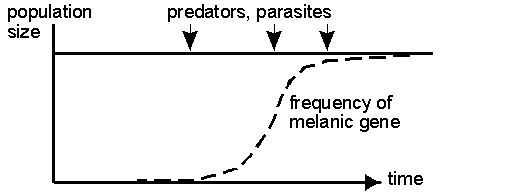
Actually, selection may increase decrease, or have little or no effect on population size. If selection affects population size, it is called "hard selection"; if it does not, it is called "soft selection". But evolution occurs whether selection is "soft" or "hard".
a) Evolution of pesticide resistance - increases population size (hard selection)
b) Evolution of a costly male trait preferred by females e.g. male peacock's tail - may actually reduce population size, because predation on males increases (hard selection again). Here, the evolution of the peacock's tail we still call evolution!
c) Evolution of melanism in an adult moth while caterpillar numbers are strongly regulated by parasites and predators &c. No change in population size (soft selection)
EVOLUTION IN NON-LIVING SYSTEMS?
Natural selectionExample of evolution in a non-living system, an Ain vitro experiment@ on evolution
Variation
Heredity
Differential survival
Phage qb - parasite of E. coli
- RNA virus
In vitro experiment on evolution
Take and mix together:
RNA replicase enzyme of qb Orgel 1979RNA replicates, but with errors at rate approx. 10-4
+ ATP
+ GTP
+ UTP
+ CTP
+ RNA template
+ ions, buffers &c
Always produces same endpoint, an RNA of 218 bp under similar conditions.
Even if no template! (After a long wait)
Presumably, this RNA replicates faster than competitors.
Probability in a single go, is = 4218 . 10-128. Even if we could look at 1016 molecules every half hour, it would take 100,000,000,000,000,000,000,000,000,000,000,000,000,000,000,000,000,000,000,000,000,000,000,000,000,000,000,000,000,000,000,000,000,000,000,000 years to find the right molecule! NATURAL SELECTION CAN PRODUCE HIGHLY IMPROBABLE THINGS!
Similarly: Computer programming, artificial life
Genetic algorithms, solve complex problems in computer optimization,
e.g. aircraft design.
Stock Market -- Santa Fe Institute
Evolution of thought - philosophy of science
Popper falsificationism Falsification -> better theory also selectionSO EVOLUTIONARY PRINCIPLES MAY BE HIGHLY GENERAL. It is not just "life" that evolves. "Robots" could too, if they were constructed to reproduce themselves.Computer programs already do .... WATCH OUT in the next millenium!
Popper mutations, variations in thought, heredity of thought, selection
Back to BIOL
B242 TIMETABLE