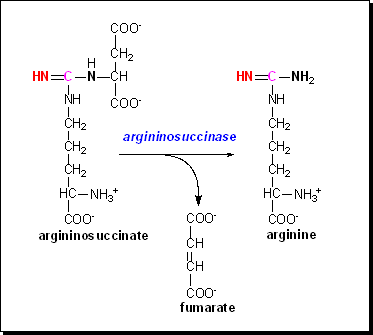
 A rare
genetic defect of the enzyme argininosuccinase leads to the condition of argininosuccinic
aciduria; the affected infants excrete large amounts of argininosuccinic acid
in their urine.
A rare
genetic defect of the enzyme argininosuccinase leads to the condition of argininosuccinic
aciduria; the affected infants excrete large amounts of argininosuccinic acid
in their urine.A rare
genetic defect of the enzyme argininosuccinase leads to the condition of argininosuccinic
aciduria; the affected infants excrete large amounts of argininosuccinic acid
in their urine.
More importantly, affected infants suffer from hyperammonaemia, and after even a moderate intake of protein can become comatose, and may suffer convulsions, leading to brain damage, or die.
Brusilow & Batshaw (1979) reported the successful treatment of a child with argininosuccinic aciduria using supplements of arginine [Brusilow, S W &. Batshaw, ML (1979). Arginine therapy of argininosuccinase deficiency. Lancet 313 (issue 8108): 124-7].
Can you explain why a child with argininosuccinic aciduria, who lacks argininosuccinase, should become hyperammonaemic after a moderate intake of protein?
Can you explain how supplements of arginine prevent
the development of hyperammonaemia and permit the child to consume a more or
less normal diet?