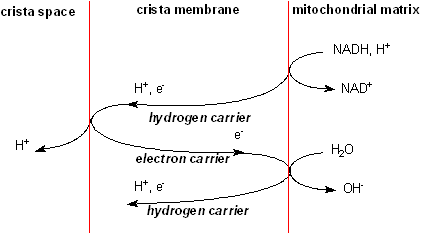
The carriers of the electron transport chain pump protons across the crista membrane, forming a gradient, with an excess of protons in the crista space, and an excess of hydroxyl ions in the matrix. These protons return to the matrix, down the concentration gradient, through the stalk of the primary particles. This provides the driving force for the ATP synthetase to catalyse the condensation of ADP + phosphate to form ATP.
The creation of the proton gradient is seen most simply in complex I, where there is alternation between coenzymes that carry protons and electrons and those that carry only electrons, so that protons are expelled into the crista space, then acquired from water at the matrix face.
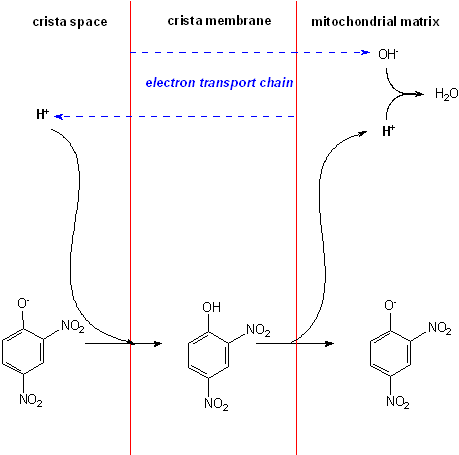 Uncouplers
are weak acids that transport the protons back into the matrix directly, bypassing
the ATP synthetase - the classic example of an uncoupler is 2,4-dinitrophenol,
which is water-soluble when deprotonated, but lipid soluble when protonated,
so that it will diffuse across the crista membrane down its concentration gradient.
This means that the rate of oxidation of substrates, and utilisation of oxygen,
is no longer controlled by the availability of ADP, and in the presence of an
uncoupler there is rapid and more or less complete utilisation of oxygen, regardless
of the amount of ADP present.
Uncouplers
are weak acids that transport the protons back into the matrix directly, bypassing
the ATP synthetase - the classic example of an uncoupler is 2,4-dinitrophenol,
which is water-soluble when deprotonated, but lipid soluble when protonated,
so that it will diffuse across the crista membrane down its concentration gradient.
This means that the rate of oxidation of substrates, and utilisation of oxygen,
is no longer controlled by the availability of ADP, and in the presence of an
uncoupler there is rapid and more or less complete utilisation of oxygen, regardless
of the amount of ADP present.
Uncouplers also permit rapid utilisation of oxygen in the presence of compounds that inhibit ATP synthetase, or the transport of ADP into, and ATP out of, the matrix.
Obviously, an uncoupler will have no effect if the electron transport chain itself has been inhibited, since there is no proton gradient to be discharged by the uncoupler.
Click here to view a cartoon of proton transport across the crista membrane with and without an uncoupler.
(This is a VisualBasic program that will fill the full screen. You can minimise it to see this screen without closing the program; when you close or end the program this screen will be visible again)