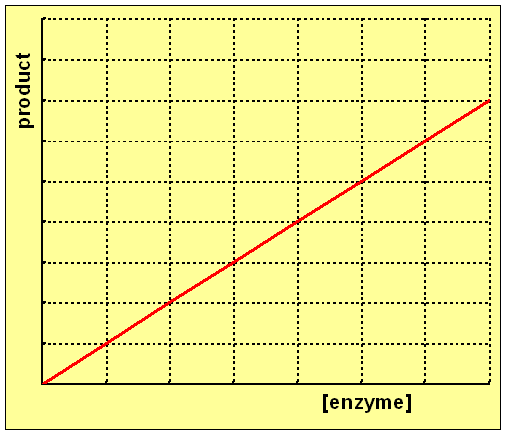
As long as there is substrate present, the amount of product formed might be expected to increase in a linear fashion as the amount of enzyme increases, as shown in the graph below.
This is not always so.
Some enzymes form dimers or other aggregates at high concentration. This may affect the catalytic activity, either increasing or decreasing it compared with the monomer in a dilute solution. Similarly, dimers, or other aggregates that are the normal form of the enzyme may disaggregate when the preparation is diluted, again affecting the catalytic activity of the sample.
Some enzymes are unstable in dilute solution, and so are readily denatured, resulting in lower activity in dilute solutions than would otherwise be expected. This is especially a problem with purified enzyme preparations, where there is very little protein present in the sample. One common way of overcoming the instability of purified preparations is to add a relatively large amount of an inert protein, such as albumin, to act as a chaperone to the purified enzyme.
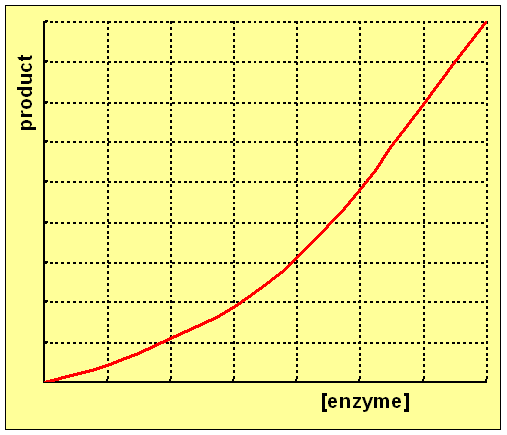
The graph below shows the effect of increasing the concentration of an enzyme that has low activity as the monomer and higher activity when it has formed a dimer at a higher concentration of enzyme.
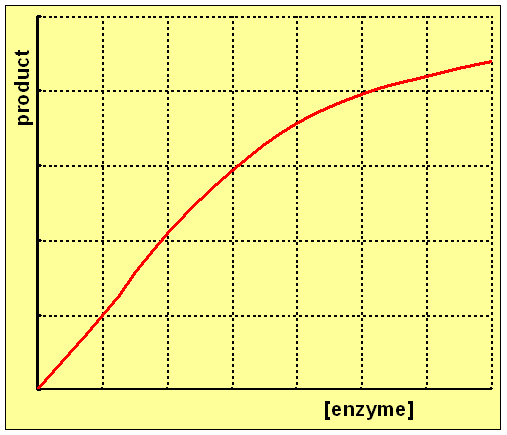
The graph below shows the opposite - an enzyme that has higher activity as the monomer, and decreased activity as it associates to form a dimer, at higher concentrations.
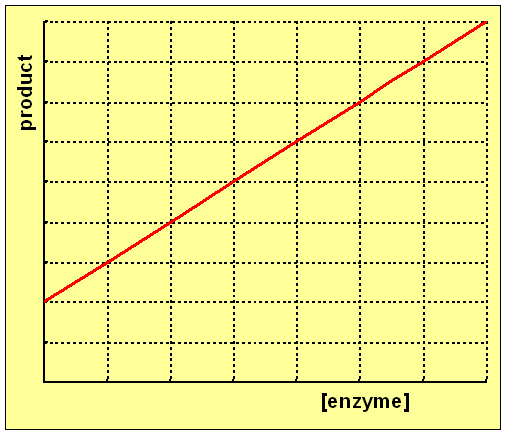
Sometimes there may be some non-enzymic conversion of substrate to product, or there may be some product already present in the tissue sample being used, so that there is some product present even when there is no enzyme present, or it has been incubated for zero time. Investigation of. The graph below shows the results you would observer if there were formation of the product other than as a result of enzyme activity.
In general, the enzyme preparation is the most valuable constituent of the incubation; it may have taken several days to produce a purified preparation, or you may be working with a very small sample of tissue from a patient. Therefore, it is usual to set up incubations using the lowest amount of enzyme that can be pipetted with acceptable precision, and which leads to the formation of a readily detectable amount of product.
If you are working with a relatively unpurified preparation, or do not know
the molecular mass of your enzyme, then you can express the activity of the
enzyme as:
If you are working with a partially purified enzyme preparation you should express its activity as the specific activity:
specific activity = mol of product formed / unit time / mg protein
If you are working with a purified enzyme preparation, and know its molecular mass, or if there is some other way of determining the molar concentration of the enzyme in the sample, e.g. by measurement of a prosthetic group bound to the enzyme protein, then it is possible to express the activity of the enzyme as the catalytic rate constant:
kcat = mol of product formed / sec / mol of enzyme.