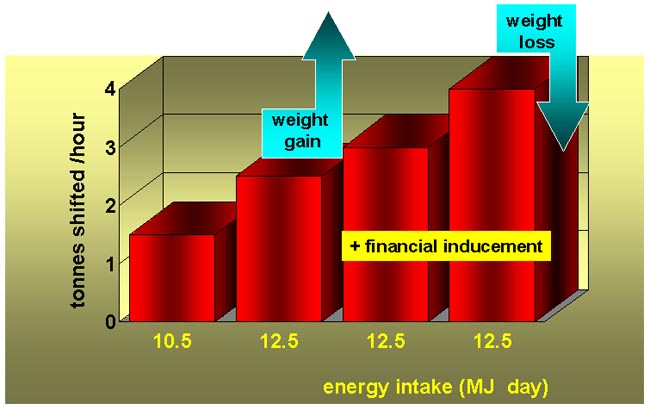
There is obviously a relationship between food intake, energy expenditure in physical activity and body weight; the figure shows the results of studies conducted by McCance and Widdowson in 1946, in post-war Germany. There was a large amount of rubble to be cleared from bomb damage, a large number of people had to be found employment, and food was scarce. They investigated the effects of increasing food intake from an initial 10.5 MJ (2450 kcal) /day to 12.5 MJ (2990 kcal) /day on work output and body weight:
Initially, when the people were given the extra food their work output increased, and they gained body weight. In other words, their energy expenditure in physical work was less than their energy intake from food, and they were able to store the surplus as fat.
When they were offered a financial inducement to work harder, they did so; at the highest level work output they lost weight. In other words, at this high level of energy expenditure their food intake was inadequate, and they were calling on body reserves of fat.
In this simulation you can investigate the relationship between food intake and physical activity in three ways:
To run the program, click the "Run" link. the program will then run in a separate window, and at any time you can minimise the program window to check the theory from this page.
As you run the program, you are asked after each simulated experiment whether you wish to save the results to print out. If you save results, they are saved in a file called simout.txt in your temporary file area. The program automatically locates your temporary file area, and displays the path on the opening screen. When you close the program you are given the option of printing out the results you have chosen to save for printing.