NANOMAGNETISM NETWORK: CLUSTERS, PARTICLES AND GRAINS
1. Scientific Background
The UK currently hosts a wide spectrum of world-class activities in nanomagnetism. These range from the highly technical fields of nanolithography and individual-element nanocharacterisation, through to the complexity of polydisperse nanoparticles and grains in composites, colloids and solid dispersions. At one extreme the goal is to obtain data on model systems in order to probe fundamental questions in nanomagnetism, and to explore their possible application in devices such as magnetic logic gates. In the more complex systems there are many goals. These include the manufacturing and tailoring of materials for specific technological applications, where a particular attraction is the non-volatility of the product and the ability to modify performance via materials properties rather than by multilevel fabrication as for semiconductors. Examples of such materials are found in ultra-soft or ultra-hard magnets, high density recording media and magnetoresistive sensors. Other goals include seeking to understand aspects of the natural world that as yet we cannot emulate, such as biomineralisation in the bacterial growth of monodisperse nanomagnets; and using the ubiquitous appearance of nanomagnetic materials to further other scientific endeavours, such as in geomagnetism and in archaeology.
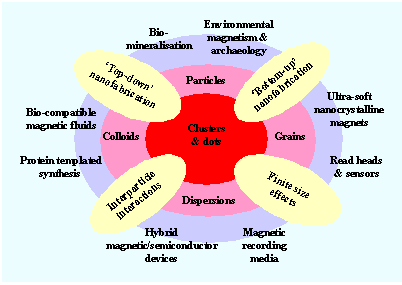
Fig. 1: UK Nanomagnetism Network in Clusters, Particles and Grains. The schematic shows the role that the Network will play as a focus for interdisciplinary nanoscience research in the UK. The Network will act as a bridge between the physical and life sciences and engineering. It will encompass both the bottom-up and top-down approaches to synthesis, and the full range of interparticle and intergranular interactions from isolated to strongly interacting. The formation of this Network is an essential step if the UK is to remain internationally competitive in this rapidly changing field.
Despite the extreme breadth of these areas of research, the practitioners speak a common language when it comes to the two central issues regarding nanomagnetism, viz. the nature of the finite size effects that make a nanomagnet different from the bulk; and the strength and influence of interparticle or intergranular interactions. In light of this common interest, and the extraordinary potential for mutual growth that may be achieved by bringing together this interdisciplinary group, we are proposing to create a UK Network in Nanomagnetic Clusters, Particles and Grains. The theme of the Network is illustrated in Figure 1. At the centre of the schematic lies the nanoscience study on fabricated clusters and dots, surrounded by those endeavours that, proceeding outwards, are further removed from the realm of model systems. Cross-cutting themes are summarised by the phrases ‘interparticle interactions’ and ‘finite size effects’. The vital role of materials synthesis is denoted by the phrases ‘top-down’ and ‘bottom-up’ nanofabrication: examples being mechanical alloying and nanocrystallisation for top-down nanofabrication, and co-ordination chemistry and cluster beam deposition for bottom-up nanofabrication.
The Network will draw together the net UK expertise in this area in an unprecedented way, and provide a focus for substantial progress across many disciplines through meetings and workshops, collaborative visits and exchange schemes, and a web site. It will serve as a reference for other, more application-oriented UK activities on nanoscale magnetic materials, while appealing to the full range of people working in the field. The many letters of support (attached) attest to the tremendous need for a Network to provide the scientific underpinning of current UK research into nanomagnetism.
2. Initial Membership
The academic remit of the Network is intentionally broad, with members coming from many research backgrounds and disciplines. An open door policy will be followed with regard to membership, with encouragement being given to all who wish to join the Network once it is established. A brief description of the initial set of participants is given below. Further details of these individuals/groups, including a selection of their recent nanomagnetism related publications, their EPSRC grant portfolios, and additional presentations, are given in Appendices 1, 2 and 3.
2.1 Clusters and dots
BIRMINGHAM - Prof. Ted Forgan (Physics)
Magnetic clusters in non-magnetic matrices, studied by low energy muons (able to measure static and fluctuating magnetic fields over depths from 50 to 1500 Å near surfaces) and SQUID magnetometry.
CAMBRIDGE (to move to DURHAM) - Dr. Russell Cowburn (Engineering)
Nanoscale particles, fabricated by electron beam lithography, with particular application to advanced computing devices. Interest in the competing roles played by quantum mechanics and classical magnetostatics, and potential devices e.g. an all-magnetic logic gate. Techniques employed include magneto-optic Kerr effect and anisotropy measurements.
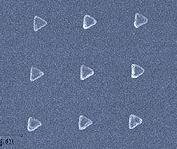
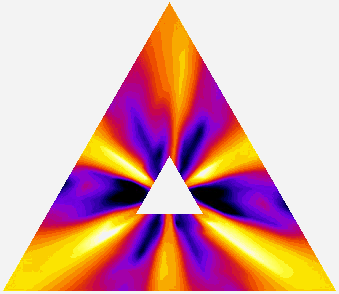
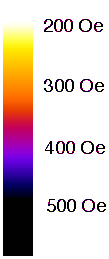
Fig. 2: Properties of Magnetic Nanoscale Objects. Electron beam lithography allows the study of magnetic arrays, such as the 100 nm sized triangular lattice shown. Magneto-optical data reveal the internal anisotropy fields, shown for triangular nanomagnets in the size range 50-500 nm. The results demonstrate that fundamental properties like anisotropy may be tailored by nanofabrication.
CCLRC DARESBURY LABORATORY - Dr. Derek Eastham
Production of size-selected, soft-landed cluster beams. Working on high density magnetic storage devices using discrete magnetic particles. Interests in nanolithography and the manipulation of clusters on surfaces with laser beams.
EDINBURGH (to move to MANCHESTER) - Dr. Richard Winpenny (Chemistry)
Using co-ordination chemistry to make ‘single molecule magnets’, a ‘bottom-up’ approach to nanomagnetism. Has made compounds containing up to twenty-four metal centres, and has shown that several of these complexes show slow relaxation of magnetisation at very low temperatures.
GLASGOW - Prof. John Chapman (Physics)
Using electron microscopy to measure local structural, compositional, electronic and magnetic properties with a spatial resolution approaching 1nm. Interested in lithographically-defined nanostructures, thin films and multilayers for sensor and high density information storage applications, and high energy-product permanent magnet materials.
LEICESTER - Dr. Chris Binns (Physics)
Size-selected deposited clusters in the size range 50 - 5000 atoms, obtained from a portable UHV-compatible cluster source. In situ X-ray dichroism studies at ESRF and Daresbury to measure orbital and spin moments as a function of size. Lab-based magnetometry and magneto-transport measurements. Interested, with Seagate, in optimising GMR performance in films, and in producing films with a high saturation moment.
READING - Dr. John Blackman (Physics)
Theory and modelling of clusters and clusters on surfaces, via MD and MC simulations, scaling theory, and electronic calculations (ab initio and semi-empirical). Research on growth characteristics and magnetic properties of nanoclusters, e.g. Co in Ag.
UCL - Prof. Gabriel Aeppli (Physics)
Neutrons as a probe of magnetisation on atomic to mesoscopic scales. Quantum tunnelling in disordered magnets. Magnetoresistance from quantum interference effects in ferromagnets. Quantum phase transitions. Magnetic force microscopy.
2.2 Nanoparticles and magnetic colloids
BRISTOL - Dr. Walther Schwarzacher (Physics)
Electrodeposition of thin films and nanostructures, including arrays of magnetic dots and pillars, and multilayered and granular alloy nanowires.
DURHAM - Prof. Roy Chantrell (Physics)
Theory and modelling of nanoparticles and grains, micromagnetic models for macroscopic observables, interparticle interactions.
EDINBURGH - Prof. Andrew Harrison (Chemistry)
Fundamental studies of growth processes for metal oxide particles to understand better how to control size and shape, particularly for iron oxides and oxyhydroxides. Recent developments include (i) culturing bacteria that excrete magnetic particles to make doped iron oxides; (ii) growth of Langmuir-Blodgett films using tailored surfactants to bind and connect magnetic ions in exchange-coupled magnetic arrays.
KEELE - Dr. Jon Dobson (Biomedical Engineering & Medical Physics)
Developing biocompatible ferrofluids and nanomagnetic particles for biomedical engineering applications (e.g. magnetically targeted drug and gene delivery, bioreactor design, disease diagnosis). Also nanoscale biogenic magnetic particle biomineralisation in humans and how this may relate to neurodegenerative diseases.
LIQUIDS RESEARCH LIMITED - Dr. Vijay Patel
LRL is a small consultancy and manufacturer of magnetic colloids and related materials, employing 6 full time staff. Currently involved in SMART and BRITE-EURAM programmes on automotive dampers, immunoassaying and microdispensers.
NANOMAGNETICS LIMITED - Dr. Eric Mayes
Formed in 1997 to exploit the production and use of uniform magnetic nanoparticles prepared chemically in ferritin templates. Currently a staff of 8, soon to be expanded.
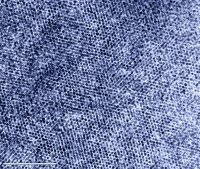
Fig. 3: Protein Encapsulated Isolated Nanoparticles. TEM micrograph of a hexagonal close-packed film of 12 nm diameter ferritin cages, each containing an 8 nm diameter single domain magentic oxide core, currently under deveploment by NanoMagnetics Ltd. Self-assembling films of this nature could ultimately offer monodispersed and decoupled recording media with storage densities of up to 4.5 Tbits/in2.
NATURAL HISTORY MUSEUM - Dr. Phil Bland (Mineralogy)
Studies of the composition of meteorites and the interstellar medium, with recent work focussing on nanoscale magnetic silicates whose IR spectra match those of the interstellar medium.
NOTTINGHAM - Dr. Bryan Gallagher (Physics)
Studies of MBE grown hybrid materials including magnetic clusters placed directly on the surface of a sub-micron semiconductor device containing a near surface 2D electron gas.
SEAGATE TECHNOLOGY - Dr. Declan Macken
Represents a 52 strong group carrying out R&D on magnetic recording heads, magnetic media, tribology etc. Seeking to expand capabilities in (i) increasing areal density of recording apparatus i.e. increasing storage capacity, and (ii) increasing data transfer rate i.e. increasing operating speed.
UCL - Prof. Peter Dunnill (Biochemical Engineering) and Dr. Quentin Pankhurst (Physics)
Biocompatible magnet fluids for protein purification and immunoassaying, and studies of natural and synthetic iron oxide and oxyhydroxide fine particles by scanning probe microscopy, Mössbauer spectroscopy, VSM and SQUID magnetometry and m SR.
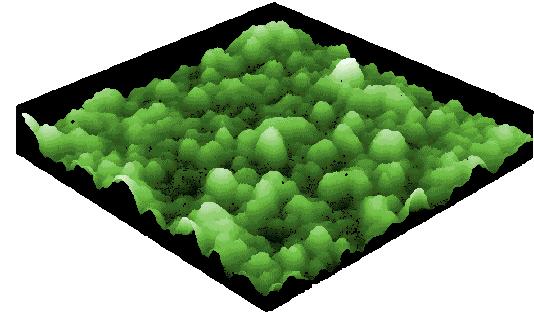
Fig. 4: Biocompatible Magnetic Fluids. AFM image of an aminosilane coated iron oxide magnetic fluid deposited on a glass slide (350 ´ 350 ´ 10 nm3). These biocompatible fluids could be the basis of a new magnetic separation based technology for protein purification, and a means of enzyme immobilisation and assaying.
UCL - Dr. Ivan Parkin (Chemistry)
Developing new chemical routes to nanoscaled magnetic materials by solution phase synthesis, sodium borohydride reductions and self propagating reactions.
UCL - Dr. Ellen Platzman (Geological Sciences)
Using magnetic ferrofluids in conjunction with more established rock physics techniques to image changes in pore fabrics resulting from the application of stress.
YORK - Prof. Kevin O’Grady (Physics)
Fundamental studies of fine particle magnetism and granular systems, especially magnetisation reversal mechanisms, thermal activation and the underlying magnetic and physical microstructure that leads to these effects. Magnetometry.
2.3 Granular alloys
BRISTOL - Dr. Walther Schwarzacher (Physics)
Electrodeposition of thin films and nanostructures, including arrays of magnetic dots and pillars, and multilayered and granular alloy nanowires.
SHEFFIELD - Dr. Neil Cowlam (Physics)
Structure and magnetism of highly disordered materials on nanometre length scales. Non-collinear ferromagnetism in metallic alloy glasses and duplex ferromagnetic samples produced by mechanical alloying which exhibit fractal structures. X-ray and neutron scattering, and SQUID magnetometry.
ST. ANDREWS (to move to LEEDS) - Prof. Bob Cywinski (Physics)
Fundamental studies of nanoscale granular alloys, including Co:Cu, and iron oxyhydroxide and ferrihydrite nanoparticles, by neutron scattering and muon spectroscopy.
UCL - Prof. Ian Boyd (Electrical Engineering)
Pulsed laser deposition of granular alloy thin films, including Fe:Ag and Co:Ag, as giant magnetoresistive materials.
UCL - Dr. Quentin Pankhurst (Physics)
Chemical reduction synthesis of nanoscale amorphous and nanocrystalline alloys for ultra-soft magnets. Superparamagnetism and giant magnetoresistance in nanoscale granular alloys including Fe-Cu-Ag and Fe-Co-Ag prepared by mechanical alloying.
3. Objectives
The overall objectives of the proposal are
One of the main advantages of the Network as a wide-ranging interdisciplinary enterprise is its potential for addressing key problems in an open-minded way. To this end, specific scientific objectives for the Network will include advances in the following emerging fields
4. Outcomes
Some of the most quantifiable outcomes of the Network will take the form of (i) joint publications prepared for leading journals by new collaborations of Network members, with a target of 20+ per year within 5 years; (ii) the presentation of results from new collaborations at national and international conferences (target 30+ per year); and (iii) research grant applications put forward by new sets of research groups (target 5+ successful applications per year).
It is also intended that the Network will have become self-sustainable by the end of 2003. By this stage the UK-based membership will be well established, as will be the website and the email database and newsletter. We expect the Network to grow, and for the meetings and workshops to become self-funding. Further, we shall take every opportunity to make specific proposals, as part of European Union programmes, to establish a Europe-wide collaboration the will consolidate the activities of the UK Nanomagnetism Network.
5. Interactions
We are aware of other Network proposals in neighbouring areas that are complementary to the Nanomagnetism Network, and we will actively engage with them and explore areas of common interest. This also applies to the recent Advanced Magnetics Programme call for Network proposals. Although AMP Networks are primarily drawn from a different user group than here (thin film and multilayer devices as opposed to clusters, particles and grains), there is some overlap, and some of the Nanomagnetism Network members are also leading members of proposed AMP Networks. Their involvement will ensure that there is close collaboration, for the benefit of all.
6. Activities
The primary goal of the Network, to provide an inclusive forum for nanomagnetism researchers from a wide range of academic and commercial backgrounds, will be achieved via a programme of Network Meetings and Workshops. The Network Meetings will involve all the Network members - two will be held during the course of the grant. Three smaller Workshops will also be held, one each on the Clusters, Particles and Grains themes.
Networking will be further enhanced by a programme of Exchange of Young Scientists, with funds being made available for exchange visits between laboratories, typically of one weeks duration. As well as raising the awareness of young scientists of other techniques and approaches to their research, this will help to forge collaborative links between groups. These links will be further supported through the provision of funds for overnight visits amongst the Network members for collaborative discussions.
7. Dissemination
A website will be established to act as a central resource for Network members, and as a direct means of publicising the activities of the Network. The site will be regularly updated and will contain profiles of all members (including equipment and sample availability), with contact details, as well as links to related networks and international groups. Members will be encouraged to post their latest results and papers on the site.
Additionally, an email database of the academic, SME and industrial members of the Network, together with a list of other interested bodies both within nd outside the UK, will be established,. This will then enable the widest possible dissemination of information of the activities of the Network via a periodic email newsletter.
8. Management
The overall Network co-ordinator will be Dr. Quentin Pankhurst of the Department of Physics & Astronomy, University College London. Dr. Pankhurst has more than 15 years experience of research in magnetic materials, alloys and fine particle magnetism, and has written more than a hundred papers in the field. In addition to this expertise, he brings to the role four years experience as Secretary/Treasurer of the Royal Society of Chemistry Mössbauer Discussion Group, an interdisciplinary network that has met annually for over 30 years. Dr. Pankhurst has organised and run the last three meetings in this series.
The Network will be managed by a committee comprising Dr. Chris Binns of the University of Leicester, representing the ‘clusters and dots’ subgroup, Prof. Andrew Harrison of the University of Edinburgh, representing ‘nanoparticles’, and Dr. Pankhurst as co-ordinator and also representing ‘granular alloys’. The function of the committee will be to source the organisation of the Network Meetings and Workshops, to approve requests for exchange and collaboration visits, and where necessary to stimulate exchanges between the Network members. As well as discussions by email, the committee will meet at the Network Meetings and Workshops, and in person as required. Reports on the meetings will be posted on the website, and also circulated in the email newsletter.
9. Resources
Sectretarial support at the level of 10% full-time is requested for the running of the Network. The secretary will (i) help to organise the Network Meetings and Workshops, including arrangements for invited speakers; (ii) maintain records of all expenses claimed by Network members, and (iii) help to maintain the website. We also request a modest consumables budget of £500 per year, as well as a contribution towards the cost of a new office computer to replace an existing, outdated, machine.
The remainder of the funding is requested for travel and subsistence to support (i) the Network Meetings – two, each of two days duration, with 45 participants; (ii) the Workshops – three, each of 3 days duration, with 20 participants; (iii) the overnight collaboration visits between Network members – 25 per year for 3 years; and (iv) the week long Exchange of Young Scientists visits – 10 per year for 3 years. Thus the majority of the funds are to be spent directly on networking and on supporting the participation of youg scientists.
Appendix 1 – Selected Publications
[1] Aeppli G and Hayden S M 1999 Neutrons as a probe of magnetization on atomic to mesoscopic scales MRS Bulletin 24 29-33
[2] Baker A S J, Brown A S C, Edwards M A, Hargreaves J S J, Kiely C J, Meagher A and Pankhurst Q A 2000 A structural study of haematite samples prepared from sulfated goethite precursors: the generation of axial mesoporous voids J. Mat. Chem. 10 761-6
[3] Baker S H, Thornton S C, Keen A M, Preston T I, Norris C, Edmonds K W and Binns C 1997 The construction of a gas aggregation source for the preparation of mass-selected ultrasmall metal particles Rev. Sci. Instrum. 68 1853-7
[4] Barquin L F, Forster G D, Cohen N S, Pankhurst Q A and Parkin I P 1999 Synthesis of amorphous Fe-Zr-B by chemical reduction J. Mat. Sci. Lett. 18 425-6
[5] Benelli C, Blake A J, Brechin E K, Coles S J, Graham A, Harris S G, Meier S, Parkin A, Parsons S, Seddon A M and Winpenny R E P 2000 A family of polynuclear cobalt and nickel complexes stabilised by 2-pyridonate and carboxylate ligands Chemistry-a European Journal 6 883-96
[6] Bewley R I and Cywinski R 1998 Superparamagnetic CuCo studied by mu SR J. Magn. Magn. Mater. 177 923-4
[7] Bewley R I and Cywinski R 1998 Muon spin relaxation in a superparamagnet: Field dynamics in Cu98Co2 Phys. Rev. B 58 11544-51
[8] Blackman J A and Brochard S 2000 Polydispersity exponent in homogeneous droplet growth Phys. Rev. Lett. 84 4409-12
[9] BlancoMantecon M and O'Grady K 1999 Grain size and blocking distributions in fine particle iron oxide nanoparticles J. Magn. Magn. Mater. 203 50-3
[10] Bland P A, Bevan A W R and Jull A J T 2000 Ancient meteorite finds and the earth's surface environment Quaternary Research 53 131-42
[11] Bland P A, Hoffman E, Jones R, Cressey G and Cadogan J M 1999 Magnetite in ''oxidized'' and ''reduced'' CV chondrites Meteoritics & Planetary Science 34 A12-A3
[12] Brechin E K, Clegg W, Murrie M, Parsons S, Teat S J and Winpenny R E P 1998 Nanoscale cages of manganese and nickel with ''rock salt'' cores Journal of the American Chemical Society 120 7365-6
[13] Brechin E K, Graham A, Grant C M, Murrie M, Parsons S and Winpenny R E P 1999 Structural variations and magnetic studies of polymetallic cages Molecular Crystals and Liquid Crystals Science and Technology Section a-Molecular Crystals and Liquid Crystals 334 975-94
[14] Brooke J, Bitko D, Rosenbaum T F and Aeppli G 1999 Quantum annealing of a disordered magnet 0036-8075 284 779-81
[15] Bui Q T, Pankhurst Q A and Zulqarnain K 1998 Inter-particle interactions in biocompatible magnetic fluids IEEE Trans. Magn. 34 2117-9
[16] Chantrell R W, Walmsley N S, Gore J and Maylin M 1999 Theoretical studies of the field-cooled and zero-field cooled magnetization of interacting fine particles J. Appl. Phys. 85 4340-2
[17] Chapman J N and Scheinfein M R 1999 Transmission electron microscopies of magnetic microstructures J. Magn. Magn. Mater. 200 729-40
[18] Cohen N S, Pankhurst Q A and Barquin L F 1999 Structural and magnetoresistive properties of mechanically alloyed Fe-Co-Ag J. Phys. Condens. Matter 11 8839-53
[19] Cooper R J, Randrianantroandro N, Cowlam N and Greneche J M 1997 A study of amorphous Fe58Ta42 alloys produced by mechanical alloying Mat. Sci. Eng. A 226 84-9
[20] Coverdale G N and Chantrell R W 2000 Calculations of the microstructure and magnetic properties of particulate recording media J. Magn. Magn. Mater. 209 21-4
[21] Cowburn R P, Adeyeye A O and Welland M E 1998 Configurational anisotropy in nanomagnets Phys. Rev. Lett. 81 5414-7
[22] Cowburn R P, Koltsov D K, Adeyeye A O and Welland M E 1999 Designing nanostructured magnetic materials by symmetry Europhysics Letters 48 221-7
[23] Cowburn R P, Koltsov D K, Adeyeye A O and Welland M E 2000 Sensing magnetic fields using superparamagnetic nanomagnets J. Appl. Phys. 87 7082-4
[24] Cowburn R P, Koltsov D K, Adeyeye A O, Welland M E and Tricker D M 1999 Single-domain circular nanomagnets Phys. Rev. Lett. 83 1042-5
[25] Cowburn R P and Welland M E 2000 Room temperature magnetic quantum cellular automata 0036-8075 287 1466-8
[26] Cowlam N 1997 Structure changes in nanostructured materials Solid State Phenomena 56 145-77
[27] Denby P M and Eastham D A 2000 A large-aperture, low-resolution quadrupole separator for producing deposited cluster materials Nuclear Instruments & Methods in Physics Research Section a-Accelerators Spectrometers Detectors and Associated Equipment 441 588-94
[28] Dobson J, StPierre T, Wieser H G and Fuller M 2000 Changes in paroxysmal brainwave patterns of epileptics by weak-field magnetic stimulation Bioelectromagnetics 21 94-9
[29] Dobson J and StPierre T G 1998 Thermal effects of microwave radiation on biogenic magnetite particles and circuits: Theoretical evaluation of cellular phone safety aspects Electro- and Magnetobiology 17 351-9
[30] Duffy D M, Blackman J A, Mulheran P A and Williams S A 1998 Transition metal clusters on graphite J. Magn. Magn. Mater. 177 953-4
[31] Edmonds K W, Baker S H, Thornton S C, Maher M J, Keen A M and Binns C 1999 X-ray photoemission and absorption spectroscopy of supported nanoscale iron clusters J. Appl. Phys. 86 2651-4
[32] Edmonds K W, Binns C, Baker S H, Thornton S C, Norris C, Goedkoop J B, Finazzi M and Brookes N B 1999 Doubling of the orbital magnetic moment in nanoscale Fe clusters Phys. Rev. B 60 472-6
[33] ElHilo M, Chantrell R W and O'Grady K 1998 A model of interaction effects in granular magnetic solids J. Appl. Phys. 84 5114-22
[34] Evans P R, Yi G and Schwarzacher W 2000 Current perpendicular to plane giant magnetoresistance of multilayered nanowires electrodeposited in anodic aluminum oxide membranes Appl. Phys. Lett. 76 481-3
[35] Fedosyuk V M, Kasyutich O I and Schwarzacher W 1999 Granular AgCo and AgCuCo nanowires J. Magn. Magn. Mater. 199 246-7
[36] Field M, Smith C J, Awschalom D D, Mendelson N H, Mayes E L, Davis S A and Mann S 1998 Ordering nanometer-scale magnets using bacterial thread templates Appl. Phys. Lett. 73 1739-41
[37] Forster G D, Barquin L F, Bilsborrow R L, Pankhurst Q A, Parkin I P and Steer W A 1999 Sodium borohydride reduction of aqueous iron-zirconium solutions: chemical routes to amorphous and nanocrystalline Fe-Zr-B alloys J. Mat. Chem. 9 2537-44
[38] Forster G D, Barquin L F, Pankhurst Q A and Parkin I P 1999 Chemical reduction synthesis of fine particle FeZrB alloys under aerobic and anaerobic conditions J. Non-Cryst. Solids 244 44-54
[39] Franco V, Batlle X, Labarta A and O'Grady K 2000 The nature of magnetic interactions in CoFe-Ag(Cu) granular thin films J. Phys. D 33 609-13
[40] Frattini R, Mulas G, Enzo S and Cowlam N 1997 A study of nanocrystalline binary Fe80Cu20 and multicomponent Fe81Cu1Si9B6Nb3 alloys prepared by mechanical alloying Nanostr. Mater. 9 513-8
[41] Gonzalez J M, Montero M I, Vazquez L, Gago J A M, Givord D, deJulian C and O'Grady K 1999 Magnetic viscosity of granular Fe films prepared by laser ablation J. Magn. Magn. Mater. 197 96-8
[42] Herrmann M, McVitie S and Chapman J N 2000 Investigation of the influence of edge structure on the micromagnetic behavior of small magnetic elements J. Appl. Phys. 87 2994-9
[43] Jackson T J, Binns C, Forgan E M, Morenzoni E, Niedermayer C, Gluckler H, Hofer A, Luetkens H, Prokscha T, Riseman T M, Schatz A, Birke M, Litterst J, Schatz G and Weber H P 2000 Superparamagnetic relaxation in iron nanoclusters measured by low energy muon spin rotation J. Phys. Condens. Matter 12 1399-411
[44] Jones G R, Prichard L S, Hutchings J A, Laidler H and O'Grady K 2000 Determination of anisotropy fields in recording media J. Appl. Phys. 87 5711-3
[45] Keen A M, Baker S H, Binns C, Mozley S N, Norris C and Derbyshire H S 1998 Spin-polarized photoelectron diffraction of nanoscale manganese structures Solid State Commum. 107 523-6
[46] Kirk K J, Chapman J N, McVitie S, Aitchison P R and Wilkinson C D W 1999 Switching of nanoscale magnetic elements Appl. Phys. Lett. 75 3683-5
[47] Kirk K J, Chapman J N, McVitie S, Aitchison P R and Wilkinson C D W 2000 Interactions and switching field distributions of nanoscale magnetic elements J. Appl. Phys. 87 5105-7
[48] Kubrak V, Neumann A, Gallagher B L, Main P C, Henini M, Marrows C H and Hickey B J 2000 Magnetoresistance and Hall magnetometry of single submicron ferromagnetic structures J. Appl. Phys. 87 5986-8
[49] Lee M R and Bland P A 1999 Scanning electron microscopy and transmission electron microscopy characterization of terrestrial weathering products in equilibrated ordinary chondrite finds from hot and cold deserts Meteoritics & Planetary Science 34 A73-A4
[50] Lopez A, Lazaro F J, GarciaPalacios J L, Larrea A, Pankhurst Q A, Martinez C and Corma A 1997 Superparamagnetic particles in ZSM-5-type ferrisilicates J. Mater. Res. 12 1519-29
[51] Mabbs F E, McInnes E J L, Murrie M, Parsons S, Smith G M, Wilson C C and Winpenny R E P 1999 Characterisation of a dodecanuclear chromium(III) cage with an S=6 ground state Chemical Communications 643-4
[52] Macken D, Scullion P and Duddy K 2000 Rapid thermal processing of sendust for magnetic recording applications J. Appl. Phys. 87 6517-9
[53] Manyala N, Sidis Y, DiTusa J F, Aeppli G, Young D P and Fisk Z 2000 Magnetoresistance from quantum interference effects in ferromagnets Nature 404 581-4
[54] Mayes E L, Vollrath F and Mann S 1998 Fabrication of magnetic spider silk and other silk-fiber composites using inorganic nanoparticles Advanced Materials 10 801-5
[55] Nowak U, Chantrell R W and Kennedy E C 2000 Monte Carlo simulation with time step quantification in terms of Langevin dynamics Phys. Rev. Lett. 84 163-6
[56] Obrien S M, Sloane R P, Thomas O R T and Dunnill P 1997 Characterisation of non-porous magnetic chelator supports and their use to recover polyhistidine-tailed T4 lysozyme from a crude E-coli extract Journal of Biotechnology 54 53-67
[57] Overend N, Nogaret A, Gallagher B L, Main P C, Henini M, Marrows C H, Howson M A and Beaumont S P 1998 Temperature dependence of large positive magnetoresistance in hybrid ferromagnetic/semiconductor devices Appl. Phys. Lett. 72 1724-6
[58] Overend N, Nogaret A, Gallagher B L, Main P C, Henini M, Wirtz R, Newbury R, Marrows C H, Howson M A and Beaumont S P 1998 Observation of giant magnetoresistances in hybrid semiconductor/ferromagnetic devices J. Magn. Magn. Mater. 177 898-9
[59] Pardoe H and Dobson J 1999 Magnetic iron biomineralization in rat brains: effects of iron loading Biometals 12 77-82
[60] Pickering K T, Souter C, Oba T, Taira A, Schaaf M and Platzman E 1999 Glacio-eustatic control on deep-marine clastic forearc sedimentation, Pliocene-mid-Pleistocene (c. 1180-600 ka) Kazusa Group, SE Japan J. Geological Society 156 125-36
[61] Prichard L S and O'Grady K 1999 High speed switching in metal particle recording media J. Magn. Magn. Mater. 193 220-3
[62] Prokscha T, Birke M, Forgan E, Glucker H, Hofer A, Jackson T, Kupfer K, Litterst J, Morenzoni E, Niedermayer C, Pleines M, Riseman T, Schatz A, Schatz G, Weber H P and Binns C 1999 First mu+SR studies on thin films with a new beam of low energy positive muons at energies below 20 keV Hyper. Interact. 121 569-73
[63] Ridley P H W, Roberts G W, Wongsam M A and Chantrell R W 1999 Finite element modelling of nanoelements J. Magn. Magn. Mater. 193 423-6
[64] Schroder A, Aeppli G, Bucher E, Ramazashvili R and Coleman P 1998 Scaling of magnetic fluctuations near a quantum phase transition Phys. Rev. Lett. 80 5623-6
[65] SchultheissGrassi P P, Wessiken R and Dobson J 1999 TEM investigations of biogenic magnetite extracted from the human hippocampus Biochimica Et Biophysica Acta-General Subjects 1426 212-6
[66] Schwarzacher W, Attenborough K, Michel A, Nabiyouni G and Meier J P 1997 Electrodeposited nanostructures J. Magn. Magn. Mater. 165 23-9
[67] Schwarzacher W, Kasyutich O I, Evans P R, Darbyshire M G, Yi G, Fedosyuk V M, Rousseaux F, Cambril E and Decanini D 1999 Metal nanostructures prepared by template electrodeposition J. Magn. Magn. Mater. 199 185-90
[68] Soh Y A, Aeppli G, Mathur N D and Blamire M G 2000 Temperature dependent phenomena in La1-xSrxMnO3 films studied by magnetic force microscopy J. Appl. Phys. 87 6743-5
[69] Stewart Z, Martinac B and Dobson J 2000 Evidence for mechanosensitive transmembrane ion channels of small conductance in magnetotactic bacteria Electro- and Magnetobiology 19 81-9
[70] Suss D, Schrefl T, Fidler J and Chapman J N 1999 Micromagnetic simulation of the long-range interaction between NiFe nano-elements using the BE-method J. Magn. Magn. Mater. 197 617-9
[71] Trohidou K N, Zianni X and Blackman J A 1998 Surface effects on the magnetic behavior of antiferromagnetic particles J. Appl. Phys. 84 2795-800
[72] Walmsley N S, Coverdale G N, Chantrell R W, Parker D A and Bissell P R 1998 Monte Carlo calculations of the microstructure of barium ferrite dispersions J. Phys. D 31 1652-9
[73] Wang G H and Harrison A 1999 Preparation of iron particles coated with silica Journal of Colloid and Interface Science 217 203-7
[74] Wang G H, Whittaker G, Harrison A and Song L J 1998 Preparation and mechanism of formation of acicular goethite-magnetite particles by decomposition of ferric and ferrous salts in aqueous solution using microwave radiation Materials Research Bulletin 33 1571-9
[75] Wills A S, Harrison A, Ritter C and Smith R I 2000 Magnetic properties of pure and diamagnetically doped jarosites: Model kagome antiferromagnets with variable coverage of the magnetic lattice Phys. Rev. B 61 6156-69
[76] Winpenny R E P 1998 The structures and magnetic properties of complexes containing 3d- and 4f-metals Chemical Society Reviews 27 447-52
[77] Zhang W, Boyd I W, Cohen N S, Bui Q T, Pankhurst Q A, Elliott M and HerrendenHarkerand W 1997 Phase segregation and giant magnetoresistance behavior in as-deposited Co-Ag film grown by pulsed laser deposition J. Appl. Phys. 81 5211-3
[78] Zhang W, Boyd I W, Elliott M and HerrendenHarkerand W 1997 Growth of giant magnetoresistance metallic granular Co-Ag films by pulsed laser deposition J. Magn. Magn. Mater. 165 330-3
[79] Zhang W, Wang X R, Elliott M, HerrendenHarkerand W and Boyd I W 1999 Preparation dependence of the magnetic behaviour in La-Ca-Mn-O films Applied Surface Science 139 569-73
[80] Zianni X, Trohidou K N and Blackman J A 1997 Effect of surface anisotropy on the coercive field of small magnetic particles J. Appl. Phys. 81 4739-40
Dr C Binns, Leicester University
A NOVEL, HIGH-SENSITIVITY DETECTOR FOR SPIN-POLARISED PHOTOEMISSION EXPERIMENTS USING SYNCHROTRON RADIATION GR/M50447/01 (P)
GMR IN SIZE-SELECTED CLUSTER ASSEMBLED MATERIALS GR/M46518/01 (P)
JREI: MAGNETOMETRY OF SIZE - SELECTED NANOSCALE MAGNETIC CLUSTERS ON SURFACES PREPARED IN SITU GR/L90026/01 (P)
OVERSEAS TRAVEL GRANT: MAGNETIC CIRCULAR DICHROISM STUDY OF MASS-SELECTED NANOSCALE FE CLUSTERS GR/M74481/01 (P)
MAGNETIC CIRCULAR DICHROISM STUDY OF SUPPORTED NANOSCALE FE CLUSTERS GR/L88931/01 (P)
EMBEDDED ASSEMBLIES OF MAGNETIC MESOSCOPIC PARTICLES GR/K98179/01 (P)
X-RAY DIFFRACTION STUDY OF ULTRATHIN METALLIC STRUCTURES GR/J30707/01
ELECTRON SPECTROSCOPY OF ULTRA-THIN METALLIC STRUCTURES. GR/J30769/01
SUPPORTED ULTRA-SMALL METAL PARTICLES GR/J41055/01 (P)
X-RAY DIFFRACTION STUDY OF ULTRATHIN METALLIC STRUCTURES GR/H99950/01
SYNCHROTRON RADIATION STUDY OF POLARISATION SENSITIVE SOFT X-RAY PHOTOCATHODES GR/F70150/01 (P)
X-RAY SCATTERING FROM EPITAXIAL METAL FILMS GR/F56994/01
ELECTRONIC AND ATOMIC STRUCTURE OF ULTRA-THIN FILMS OF RARE-EARTH METALS AND ALLOYS GR/F17667/01
Dr JA Blackman, University of Reading
MAGNETISM AND ANISOTROPY OF EMBEDDED NANOCLUSTERS GR/M80666/01 (P)
COMPUTING FACILITIES FOR CONDENSED MATTER RESEARCH GR/H65221/01 (P)
MODELLING THE ELECTRONIC AND STATISTICAL PROPERTIES OFMATERIALS GR/E95521/01 (P)
STUDY OF HIGH ENERGY MAGNETIC EXCITATIONS IN IRON BY IRON INELASTIC NEUTRON SCATTERING GR/E15420/01 (P)
Prof IW Boyd, University College London
STUDY AND DEVELOPMENT OF NEW ULTRAVIOLET SOURCES AND THEIR APPLICATIONS TO LOW TEMPERATUTRE PHOTO-REACTION GR/L90606/01 (P)
VUV OXIDATION OF SI AND SIGE STRUCTURES GR/J47750/01 (P)
GROWTH OF THIN FILMS AND MULTILAYERS BY PULSED LASER DEPOSITION (PLD) GR/J32831/01 (P)
DEVELOPMENT OF LASER ASSISTED DEPOSITION (LAD) FOR HIGH QUALITY LARGE AREA MULTI LAYERED STRUCTURES GR/H67133/01 (P)
DEVELOPMENT OF LASER ASSISTED DEPOSITION FOR HIGH QUALITY LARGE AREA MULTI-LAYER STRUCTURES GR/H72069/01 (P)
THE UK LASER ABLATION PROGRAMME FOR THE GROWTH OF SUPERCONDUCTING THIN FILMS GR/H13154/01 (P)
THE UK LASER ABLATION PROGRAMME FOR THE GROWTH OF SUPERCONDUCTING THIN FILM GR/G07432/01 (P)
LARGE AREA PHOTODEPOSITION OF SILICON DIOXIDE GR/F02229/01 (P)
GROWTH OF THIN FILM HIGH TEMPERATURE SUPERCONDUCTORS BY REACTIVE LASER ABLATION AT UNIVERSITY COLLEGE LONDON GR/F24115/01 (P)
LASER PROCESSING OF SUPERCONDUCTING THIN FILMS: CHARACTERIZATION AT IMPERIAL COLLEGE GR/F13164/01
Prof RW Chantrell, Durham University
THERMAL STABILITY OF THIN FILM RECORDING MEDIA GR/N09657/01 (P)
MAGNETISATION REVERSAL IN MAGNETO OPTIC FILMS GR/M47652/01 (P)
WAVELET TECHNIQUES FOR MICROMAGNETIC SIMULATIONS GR/M60033/01
THERMALLY ACTIVATED REVERSAL - A MICROMAGNETIC APPROACH GR/M24011/01 (P)
STUDY OF MICROSTRUCTURE & MAGNETIC PROPERTIES OF ADVANCED METAL PARTICULLUATE RECORDING MEDIA GR/L40045/01 (P)
A MICROMAGNETISM GRAND CHALLENGE GR/L04924/01 (P)
COMPUTATIONAL STUDIES OF GRANULAR MAGNETIC SOLIDS GR/J87879/02 (P)
STUDIES OF MICROSTRUCTURE AND NOISE IN BA FERRITE MEDIA FOR HIGH DENSITY RECORDING GR/K22280/02 (P)
COMPUTER SIMULATIONS OF THE MAGNETIC PROPERTIES OF THIN FILMS & METAL EVAPORATED TAPE GR/K72094/02 (P)
COMPUTER SIMULATIONS OF THE MAGNETIC PROPERTIES OF THIN FILMS & METAL EVAPORATED TAPE GR/K72094/01 (P)
STUDIES OF MICROSTRUCTURE AND NOISE IN BA FERRITE MEDIA FOR HIGH DENSITY RECORDING GR/K22280/01 (P)
COMPUTATIONAL STUDIES OF GRANULAR MAGNETIC SOLIDS GR/J87879/01 (P)
STUDIES OF NOISE IN BA FERRITE MEDIA FOR HIGH DENSITY RECORDING . GR/J94457/01
COMPUTER SIMULATION OF THE BEHAVIOUR OF MAGNETIC MULTILAYERS GR/J33395/01 (P)
FERROMAGNETIC RESONANCE STUDIES OF PARTICULATE MAGNETIC MEDIA AND RANDOM ANISOTROPY MAGNETS GR/H67867/01
TIME DEPENDENT PHENOMENA IN RECORDING MEDIA AND PERMANENT MAGNET MATERIALS GR/H66976/01 (P)
COMPUTER SIMULATION OF THE MAGNETIC PROPERTIES OF FINEPARTICLES & THIN FILMS GR/G08934/01 (P)
MODELLING OF THIN FILM METALLIC MEDIA GR/G60574/01 (P)
MANY BODY EFFECTS AND MAGNETISATION REVERSAL IN RE FE B PERMANENT MAGNET ALLOYS. GR/G60963/01 (P)
MAGNETIC STUDIES USING AN ALTENATING GRADIENT FORCE MAGNETOMETER (AGFM) GR/G15345/01
NOISE & MICROSTRUCTURE OF BAFE RECORDING MEDIA GR/G16083/01
THE DEVELOPMENT AND APPLICATION OF TENIQUES FOR THE CHARACTERISATION OF MAGNETIC PIGMENT DISPERSIONS GR/F84331/01
MODELLING OF THIN FILM METALLIC RECORDING MEDIA GR/F53788/01 (P)
A STUDY OF TIME DEPENDENT EFFECTS IN MAGNETIC MATERIALS USING A VIBRATING SAMPLE MAGNETOMETER GR/F40597/01
Prof JN Chapman, Glasgow University
MAGNETISATION PROCESSES IN MAGNETIC NANOSTRUCTURES GR/N09015/01 (P)
DESIGN, CONSTRUCTION AND CHARACTERISATION OF A FERROMAGNETIC SINGLE ELECTRON TRANSISTOR (FSET) GR/N11087/01
A MAGNETIC FORCE MICROSCOPE FOR THE STUDY OF MAGNETIC NANOSTRUCTURES AND ADVANCED MAGNETIC MATERIALS GR/M34638/01 (P)
MAGNETISATION PROCESSES IN ADVANCED MAGNETIC FILMS & ELEMENTS GR/M23991/01 (P)
CONTROL AND CHARACTERISATION OF NANOSTRUCTURE FOR IMPROVED BONDED AND HOT-PRESSED HDDR NDFEB MAGNETS GR/L95366/01 (P)
STUDIES OF MICROMAGNETIC STRUCTURE IN ULTRA-SMALL LITHOGRAPHICALLY-DEFINED ELEMENTS GR/M23984/01 (P)
ASPECTS OF STATISTICAL IMAGE ANALYSIS APPLIED TO THE BEHAVIOUR OF MAGNETIC MATERIALS GR/K73114/01
ADVANCED PROCESSING FOR OPTIMISING THE MICROSTRUCTURES AND MAGNETIC PROPERTIES OF NDFEB-TYPE MAGNETS GR/K71554/01 (P)
NANOMAGNETIC INVESTIGATIONS FOR NEW AND IMPROVED MAGNETIC MATERIALS GR/K98391/01 (P)
MAGNETIOSTATIC INTERACTIONS BETWEEN NANO-ENGINEERED ARRAYS OF ANISOTROPIC MATERIALS GR/J74831/01
MODIFICATION OF THE MICROMAGNETIC PROPERTIES OF MAGNETIC FILMSAND MULTILAYERS THROUGH PATTERNING GR/J24959/01 (P)
QUANTITATIVE MAGNETIC FORCE MICROSCOPY FOR MAGNETIC MATERIALS ANALYSIS GR/G48343/01
MAGNETIC AND STRUCTURAL PROPERTIES OF EPITAXIAL METAL FILMS GR/H10313/01
A NOVEL ELECTRON MICROSCOPE FOR MICROMAGNETIC AND MICROSTRUCTURAL STUDIES GR/G49371/01
INVESTIGATION OF THE MICROMAGNETIC PROPERTIES OF REGU-LAR MAGNETIC PARTICLES & PARTICLES ARRAYS GR/F49163/01 (P)
DEVELOPMENT OF OPTIMISED COMMON USER SOFTWARE FOR IMAGE PROCESSING AND OTHER INVERSE PROBLEMS GR/E94999/01
DEVELOPMENT OF THE IMAGING AND MICROANALYTICAL CAPABILITIES OF THE GLASGOW FEGSTEM GR/E94425/01
THE APPLICATIONS OF ELECTRON MICROSCOPY TO THE STUDY OF THE PHYSICS OF MAGNETIC RECORDING GR/E29274/01
Dr RP Cowburn, Cambridge University
SPIN DYNAMICS IN MAGNETIC NANOSTRUCTURES GR/N09053/01
Dr N Cowlam, Sheffield University
CHARACTERISATION OF THIN FILMS & INTERFACES BY COMPLEM ENTARY USE OF X-RAY REFLECTIVITY & ATOMIC FORCE MICRO GR/M34645/01
THE DEVELOPMENT OF NEUTRON REFLECTOMETRY FOR THE MEASUREMENT OF LIQUID METAL SURFACES GR/J30714/01 (P)
STUDY OF SELF DIFFUSION IN METALS BY NEUTRON REFLECTOMETRY GR/H56830/01 (P)
NEUTRON SCATTERING INVESTIGATIONS OF HYDROGEN IN METALLIC ALLOY GLASSES GR/E53156/01
Prof R Cywinski, St Andrews University
JREI:THE DEVELOPMENT & APPLICATION OF A CRYOMAGNETIC FACILITY FOR RAPID CHARACTERISATION OF ADV.MATERIALS GR/M29931/01 (P)
APPLICATIONS, SIMULATIONS AND ANALYSIS OF MUSR GR/K83755/01 (P)
MAGNETIC AND TRANSPORT STUDIES OF INTERMETALLIC COMPOUNDS AND UNCONVENTIONAL SUPERCONDUCTORS. GR/K67199/01 (P)
CORRELATIONS, TRANSITIONSAND DYNAMICS IN RANDOM ANISOTROPY MAGNETS GR/K66475/01 (P)
CORRELATIONS, TRANSITIONS AND DYNAMICS IN RANDOM ANISOTROPY MAGNETS GR/K28824/01 (P)
MAGNETIC STUDIES OF CRYSTALLINE, AMORPHOUS AND THIN FILM METALLIC COMPOUNDS AND OXIDE SUPERCONDUCTORS GR/H65214/01 (P)
A STUDY OF MOMENT LOCALISATION IN 3D COMPOUNDS: DEVELOPMENT AND EXPLOITATION OF USR TECHNIQUES GR/H36054/01 (P)
A VSM FOR STUDIES OF MAGNETIC ALLOYS, POLYMERS, THIN FILMS, SUPERCONDUCTORS AND BIOMAGNETIC SYSTEMS GR/F40962/01 (P)
NEUTRON STUDIES OF STRUCTURAL AND MAGNETIC ORDER IN HIGH TC SUPERCONDUCTORS AND RELATED COMPOUNDS GR/F31151/01 (P)
Prof P Dunnill, University College London
NETWORK FOR ENGINEERING - LIFE SCIENCES INTERDICSIPLINARY COLLABORATION (NELSIC) GR/M90726/01 (P)
Dr DA Eastham, CCLRC
CHEMISORPTION AT METAL NANOSTRUCTURES CREATED WITH SIZE-SELECTED CLUSTER BEAMS GR/L93942/01
NOVEL MAGNETIC NANOMATERIALS GR/M47072/01 (P)
NANOCOMPOSITE MAGNETIC MATERIALS PRODUCED WITH CLUSTER BEAMS GR/L78369/01 (P)
Prof EM Forgan, University of Birmingham
PREPARATION, REFINING, CRYSTAL GROWTH AND SUPPLY OF SPECIMENS FOR METAL PHYSICS RESEARCH GR/M72227/01
JREI: A HIGH-FIELD CRYOMAGNET OPTIMISED FOR SANS MEASUREMENTS ON SUPERCONDUCTORS GR/M29979/01 (P)
HIGH TEMP.SUPERCONDUCTIVITY:ENABLING SCIENCE,SYNTHESIS MATERIALS CHARACTERISATION & PROCESSING FOR APPLS GR/L65581/01
THE UTILISATION OF SLOW MUONS FOR INVESTIGATION OF MAGNETIC PROPERTIES OF THIN SAMPLES & SURFACES GR/K87753/01 (P)
DETERMINATION OF MAGNETIC STRUCTURES BY RESONANT MAGNETIC X-RAY SCATTERING. GR/K80402/01 (P)
HIGH TEMPERATURE SUPERCONDUCTORS: FROM FUNDAMENTAL SCIENCE TO APPLICATIONS GR/J85523/01
PREPARATION, REFINING AND CRYSTAL GROWTH OF SPECIMENS FOR METAL PHYSICS RESEARCH GR/J25673/01
A VAX/VMS SYSTEM FOR NEUTRON SCATTERING DATA ANALYSIS AND ANALYSIS SOFTWARE DEVELOPMENT GR/J19733/01 (P)
HTC SUPERCONDUCTIVITY: FUNDAMENTAL SCIENCE, CHEMICAL SYNTHESIS, MATERIALS SCIENCE AND DEVICE APPLICATIONS GR/H37327/01
SAS FROM THE FLUX-LINE LATTICE IN HIGH TEMPERATURE SUPERCONDUCTORS GR/H35712/01
PREPARATION REFINING AND CRYSTAL GROWTH OF SPECIMENS FOR METAL PHYSICS RESEARCH GR/H05111/01
PREPARATION REFINING & CRYSTAL GROWTH OF SPECIMENS FORMETAL PHYSICS RESEARCH GR/F53207/01
PREPARATION, REFINING AND CRYSTAL GROWTH OF METALS ANDALLOYS AND THE SUPPLY OF SPECIMENS GR/E49852/01 (P)
INVESTIGATION OF MAGNETIC ORDERING IN DHCP LIGHT RARE EARTH ALLOYS GR/E11323/01 (P)
Dr BL Gallagher, Nottingham University
QUANTUM PHENOMENA IN III-V SEMICONDUCTOR HETEROSTRUCTURES GR/N02863/01
HYBRID FERROMAGNET/SEMICONDUCTOR SYSTEMS: NANOMAGNETOMETRY AND DEVICES GR/M82264/01 (P)
ELECTRICAL TRANSPORT IN HYBRID SEMICONDUCTOR/MAGNETIC SYSTEMS GR/L32194/01 (P)
PHONON STUDIES, TUNNELLING LITHOGRAPHY AND DEVELOPMENTS IN GROWTH BY THE NUMBERS SYNDICATE. GR/H96997/01
QUANTUM TRANSPORT IN LOW DIMENSIONAL STRUCTURES. GR/H97000/01
PHONON INTERACTIONS IN LOW DIMENSIONAL STRUCTURES GR- OWN BY THE NOTTINGHAM MBE RESEARCH SYNDICATE (NUMBERS) GR/G36623/01
QUANTUM TRANSPORT AND SPECTROSCOPY OF LATERAL PATTERNED AND MULTILAYER SEMICONDUCTOR STRUCTURES GR/F87790/01
Prof A Harrison, Edinburgh University
AN AREA DETECTOR DIFFRACTOMETER FOR MULTIDISCIPLINARY RESEARCH GR/M81830/01
MODEL MAGNETIC MATERIALS GR/M45214/01 (P)
MICROWAVE SYNTHESIS OF BULK SOLIDS, FINE PARTICLES AND COATINGS GR/L53601/01 (P)
CHARACTERIZATION OF REACTIVE SOLIDS AND NEW MATERIALS BY X-RAY POWDER DIFFRACTION GR/L01770/01
SYNTHESIS AND STUDY OF NEW MEGNETIC MATERIALS. GR/J36075/01 (P)
SYNTHESIS AND STUDY OF NEW MAGNETIC MATERIALS GR/J34231/01
MAGNETIC PROPERTIES OF NEW INORGANIC MATERIALS GR/H64811/01
REALXATION PROCESSES IN GLASSES AND APPLIED TWO PHOTON SPECTROSCOPY GR/H32872/01
Prof K O'Grady, University of York
THERMAL ACTIVATION EFFECTS IN ADVANCED THIN FILM MEDIA GR/N09602/01 (P)
MICROSTRUCTURE AND MAGNETISATION REVERSAL IN SPIN- VALVE STRUCTURES GR/M82721/01
EXCHANGE - BIASING AND MAGNETISATION REVERSAL IN SPIN - VALVE AND EXCHANGE - COUPLE STRUCTURES GR/M82691/01
CORRELATION OF MAGNETIC PROPERTIES WITH MICROSTRUCTURE IN MODEL THIN FILM MEDIA GR/M23861/01
COERCIVITY MECHANISMS IN METAL PARTICLE PIGMENTS GR/L68582/01 (P)
NOVEL MAGNETIC NANOMATERIALS GR/M47072/01
MAGNETIC CHARACTERISATION OF ADVANCED THIN FILM MEDIA GR/L19102/01 (P)
THERMAL ACTIVATION AND SWITCHING PROCESSES IN HIGH DENSITY PARTICULATE RECORDING MEDIA GR/K71950/01 (P)
DEVELOPMENT AND APPLICATIONS OF A LOW TEMPERATURE AGFM GR/K46712/01 (P)
TEACHING COMPANY PROGRAMME WITH FERROPERM UK LTD GR/K50757/01
TEACHING CO PROGRAMME BETWEEN UNIVERSITY COLLEGE OF NORTH WALES / AEROSONIC LTD GR/J57117/01 (P)
MAGNETIC RELAXTION AT LOW TEMPERATURES GR/J26847/01 (P)
NEW THERMAL AND MAGNETIC MEASUREMENTS ON 3RD LAYERED AND ALLOY MAGNETIC THIN FILM SYSTEMS GR/J02384/01
INTERACTIONS AND COUPLING MECHANISMS IN THIN FILMS AND MULTI-LAYERS GR/H67416/01 (P)
MAGNETIC STUDIES USING AN ALTENATING GRADIENT FORCE MAGNETOMETER (AGFM) GR/G15345/01
THE DEVELOPMENT AND APPLICATION OF TENIQUES FOR THE CHARACTERISATION OF MAGNETIC PIGMENT DISPERSIONS GR/F84331/01 (P)
LASER ANNEALING OF MAGNETO-OPTIC FILMS GR/F16592/01
A STUDY OF TIME DEPENDENT EFFECTS IN MAGNETIC MATERIALS USING A VIBRATING SAMPLE MAGNETOMETER GR/F40597/01 (P)
SMALL METAL AND METAL OXIDE PARTICLES ENCAPSULATED IN MICROPOROUS MATTER: A NEW CLASS OF EFFECT MATERIALS GR/K07409/01 (P)
EXPLORING NEW MOSSBAUER METHODS FOR PROBING MAGNETISM IN GD/W MULTILAYERS AND FE-BASED METALLIC GLASSES. GR/K40574/01 (P)
MICRO-MAGNETIC ANALYSIS OF MOMENT DISTRIBUTIONS IN METALLIC GLASSES GR/J97618/01 (P)
MICROMAGNETIC ANALYSIS OF MOMENT DISTRIBUTIONS IN METALLIC GLASSES GR/H28073/01 (P)
Dr IP Parkin, University College London
CHEMICAL VAPOUR DEPOSITION OF TRANSITION AND MAIN GROUP METAL PHOSPHIDES GR/M98630/01
CHEMICAL VAPOUR DEPOSITION OF TRANSITION AND MAIN GROUP METAL PHOSPHIDES GR/M98623/01 (P)
SELF CLEANING COATINGS: TUNGSTEN-SUBSTITUTED TITANIA GR/M95042/01
SELF CLEANING COATINGS: TUNGSTEN-SUBSTITUTED TITANIA GR/M95059/01 (P)
RAMAN MICROSCOPY: IDENTIFICATION AND STUDY OF PIGMENTS DYES AND THIN FILMS ON GLASS SUBSTRATES GR/M82592/01
LOW TEMPERATURE CHEMICAL APPROACHES FOR THE SYNTHESIS OF TRANSITION METAL SULFIDES GR/M11981/01
NEW PRECURSORS FOR THE CHEMICAL VAPOUR DEPOSITION OF TIN SULPHIDE SEMICONDUCTORS & RELATED MATERIALS GR/L56442/01 (P)
NEW PRECURSORS FOR THE CHEMICAL VAPOUR DEPOSITION OF DOPED TIN SULPHIDE SEMICONDUCTORS & RELATED MATERIALS GR/L54721/01
NEW MICROANALYTICAL TECHNIQUES BASED ON ELNES AND THEIRUSE TO STUDY SURFACE COATINGS GR/K93600/01
NEW MICROANALYTICAL TECHNIQUES BASED ON ELNES AND THEIR USE TO STUDY SURFACE COATINGS GR/L06850/01 (P)
METAL NITRIDES: BULK SOLID SYNTHESIS, APPLICATIONS TO CATALYSIS AND HARDNESS COATINGS GR/J97571/01 (P)
NEW OXIDE MATERIALS AS GAS SENSITIVE RESISTORS FOR COMBUSTION CONTROL GR/H64439/01
METAL NITRIDES: BULK SOLID SYNTHESIS, APPLICATIONS TO CATALYSIS AND HARDNESS COATINGS GR/H54881/01 (P)
Dr W Schwarzacher, Bristol University
NUCLEATION & GROWTH OF ELECTRODEPOSITS IN LITHOGRAPHICALLY DEFINED TEMPLATES GR/M16252/01 (P)
MAGNETIC AND TRANSPORT PROPERTIES OF ELECTRODEPOSITED NANOWIRES GR/M23519/01 (P)
CONTROLLING THE GMR OF ELECTRODEPOSITED MULTILAYERS GR/L67509/01 (P)
ELECTRODEPOSITED PT/CO-NI ALLOY SUPERLATTICES GR/L07550/01 (P)
SUPERLATTICE NANOWIRES GR/L02951/01 (P)
IN-SITU CHARACTERIZATION OF ELECTRODEPOSITED MAGNETIC FILMS BY ELECTRO CHEMICAL SCANNING PROBE MICROSCOPY. GR/J38239/01 (P)
CHARACTERIZATION AND GROWTH OF ELECTRODEPOSITED MAGNETIC EPITAXIAL SUPELATTICES GR/H08532/01 (P)
Dr REP Winpenny, Edinburgh University
TURNING UP THE HEAT: HIGH TEMPERATURE ROUTES TO HIGH NUCLEARITY CAGES GR/M42565/01 (P)
AN AREA DETECTOR DIFFRACTOMETER FOR MULTIDISCIPLINARY RESEARCH GR/M81830/01
MODEL MAGNETIC MATERIALS GR/M45214/01
INELASTIC NEUTRON SCATTERING STUDIES OF NANOSCALE MAGNETS GR/M17785/01 (P)
LIGAND DESIGN FOR METAL OXIDE SURFACES GR/L69145/01
DESIGN AND EXPLOITATION OF LIGANDS FOR METAL SURFACES GR/L06188/01
ABSORPTION AND CO-OXIDATION OF SULPHUR CONTAINING GASESBY SOLID ABSORBENTS GR/L92242/01
CHARACTERIZATION OF REACTIVE SOLIDS AND NEW MATERIALS BY X-RAY POWDER DIFFRACTION GR/L01770/01
TOWARDS MOLECULAR MAGNETS, STUDIES OF POLYNUCLEAR COMPLEXES WITH NOVEL MAGNETIC PROPERTIES GR/K53543/01 (P)
SYNTHESIS AND STUDY OF NEW MEGNETIC MATERIALS. GR/J36075/01
SYNTHESIS AND STUDY OF NEW MAGNETIC MATERIALS GR/J34231/01
CRYSTALLOGRAPHIC STUDIES IN INORGANIC CHEMISTRY GR/H93224/01
CRYSTALLOGRAPHIC STUDIES IN ORGANIC CHEMISTRY GR/J57018/01
MAGNETIC INTERACTIONS BETWEEN D AND F BLOCK ELEMENTS WITHIN DICRETE MOLECULES GR/H25881/01 (P)
|
Chris Binns, Leicester |
Date: Mon, 12 Jun 2000 18:27:23 +0100 (BST)
Dear Quentin
I would be delighted to join the network on nanoscale magnetism. I lead a small group consisting of 5 people: 2 PhD students, one temporary lecturer, a technician and myself.
Our research focuses on the magnetic behaviour of size-selected deposited clusters in the size range 50 - 5000 atoms. For this we have developed a UHV-compatible cluster source that can deposit clusters in situ at other laboratories. About half our work is in situ X-ray dichroism studies using synchrotron radiation at the ESRF, Grenoble and the SRS, Daresbury to measure the orbital and spin moments in exposed clusters on surfaces as a function of size. We also carry out measurements on coated clusters and nanostructured films formed by depositing size-selected clusters in conjunction with a matrix material.
The other half consists of lab-based magnetometry and magneto-transport measurements of nanostructured material made by the above process. We are especially interested in optimising GMR performance in these films and also trying to produce films with a high saturation moment. In both of these areas we have a strong collaboration with Seagate technology in Northern Ireland (see below).
Some more information is available on our website (
www.le.ac.uk/physics/research/cmp/np.html)We would like to have funding from the network for the following:
(i) Carry out experiments at other labs using the cluster source. This involves the transport costs for the source (hire of lorry) and accommodation for the researcher(s) conducting the experiment.
(ii) Have students spend time at other labs to learn new techniques.
(iii) Meetings at other labs to discuss collaboration and new experiments.
(iv) Conferences of network members to review results.
Thanks again for inviting our group to join and good luck with the proposal.
Regards
Chris Binns
|
John Blackman, Reading |
Date: Fri, 16 Jun 2000 15:33:59 +0100
Dear Quentin
Thank you for your email. I think that your initiative regarding a Network on Nanomagnetism is timely, and will serve to provide focus for UK activity in this area which is currently rather disparate. The cross-disciplinary aspect is obviously a desirable feature. Certainly we would be interested in being involved. A brief summary of our interests follows.
The group at Reading comprises 2 academic staff (+post docs and students). The activity is in theory and computational modelling of clusters and clusters on surfaces generally. I have a particular interest in the magnetic properties. Techniques employed include MD and MC simulations, scaling theory, and electronic calculations (ab initio and semi-empirical). The main topics of research are growth characteristics and magnetic properties of nanoclusters. A current project, for example, which is funded by the Advanced Magnetism Programme is a study of the magnetism in encapsulated transition metal nanoclusters (eg Co in Ag). The following are representative publications from the range of activity:
Simulation and theory of island growth on substrate steps; P. A. Mulheran and J. A. Blackman Surface Science 376, 403-410 (1997)
Magnetism of 3d transition metal adatoms and dimers on graphite; D. M. Duffy and J. A. Blackman Phys. Rev. B58, 7443-7449 (1998)
The energy of Ag adatoms and dimers on graphite; D. M. Duffy and J. A. Blackman Surface Science, 415, L1016-L1019 (1998)
Polydispersity exponent in homogeneous droplet growth; J. A. Blackman and S. Brochard Phys. Rev. Letters, 84, 4409-4412 (2000)
Let me know of any further information that you need.
Regards
John Blackman
|
Phil Bland, Natural History Museum |
Date: Thu, 15 Jun 2000 15:00:37 +0100
Quentin,
My group is effectively me and Frank Berry, and possibly a PhD student from October. Its based at the OU (I'm back there from October), and is a collaboration between Chemistry and Planetary Sciences. Current research involves studies of primitive meteorites, and what their composition and textures can tell us about early solar system processes - nebular, and asteroidal.
I'd like to extend this to look at a topic that bridges the gap between geology and astronomy - the composition of the interstellar medium. Different combinations of nanosilicates match the IR spectrum of the interstellar medium quite well - we'd investigate different compositions in collaboration with astronomers at UCL and colleagues at NASA Goddard who make nanosilicate 'smokes'.
Phil
|
Russell Cowburn, Cambridge/Durham |
Date: Mon, 19 Jun 2000 14:38:42 +0100
Dear Quentin,
Thanks very much for your e-mail inviting me to join a nanotechnology network on nanomagnetism. I am very interested indeed in this and believe that such a network would benefit my research considerably.
In answer to your questions:
1. I am currently a research Fellow of St John's College, Cambridge, working in the Nanoscale Science Group of Cambridge University Engineering Dept with Prof Mark Welland. As of 1 October 2000 I shall be a permanent lecturer in Physics at Durham University. Upon arrival at Durham I hope to establish fairly rapidly a team looking into the physics of nanoscale particles with particular application to advanced computing devices.
2. My research interests focus on the magnetic properties of nanoscale magnetic particles fabricated by electron beam lithography. A particular interest of mine has been to determine the influence of size and geometric shape on magnetic properties, as probed my magnetooptics. I am interested in the fundamental physics of such particles, especially the competing roles played by quantum mechanics and classical magnetostatics, and also potential devices using nanoscale magnetic particles. An example of the latter is an all-magnetic logic gate which I recently reported in Science.
A few representative publications are: Cowburn et el. Science 287, 1466 (2000); Cowburn et al. Phys. Rev. Lett. 83, 1042 (1999); Cowburn et al. Phys. Rev. Lett. 81, 5414 (1998); Cowburn J. Phys. D 33 R1 (2000) - review article of all of my recent research
3. I would be interested in being part of a network in order to increase the range of characterisation techniques available for my samples. I could provide electron beam lithography and magnetooptics; I would hope others could provide Lorentz microscopy, SQUID, etc. I expect the focus of my research group in the short term to be dominated by novel nanomagnetic devices such as the logic gate. A very useful synergy could be formed within a network between this applied work and other more fundamental work.
Hope this helps. I look forward to hearing more.
Best regards,
Russell Cowburn
|
Neil Cowlam, Sheffield |
Date: Thu, 22 Jun 2000 15:52:40 +0100
Dear Quentin,
Thank you for the e-mail and news about your proposed Nanotechnology Network.
In fact we have two topics of interest in this general area, - since we have also been studying non-collinear magnetism in metallic alloy glasses. In detail, non-collinear magnetism seems to be less common than generally supposed and there is also evidence that it is sample-dependent and might be stabilised by the presence of minor phase particles and the strain fields associated with them.
So formally, in reply to your request
1) Dr N Cowlam plus two research students, in collaboration with Dr A R Wildes (I.L.L., Grenoble) and Professor S Enzo (University of Sassari).
2) We are involved in two related projects both concerned with the structural and magnetic properties of highly disordered materials on a nanometer scale.
2.1) Our first programme concerns the study of solid state "amorphisation" reactions in Mechanically Alloyed MA materials, - which are produced by high energy ball-milling. These undergo a crystalline-to-amorphous transition, which can be studied by neutron and x-ray diffraction and changes in the nanoscale structure which can be studied by neutron small-angle-scattering. We have established unequivocally using neutron SAS, that MA materials exhibit Fractal structures in the early stages of the reaction. More recently, we have studied the critical magnetic scattering from MA samples in which one of the parental constituents is ferromagnetic. We shown that it the magnetic critical scattering in these samples is significantly different from that observed for conventional bulk samples, in which the Fractal structures are obviously absent. We propose to extend this work in a more detailed study of the critical scattering and to broaden the range of samples studied, using magnetisation measurements to identify those with potential technological application.
2.2) Our second programme involves the search for non-collinear ferromagnetism in metallic alloy glasses. It is based on polarised beam neutron scattering experiments which are undertaken on IN20 at I.L.L., Grenoble.These experiments are configured such that the presence of "spin-flip" neutron scattering cross-section provides definitive proof of the presence of a non-collinear magnetic structure. These experiments have also been supported by neutron SAS and neutron and x-ray diffraction. The main findings are that the non-collinear feroomagnetic state is observed in fewer samples than the theoretical predictions and bulk magnetic measurements suggest. However, in those samples where the non-collinear state has been observed, detailed analysis has shown that the scattering cross-sections can be interpreted in terms of either a "wandering axis ferromagnet" or alternatively a "cluster ferromagnetic state", both of which exhibit magnetic correlations on the nanometer scale. Secondly the presence of non-collinear ferromagnetism has been found to depend more strongly on the details of the sample preparation that has been assumed in the past. Our study of non-collinear ferromagnetism has therefore been extended to a wider range of samples in our current work. In addition, a search has been made for ferromagnetic correlations on longer (nanometer) length scales using magnetic neutron SAS. Conventional neutron SAS measurements are also being used to study the possible presence of granular contaminants (with nanometer length sclaes) in these glassy alloys and specifically the role of the associated strain fields as a tabilising agent on the non-collinear state.
3) The establishment of a Nanotechnology Network with the theme "Nanomagnetism : Particles and Grains" would be very useful to the progress of the two programmes described above.
There are already a number of places where physicists and materials scientists can meet to discuss the processes by which nanoscale materials are produced as well as their structural and thermodynamic properties (Such as the U.K. Informal Conference series). However a Network on Nanomagnetism, which could act as a meeting place between those people interested in the experimental and theoretical aspects of the magnetic properties of nanoscale materials would be invaluable.
Specifically, in the study of the ferromagnetic samples with Fractal geometries, we would appreciate the opportunity for discussion with theoreticians to establish which aspect of the properties of these samples we should concentrate on. We would hope to present our experimental findings within the Network and to stimulate some detailed theoretical work on these novel materials. Secondly in the study of the non-collinear ferromagnetism, we would value the opportunity to discuss why the (very specific) theoretical predictions on the presence of this state are apparently so contradictory to our observations. In addition we would be keen to establish through discussion and interaction within the Network , what mechanisms and interactions might stabilise the various nanoscale magnetic structures which are consistent with our experimental observations and how these mechanisms and interactions might be probed in future experiments.
Best wishes with your submission and many thanks for contacting me,
NEIL
|
Jon Dobson, Keele |
Date: Wed, 21 Jun 2000 12:35:05 +0000
Hello Quentin,
Ellen Platzman forwarded me your e-mail regarding the nanotechnology network. I just moved here in February from the US and I was interested in the call for proposals but I didn't really have many contacts. I would be very interested in participating in this network if possible. In answer to your questions:
(1) I just took a position as Senior Lecturer in Biomaterials and Cell Engineering at Keele University. I am just starting my group. I have one student in the UK and I am co-supervisor of one in the US (Univ. of Florida) and one in Australia (Univ. of Western Australia).
(2) There are links from my webpage in the signature below with more information on my research if you are interested. At present, I am working on the development of biocompatible ferrofluids and nanoscale magnetic particles and biomedical engineering applications for these (e.g. magnetically targeted drug and gene delivery, bioreactor design, disease diagnosis). I am also examining nanoscale biogenic magnetic particle biomineralization in humans and how this may relate to neurodegenerative dieseases and biochemical processes.
(3) I would like to see this network set up so that it could give researchers a better chance to interact and exchange ideas. As the applications and synthesis methods of magnetic nanoparticles are so diverse, interdisciplinary interaction between physicists, chemists and engineers can lead to new applications in a variety of research areas.
I look forward to hearing from you. Good luck with the proposal.
Kind Regards,
Jon
|
Derek Eastham, Daresbury |
Date: Fri, 16 Jun 2000 11:08:43 +0100
Quentin,
c) Develoment of thin film photo-cells based on nanocrystalline silicon in collaboration with Pilkington (UK).
Most of the work is centred on the Darsebury Facility for the production of size-selected, soft-landed cluster beams. This is a unique and internationally leading facility for the production of novel materials and devices which incorporate nanocrystals.
3) A group from DL (Dares. Lab.),UMIST, Edinburgh and Cambridge are currently in discussion about setting up a collaboration to research the possibilities of making a discrete element magnetic storage unit at the Terrabit/sq.inch density. We are also talking with Hitachi. We would like to set up further collaborations particularly with people working in the area of nanolithography and the manipulation of clusters on surfaces with laser beams.
Cheers
Derek Eastham
|
Ted Forgan, Birmingham |
Date: Tue, 13 Jun 2000 11:03:53 +0100
Dear Quentin,
I am happy to be involved with the proposed Network. My interest in nanoscale magnetism has grown through a collaboration with Chris Binns at Leicester on the properties of magnetic clusters in a non-magnetic matrix, investigated by low energy muons and SQUID magnetometry.
The power of low energy muons has recently been demonstrated by our PRL on measurement of magnetic fields inside superconductors:
"Depth-Resolved Profile of the Magnetic Field beneath the Surface of a Superconductor with a Few nm Resolution" T. J. Jackson, T. M. Riseman, E. M. Forgan, H. Glückler, T. Prokscha, E. Morenzoni, M. Pleines, Ch. Niedermayer, G. Schatz, H. Luetkens, and J. Litterst Phys. Rev. Lett. 84, 4958 (2000)
Which was featured as an artcle of great general interest in Physical Review Focus: http://focus.aps.org/v5/st22.html
Some of our nanoparticle results have been published in :
"Superparamagnetic Relaxation in Iron Nanoclusters Measured by Low Energy Muon Spin Rotation" T J Jackson, C Binns, M Birke, E M Forgan, E Morenzoni, Ch Niedermayer, H Glückler, A Hofer, T Prokscha, T M Riseman, A Schatz, J Litterst, G Schatz and H P Weber J. Phys.: Cond. Matt.12, 1399 (2000).
The low energy muon group here is me and a couple of RFs, but we are collaborating with other UK and European groups on sample preparation and muon experiments, hence the large number of authors. Among a variety of samples, we hope to investigate some magnetic/nomagnetic and magnetic/superconducting multilayers in the near future. This should give us information about spin effects at superconducting interfaces and also about the RKKY interaction in normal metals.
We would welcome the chance to interact with other members of the Network to identify suitable samples and problems to be addressed by the ground-breaking low energy muon technique, which is capable of measuring the values of magnetic fields and temporal fluctuations of the same over depths from 50 to 1500 A near surfaces at temperatures from 2 to 500K.
Regards,
Ted Forgan
|
Bryan Gallagher, Nottingham |
Date: Tue, 27 Jun 2000 15:33:29 GMT0BST
Here are various pieces of information which may be of use for the network application
Nanomagnetometry: Recently we have demonstrated a novel approach to nanomagnetometry in which single ferromagnetic nanostructures are placed directly on the surface of sub-micron semiconductor devices containing a near surface 2D electron gas. The measured resistance of the conducting channel is dependent upon the magnetic fringing fields produced by the ferromagnet. This relatively simple semi-classical effect is well described by our analytical model and numerical simulations. From the measured magnetoresistances we are able to obtain B-H loops and observe magnetisation reversal events for individual sub-micron magnetic elements. An alternative complimentary approach is to measure the Hall resistances of the semiconductor channel. The key feature of these techniques is that one can match the size of the MR or Hall device to that of the magnetic element to optimise the sensitivity of the system as a magnetometer. The semiconductor material we have available has giving excellent sensitivity with nm size clusters. Using gas cluster source deposition we have recently deposited Fe clusters of size ~2nm above a 2
m m wide conducting channel comprising of a 2DEG contained in a 15nm quantum well which is only 5nm below the physical surface and observed both a strong enhancement of resistance and switching events. We have also imaged such clusters using a UHV STM and demonstrated our ability to manipulate individual clusters.We will now extend our nanomagnetometry work to study individual magnetic clusters. The positioning of individual clusters above the conducting channels defined by ion implantation will also be studied. It will then be possible to obtain quantitative MR and Hall magnetisation measurements, STM and MFM images of individual nanoscale ferromagnetic structures. An important feature of the MR induced in a near surface 2DEG by a magnetic modulation is its sensitive to the topology of the magnetic field. This sensitivity will allow us to study co-operative behaviour in arrays of submicron elements since the topology of the dipolar fields will determine the resistance. We intend to fabricate such small arrays and expect to see distinct resistance states corresponding to the different microscopic configurations. Our numerical calculations are capable of predicting the MR for complex magnetic modulations. The induced MR in the hybrid devices we have studied so far is up to 1,500% at 4K and is ~1% at 300K. These values are limited by the mobility of the GaAs based structures used and will be ~10% at 300K for InAs based structures. Given that it will be possible to scale the semiconductor element (the detector) to match the size of the magnetic cluster (the memory element) the It should be possible to use hybrid structures based on single or few clusters as ultra small magneto-electronic memory elements. This is an alternative way to read the Magnetisation State of individual clusters and one that is compatible with standard semiconductor processing technology MRAM architecture.
Resources available:
All the best Bryan
|
Andrew Harrison, Edinburgh |
Date: Fri, 16 Jun 2000 11:29:02 +0100
Dear Quentin -
Many thanks for your email. I'd be delighted to participate in such a network - I think that it is a very good idea indeed. Here are some essential details along the lines you gave:
(1) Andrew Harrison's group comprises 4 PhD students, 2 PDRA's and a Royal Society of Edinburgh funded Research Fellow. Of these people, 1 PDRA, 3 PhD students and the Research Fellow wok on magnetic materials and a major part of this research is on particulate magnetic materials. AH also collaborates strongly with research groups in the UK and abroad in this field and currently holds a visiting Chair at RIKEN, Tokyo to work on magnetic materials. Experimental work centres around SQUID magentometry at Edinburgh (together with various forms of structural and chemical characterisation), electron microscopy (in Geology at Edinburgh), neutron and X-ray scattering at various Central Facilities, and Mössbauer spectroscopy (collaborating with Sue Kilcoyne, Leeds )
(2) Andrew Harrisons' group is engaged in: (a) fundamental studies of model magnetic materials, and in particular in low-dimensional frustrated systems that may have unconventional, strongly fluctuating ground states; (b) nanostructured magnetic materials in the form of films of fine particles. Elaborating on (b), our work has mainly focussed on developing routes to monodispersed metal oxide particles, mainly through hydrothermal synthesis and also mainly on iron oxides as a moderately well understood canonical system. The progress of reaction may be followed by in situ diffraction (XRD and neutron) experiments, and post mortem provide by electron microscopy, while the influence of various chemicals that bind to specific faces of growing crystallites is being studied with a view to developing morphological agents. More recent developments include (i) culturing bacteria that excrete magnetic particles in solutions rich in non-ferrous ions to see if doped iron oxides may be produced this way; (ii) growth of Langmuir-Blodgett films using tailored surfactants to bind and connect magnetic ions in exchange-coupled magnetic arrays.
(3) We would like to interact with a people with complementary skills to enable to make measurements or model materials with techniques not available to us - particularly to perform microscopy at higher resolution, to under stand better magnetic interactions across grain boundaries in composite materials containing particulate/granular magnets, and also to understand better the relation between bulk magnetism and the size, shape and surface of particles (in particular the influence of surface coatings that might influence magnetic anisotropy). (There are many other reasons that we would to interact but I'll leave it at that for the moment - I should say that it would be good also to bring a community together to stimulate a debate and exchange of ideas).
Andrew
|
Neil Linford, English Heritage |
Date: Thu, 22 Jun 2000 19:35:16 +0100
Hi Quentin,
Sounds like an excellent idea... the following is a very quick reply as requested...
(1) Neil Linford, Archaeometry Branch, English Heritage
(2) A primary research interest in environmental magnetism particulalry the enhancement of soils and sediments through archaeological activity. My current research aims to characterise the magnetic enhancement of samples from archeaological features in terms of the mineral type and grain size distribution present that often contain a high concentration of superparamagnetic particles. To date, I have applied a range of techniques including hysteresis measurements and low temperature magnetisation experiments. Due to the complex nature of such environmental samples an umixing algorithm has been developed as part of my research to combine the data from a series of magnetic measurements into a common model.
(3) The main advantage of the porposed network for my research would be the opportunity to meet with colleagues from a broader spectrum of disciplines and identify which techniques could be applied to my own research.
Best regards, Neil.
|
Declan Macken, Seagate Technology |
Date: Thu, 15 Jun 2000 14:23:48 +0100
We are a 52 strong group carrying out research and development on magnetic recording heads and to a lesser degree related activities, such as magnetic media, tribology etc. Our current research seeks to expand our capabilities in the two critical areas of magnetic recording:
Increasing Areal density of recording apparatus i.e. increasing storage capacity.
Increasing data transfer rate i.e. increasing operating speed.
These activities are directed towards heads for rigid (disk drive) and tape recording systems. Since our research is very applied, we seek to achieve these goals without sacrificing functionality and cost of the final device. Research is also being carried out into cost/content reduction in the production process.
We are interested in a nanomagnetism network as we are currently offering sponsorship to Dr. Binns's group to look at this area and because, we are rapidly approaching sensor dimensions where single grain devices will become the norm. Hence production and characterisation of nanoscale structures is of great interest to Seagate.
Dec
|
Eric Mayes, NanoMagnetics Limited |
Date: Mon, 26 Jun 2000 13:27:26 -0500
Dear Dr. Pankhurst,
I am writing in support of your Nanomagnetism Network: Clusters, Particles and Grains. NanoMagnetics Ltd. was formed in the Summer of 1997 to exploit a patent we filed relating to the production and use of uniform magnetic nanoparticles. We have since grown from two to a team of eight, and will soon expand beyond our laboratories based within the Physics Department of the University of Bristol.
Because the field of nanomagnetism is our sole focus, our participation in the network could be beneficial both for us and the network.
Sincerely,
Eric
|
Ivan Parkin, UCL |
Date: Tue, 13 Jun 2000 12:51:15 -0700
Dr I. P. Parkin, Department of chemistry, University College London - 5 students 3 post docs
Synthesis of nanoscaled magnetic materials by solution phase synthesis, sodium borohydride reductions and self propagating reactions. Analysis of products by VSM, mossbauer, x-ray diffraction, EXAFS, TGA/DSC. Work is primarily synthesis focussed, with emphasis on developing new chemical routes to nanoscaled magnetic materials. In association with Dr Pankhurst we have devloped rouites to nanoscaled ferrite magnets and soft magnets such as FeZrB.
The network will enable a critical mass of researchers in this field often from diverse backgrounds to interact and generate new ideas and proposals. The network will also enable an equipment infrastructure to be built up such that we may get access to new equipment.
Dr Ivan P. Parkin
|
Vijay Patel, Liquids Research Limited |
Date: Tue, 20 Jun 2000 11:42:04 +0100 (BST)
Dear Dr. Pankhurst,
Further to your email on the 16th, Professor O'Grady has told me that he would be happy for LRL to be part of the Nanotechnology network. To that end, please find below the information you requested.
1. Liquids Research Ltd is a small consultancy and manufacturer of magnetic colloids and related materials. The company is a spin off from the University of North Wales, but is now a totally independent Ltd company. The founders, Professor Kevin O'Grady and Dr. S.W. Charles are internationally recognised as experts in the field of magnetic Liquids. The company currently employs 6 full time staff , 4 of who hold PhDs in magnetic materials related subjects. The company itself occupies a laboratory unit in the MENTEC centre based in Bangor, North Wales.
2. The company is primarily a manufacturer of magnetic colloids of Angstrom sized ferrite particles dispersed in non-polar and polar carrier fluids. These fluids find applications in areas such as high vacuum rotary seals, loudspeaker performance enhancement, magnetic separation of materials (sink float separation), domain observation, inkjet printing, stepper motors. In addition LRL also carries out consultancy work to provide individual clients with products to their unique specifications. An in-house R&D capability is offered through which collaboration with other, usually much larger companies is undertaken to develop new products based magnetic colloids or magneto-rheological dispersions. LRL has a tradition of undertaking jointly exploited projects in novel magnetic materials. Work has been undertaken with partners who have interests in organic chemistry, mechanical design and engineering and specialist needs in the field of magnetic circuit design. LRL is always open to invitations to participate in new projects. At present we are involved in a SMART award to develop an automotive damper based on magneto-rheological dispersions and a BRITE-EURAM research programme in collaboration with several European partners to develop magnetic colloids for immunoessay applications and a microdispenser application.
3. LRL would like to increase its knowledge of those working in similar fields, so as to provide further collaboration on research programmes of similar interest to those of LRL. Ultimately, such collaborations would hopefully lead to mutually beneficial business opportunities.
Yours sincerely,
Vijay Patel.
|
Ellen Platzman, UCL |
Date: Wed, 21 Jun 2000 13:55:30 +0100
Laboratory for Palaeo & Rock Magnetism .
Together with the Rock & Ice Physics Laboratory here at UCL I have a NERC grant to use magnetic ferrofluids in conjunction with more established rock physics techniques to image changes in pore fabrics resulting from the application of stress. We aim to use this technique to: 1) examine the effect of pressure on 3D pore fabric structure and permeability of anisotropic sedimentary rocks and; 2) look at the initiation and formation of isotropic and anisotropic pore fabrics as a consequence of the application of hydrostatic and non-hydrostaic stress respectively to a homogeneous rock with little or no initial porosity.
These results will then be used to evaluate quantitatively the effect of changing effective pressure and deviatoric stress on the pore fabric and the permeability anisotropy. Understanding of these relationships is absolutely fundamental to a general 3D understanding of fluid flow in porous media and will be of key importance for models which currently define policies on sub-surface fluid resource management.
I would like to se the network set up to facilitate the exchange of results and ideas that will inevitably allow us to explore other potential avenues of research that are currently only in their most rudimentary stages. .
Dr Ellen Platzman
|
Walther Schwarzacher, Univ. Bristol and Nanomagnetics Limited |
Date: Tue, 20 Jun 2000 20:48:08 +0100
Dear Quentin,
I would be keen to join this network, as would Nanomagnetics Ltd.
My group consists of myself (lecturer), 2 post-docs and 4 PhD students. Our main area of interest is in the electrodeposition of thin films and nanostructures. Among the materials we prepare, a large proportion are of interest for their magnetic properties. These include arrays of magnetic dots and pillars with diameters down to less than 100 nm prepared in templates patterned by laser interference photolithography, and multilayered nanowires consisting of ferromagnetic disks, diameter about 50 nm, thickness down to 2nm separated by non-magnetic disks of the same diameter - the total height of a stack of these disks (ie the length of a wire) would be a few um. We also prepare granular alloy nanowires. In all cases we are interested in characterizing magnetic interactions between ferromagnetic particles by means of remanence and field-cooled/zero-field cooled susceptibility measurements. We intend to apply similar methods to study interactions between the magnetic alloy nanoparticles (roughly spherical, diameter up to 8nm) prepared chemically in ferritin (protein) templates by NanoMagnetics Ltd.
We feel that the network would give us access to additional experimental characterization tools (eg AGFM, SQUID magnetometer) or would make a good basis for applying for such infrastructure, and would greatly benefit from the experiences of others interested in magnetic interactions between nanoparticles.
Yours sincerely,
Walther Schwarzacher
|
Richard Winpenny, Edinburgh/Manchester |
Date: Mon, 19 Jun 2000 09:02:53 -0000
Dear Quentin,
Many thanks for your E-mail concerning a Network on Nanomagnetism. I believe this is an interesting idea, and would like to be involved.
In answer to your request for specific pieces of information:
(1) From October 2000, I will be Professor of Inorganic Chemistry at the University of Manchester. My group at that stage will contain four post-doctoral workers, and probably three post-graduates.
(2) Our research involves using co-ordination chemistry to make "single molecule magnets", i.e. a "bottom-up" approach to nanomagnetism. We have previously made a very large number of fully-characterised compounds containing up to twenty-four metal centres, and have shown that several of these complexes show slow relaxation of magnetisation at very low temperatures. We collaborate with several groups in Europe to study these complexes by a variety of techniques including: static and dynamic susceptibility measurements; high frequency EPR spectroscopy; inelastic neutron scattering; polarised neutron diffraction. We are part of a Framework V, TMR programme entitled "Molecules as Nanomagnets", with partners from Florence, Bern, Paris, Bielefeld, Grenoble and Valencia.
(3) There seems to me to be a gap between scientists working on particles, and scientists working on molecular species. I believe a Network as proposed might help bridge this gap in a very useful way via joint meetings and workshops. For such workshops to be a success, it is vital funding is available for postgraduate and postdoctoral researchers to attend, as well as the leaders of research groups.
Regards
Richard