
Members (October 2009): Carla Faria, Tahir Shaaran, Bradley Bernhardt Augstein and Mikko Tuomas Nygren
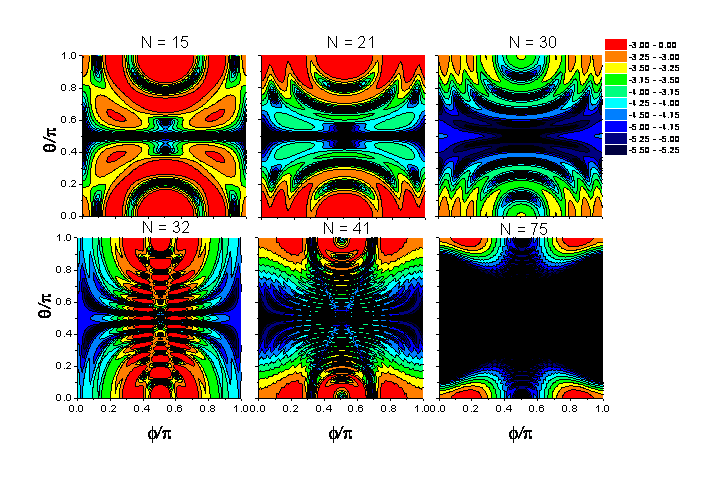 Angular distributions in above-threshold ionization, obtained with a strong infrared field and a time-delayed attosecond pulse train. For details see Phys. Rev. A 74, 053416 (2006) |
Up to the 1980s, the phenomena
occurring in the context of the
interaction of atoms and radiation were theoretically well described by
perturbation theory. Within the past decade, however, laser sources
with peak
intensities of the order of 10 16 W/cm2 have become experimentally
feasible. In this intensity regime, the external laser field is
comparable
to the binding energies of the electrons, and therefore it can no
longer be
treated as a perturbation. The inadequacy of this theory has also been
confirmed by several experimental observations concerning
high-intensity optical phenomena, already for fields of the order of 10
13 W/cm2. Therefore,
matter in strong laser fields poses now a great challenge to both
theoretical and
experimental physicists, such that this field of research constitutes
one of
the most active areas within atomic physics.
Apart from the understanding of the main phenomena in this intensity regime, such as high-order harmonic generation and ionization, applications are for instance plasma physics (in particular fusion), particle physics, and x-ray sources. Furthermore, since the physical mechanisms behind strong-field phenomena take place within hundreds of attoseconds (10-18s), they constitute powerful tools for resolving or even controlling dynamic processes with subfemtosecond precision. Concrete examples are dynamic imaging of, for instance, molecular systems, with attosecond precision, or the generation of attosecond pulses. |