About
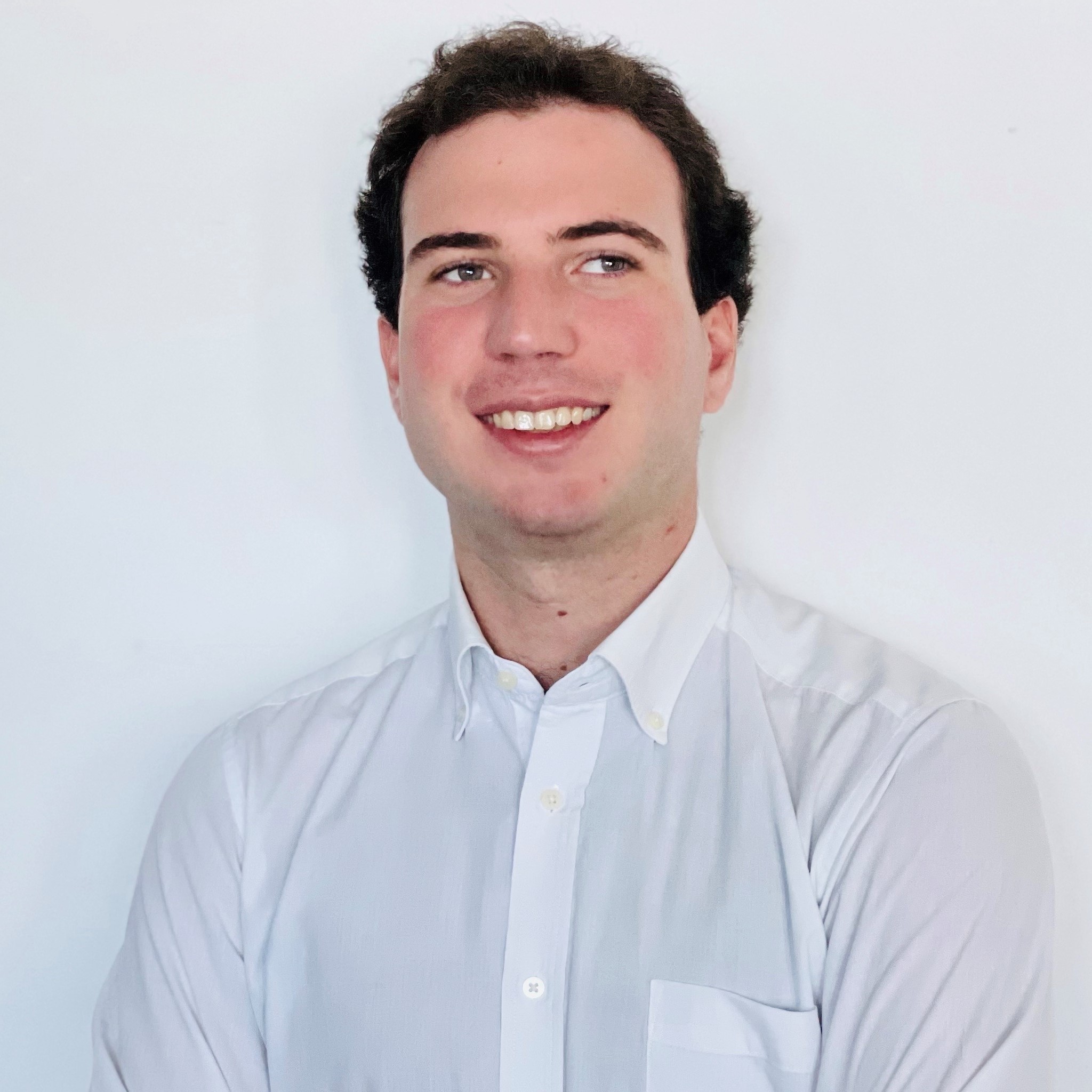
I am a Research Fellow at University College London, where I work on mathematical modeling of cancer immunotherapy as part of the NexTGen Team. I am also an Adjunct Research Fellow at Swinburne University of Technology.
I completed my PhD in Pure and Applied Mathematics at Politecnico di Torino and Swinburne University of Technology in 2024, under the supervision of Prof. Marcello Delitala and Prof. Federico Frascoli.
Detailed CVResearch
I am an applied mathematician working in Mathematical Biology, with a focus on discrete and continuous models of cell population dynamics in cancer and development. My work aims to provide insights into the mechanisms underlying treatment response and resistance, ultimately contributing to the development of more effective therapies.
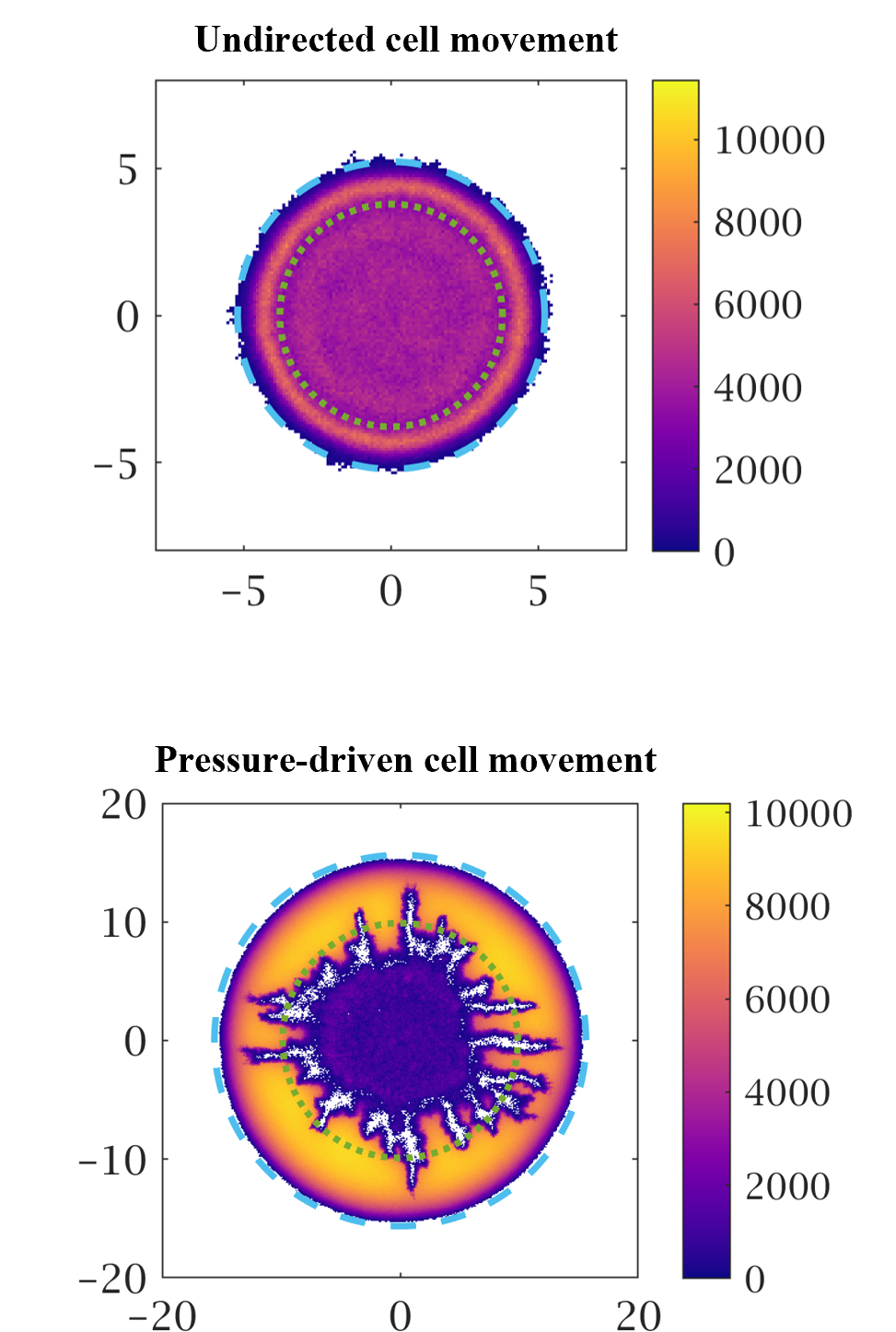
Oncolytic virotherapy
Oncolytic viruses are viral particles that specifically infect cancer cells, while mostly preserving healthy tissues. The potential of this therapy has been recognised for a long time, there are still many challenges that prevent the systematic use of this treatment. Some of the main obstacles to the propagation of oncolytic viruses inside a tumour include clearance by the immune system, physical obstacles and inhibition of the infection in hypoxic areas.
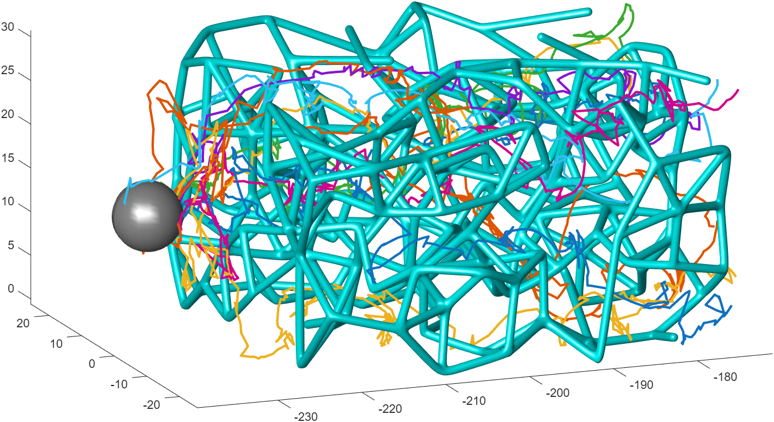
Immunotherapy and T-cell migration
Improving CAR-T cell therapies in solid cancers requires a better understanding of immune infiltration within tumours. The anisotropic cancer growth shapes the surrounding fibre architecture, whose alignment in turn influences the migration of immune cells. The use of three-dimensional microscaffolds appears instrumental to replicate the main characteristics of the tumour microenvironment in more controlled settings, both in vitro and in silico.
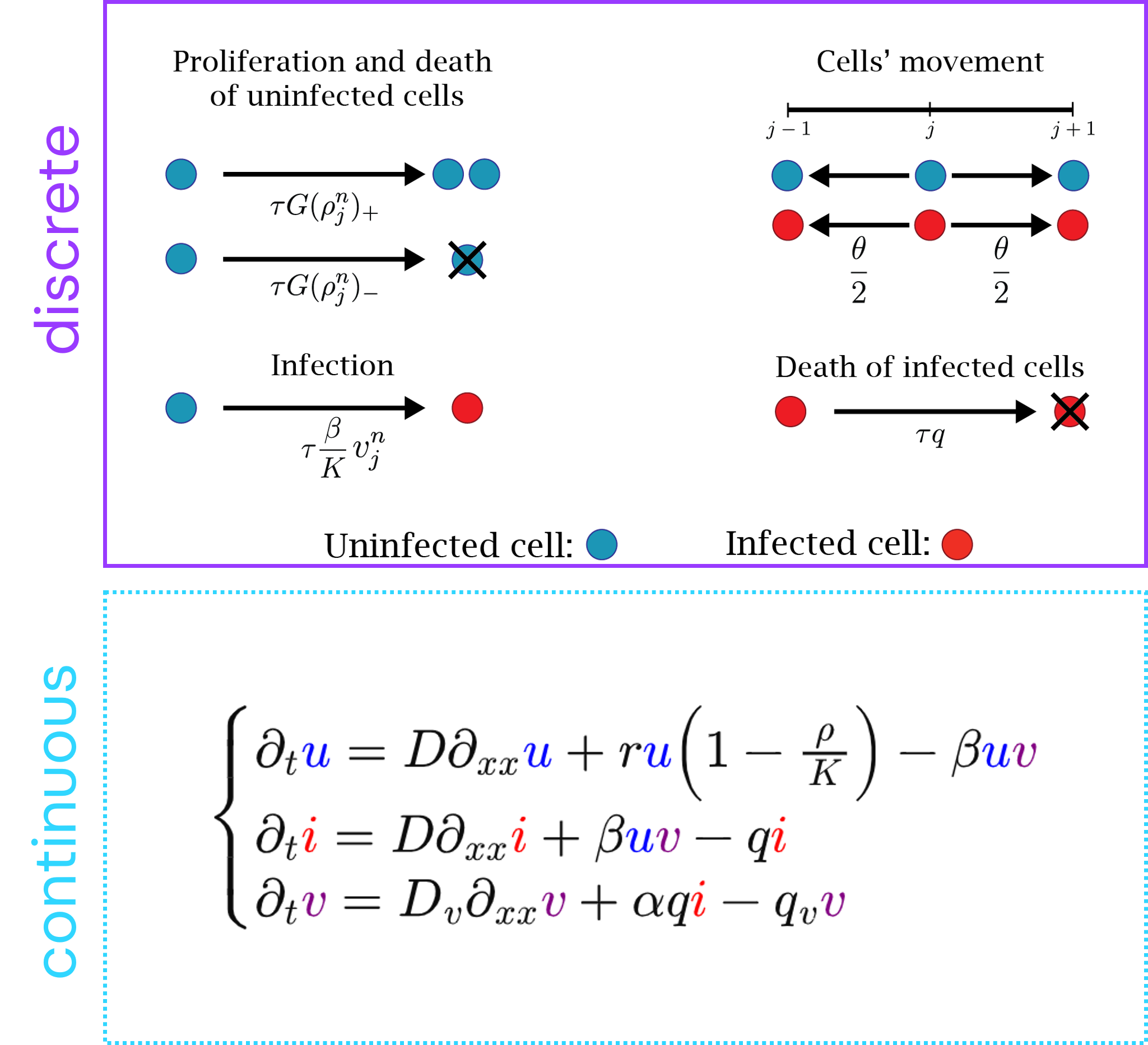
Discrete and continuous models
Different mathematical representations may describe either different scales of a biological system, or different behavioral hallmarks. The comparison of discrete and continuous modelling approaches for the same system often provides relevant insights on the underlying dynamics. Some of my works highlight the emergence of significant discrepancies between continuum model and their individual counterparts in specific parameter regimes, in which stochastic events appear extremely relevant.
Publications
-
D. Morselli, M. E. Delitala, A. L. Jenner, F. Frascoli. A hybrid discrete-continuum modelling approach for the interactions of the immune system with oncolytic viral infections. Journal of Theoretical Biology, 627:112462, 2026. DOI: 10.1016/j.jtbi.2026.112462| arXiv | BibTeX | Supplementary material
-
D. Morselli, F. Frascoli, M. E. Delitala. The role of viral dynamics and infectivity in models of oncolytic virotherapy for tumours with different motility. Bulletin of Mathematical Biology, 88:66, 2026. DOI: 10.1007/s11538-026-01630-6| arXiv | BibTeX | Supplementary material
-
D. Morselli, G. Chiari, F. Frascoli, M. E. Delitala. A phenotype-structured mathematical model for the influence of hypoxia on oncolytic virotherapy. Mathematical Biosciences, 391:109570, 2026. DOI: 10.1016/j.mbs.2025.109570| arXiv | BibTeX | Supplementary material
-
D. Morselli, M. E. Delitala, F. Frascoli. Agent-based and continuum models for spatial dynamics of infection by oncolytic viruses. Bulletin of Mathematical Biology, 85:92, 2023. DOI: 10.1007/s11538-023-01192-x | arXiv | BibTeX | Supplementary material
-
G. Chiari, M. E. Delitala, D. Morselli, M. Scianna. A hybrid modeling environment to describe aggregates of cells heterogeneous for genotype and behavior with possible phenotypic transitions. International Journal of Non-Linear Mechanics, 144:104063, 2022. DOI: 10.1016/j.ijnonlinmec.2022.104063 | PoliTo Repository | BibTeX
Ph.D. thesis: Improving the effectiveness of oncolytic virotherapy: insights from mathematical modelling
Awards
- Outstanding PhD Thesis Award, Australia and New Zealand Industrial and Applied Mathematics (ANZIAM)
- 2024 SoSCET Best Student Paper Award (Department of Mathematics), Swinburne University of Technology
- Best poster prize, INTERPHACE symposium 2025 (Francis Crick Institute)
- Best poster award, Workshop “Topics on Neuroscience, Collective Migration and Parameter Estimation” (University of Oxford)
- Best talk, Maths HDR Student Conference (Swinburne University of Technology)
Teaching
Contact
Email: d.morselli@ucl.ac.uk
Office: Department of Mathematics, University College London