The role of L-glutamate as a transmitter of sensory afferents to the thalamus has been the subject of study in this lab for many years (for a review see Salt 2002).
We have studied the role
of
ionotropic glutamate (excitatory
amino acid) receptors of the AMPA
and NMDA variety in
the transmission of somatosensory
information to the ventrobasal thalamus using iontophoretic
techniques and intracellular and
extracellular recording. We have established that sensory-evoked EPSPs
are mediated by both
AMPA receptors and NMDA receptors, with AMPA receptors mediating the
initial phase of these
responses (Salt & Eaton 1989;
1991). The role of NMDA
receptors appears to become
functionally more prominent during repetitive synaptic input, and this
is likely to be of great
functional significance under behavioural conditions (Salt
1986).
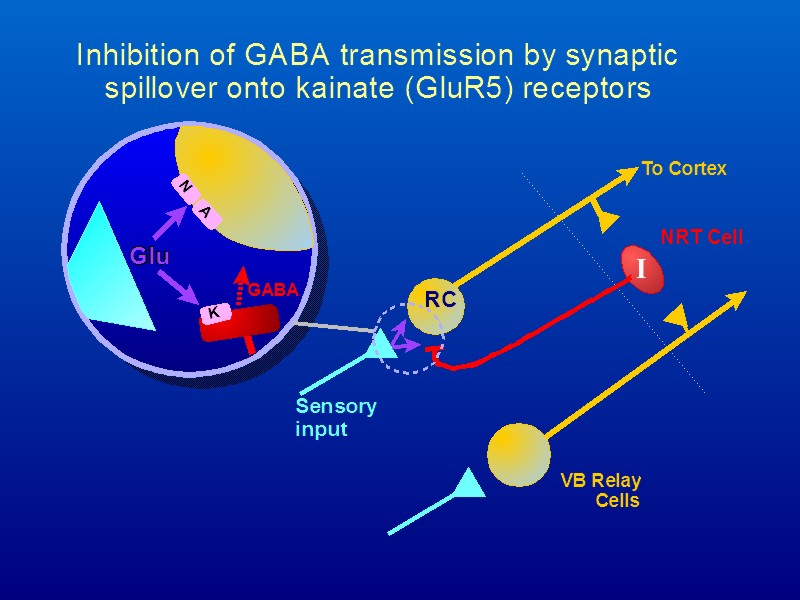
The availability of selective agonists and antagonists for some of the kainate receptors has recently allowed an evaluation of the role of kainate receptors in the thalamus. Based upon a series of in vivo and in vitro experiments, we suggest that kainate receptors are located presynaptically on inhibitory GABAergic terminals of thalamic reticular nucleus neurones, and that these are normally activated by glutamate spillover from synapses between excitatory afferents and relay neurones during physiological stimulation. We propose that this GluR5-activated disinhibition has an important novel role in extracting sensory information from background noise (Binns et.al., 2003).
We have also investigated the role(s) of metabotropic glutamate receptors (mGluRs) in the thalamus. We have found that postsynaptic receptors belonging to Group I play a significant role, together with NMDA receptors, in the responses of thalamic neurones to noxious sensory stimuli (Eaton et al., 1993; Salt & Eaton 1994). This represents the first demonstration of an involvement of mGluRs in a synaptic response, and is likely to be of importance in the understanding of acute and chronic nociceptive mechanisms. We have been able to establish that these responses comprise distinct mGluR1 and mGluR5 components (Binns & Salt 2000). Concurrently, we have also shown that mGluRs belonging to Groups II and III can reduce GABAergic inhibition in the ventrobasal thalamus, apparently via a presynaptic action upon the terminals of GABAergic neurones (Salt & Eaton 1995; Turner & Salt, 2003). This would allow modulation of inhibitory processes within the ventrobasal thalamus.
More recently, we have
been using Positive Allosteric
Modulators (PAMs) as tools to reveal the function of mGlu
receptors in sensory transmission under physiological conditions (Copeland
et.al. 2012; Salt
et.al. 2012). We have discovered a specific role for
mGlu2 receptors in meditating heterosynaptic inhibition of GABAergic
lateral inhibition, and this shows that mGlu2 has an important role in
gating sensory processing and cognitive mechanisms in the thalamus (Copeland
et.al. 2012).
This page was written by Tom Salt, and is part of the Neurotransmitters in Sensory Systems Home Page.
 |
 |
 |
 |
 |