Glutamate Receptors in
Superior
Colliculus
Glutamate Receptors and
Visual Responses in the
Adult Superior Colliculus
 The
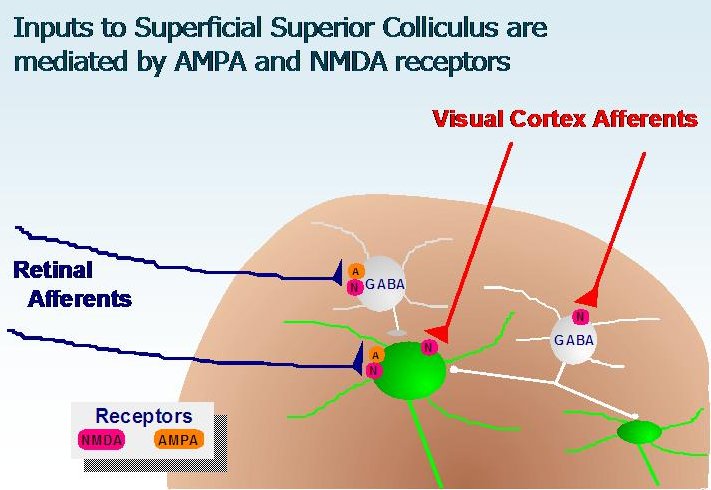
excitatory amino acid L-glutamate
is a major transmitter in the vertebrate central nervous system. We have
shown that antagonists which block glutamate receptors of either the NMDA
type or AMPA
type reduce visual responses of neurones in the adult superficial superior
colliculus
when these antagonists are applied locally by iontophoresis
(Binns
& Salt, 1994).
This indicates that both NMDA receptors and AMPA receptors mediate
visual responses of these neurones. Furthermore, involvement of NMDA
receptors in visual responses appears to be related to those neurones
which are likely to receive an input from the visual cortex: this may be
a mechanism for the cortex to gate activity in the superficial layers of
the superior colliculus.
The
excitatory amino acid L-glutamate
is a major transmitter in the vertebrate central nervous system. We have
shown that antagonists which block glutamate receptors of either the NMDA
type or AMPA
type reduce visual responses of neurones in the adult superficial superior
colliculus
when these antagonists are applied locally by iontophoresis
(Binns
& Salt, 1994).
This indicates that both NMDA receptors and AMPA receptors mediate
visual responses of these neurones. Furthermore, involvement of NMDA
receptors in visual responses appears to be related to those neurones
which are likely to receive an input from the visual cortex: this may be
a mechanism for the cortex to gate activity in the superficial layers of
the superior colliculus.
 We
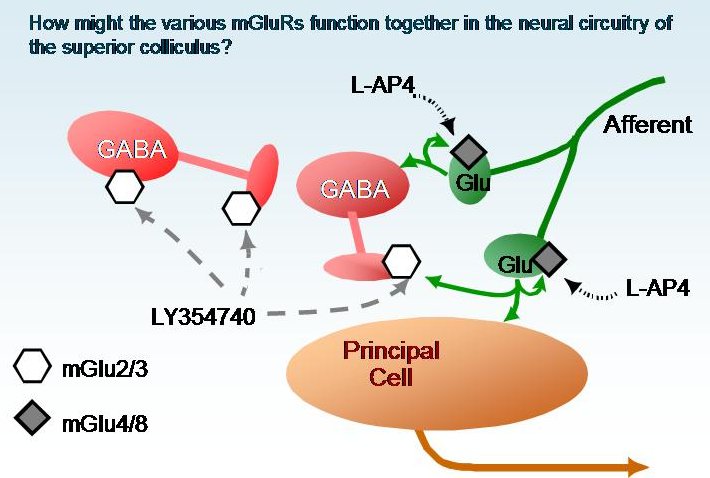
have also investigated the role of metabotropic
glutamate (mGlu)
receptors in visual processing in the superficial superior colliculus.
We have found that these receptors have distinct roles in modulating
responses under different conditions of visual stimulation (Cirone
& Salt, 2001). More recently we have discovered that
this is due to specific
functional localisation of different mGlu receptor subtypes so as
to allow specific modulation of either excitatory or inhibitory
transmission (Lacey
et.al., 2005; Neale
& Salt 2006).
We
have also investigated the role of metabotropic
glutamate (mGlu)
receptors in visual processing in the superficial superior colliculus.
We have found that these receptors have distinct roles in modulating
responses under different conditions of visual stimulation (Cirone
& Salt, 2001). More recently we have discovered that
this is due to specific
functional localisation of different mGlu receptor subtypes so as
to allow specific modulation of either excitatory or inhibitory
transmission (Lacey
et.al., 2005; Neale
& Salt 2006).
In the deeper
layers of the superior colliculus, neurones
are found which respond to combinations of visual, auditory and
somatosensory stimuli. Such multimodal responses are particularly
sensitive to NMDA receptor antagonists (Binns &
Salt, 1996). NMDA receptors are
unique amongst the ionotropic glutamate receptors in that the ion channel
is blocked by magnesium ions in a voltage dependent manner. The Mg2+ block
is strongest when the membrane is hyperpolarized, but if the neurone is
partially depolarized then the block is relieved and the responsiveness of
the cell to further depolarising inputs is enhanced. This confers the
ability to summate inputs from several sources in a non-linear fashion on
neurones which have synaptic NMDA receptors. Furthermore, given the
kinetics of NMDA-gated channels, these receptors can also be utilized in
temporal summation of inputs. Multi-modal integration by DSC sensory
neurones contributes to the generation of goal directed orientation
responses to novel sensory information. Thus, NMDA receptors underlie the
control of appropriate behavioural responses to new elements in the local
environment.
Glutamate Receptors and
Visual Responses in the Developing Superior Colliculus
As NMDA receptors are
important in the
developmental plasticity of the
nervous system, we have also investigated how NMDA
receptor-mediated
transmission of visual responses in the superfical superior
colliculus may
change
during development. We found that after eye opening, there was an
increase in the the degree of NMDA receptor involvement in visual
responses which peaked a week later (Binns
&
Salt 1998).
Furthermore, this increase is sustained
and enhanced into adulthood in the absence of visual experience (Binns
& Salt 1998),
and may
be a result of changes in the molecular properties/composition of the
NMDA receptors involved in visual responses in the superior colliculus (Binns
et. al. 1999).
Changes in
transmitter receptor function in the Superior Colliculus in retinal
degeneration and/or regeneration
Given our previous
findings that the various glutamate receptors are major players in the
mediation of visual input to the superior colliculus, we have begun to
investigate how the role and function of these receptors may change during
retinal degeneration and/or lesion . It is
evident that changes do occur in the superior colliculus and it will be
important to define these changes and how to modulate them.
This page was
written by Tom
Salt, and is
part of the Neurotransmitters
in
Sensory Systems Home Page.

Return
to Tom Salt's Home Page


