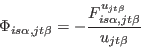
We calculate
 by the small-displacement
method. In harmonic approximation the
by the small-displacement
method. In harmonic approximation the  Cartesian component of
the force exerted on the atom at position
Cartesian component of
the force exerted on the atom at position
 is
is
 |
(2) |
 is the displacement of the atom in
 along the direction
  and
and
 is the component of the force induced on the
atom at position
. The force constant
matrix can be calculated as:
is the component of the force induced on the
atom at position
. The force constant
matrix can be calculated as:
 , and calculating the
forces
, and calculating the
forces
 induced on the atoms in
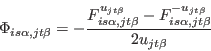
. Eqn.( 3) computes the force
constant matrix using forward differences; for numerical reasons, it
can be advantageous in some cases to use central differences, in which
case the force constant matrix can be calculated as:
induced on the atoms in
. Eqn.( 3) computes the force
constant matrix using forward differences; for numerical reasons, it
can be advantageous in some cases to use central differences, in which
case the force constant matrix can be calculated as:
Since the crystal is invariant under traslations of any lattice
vector, it is only necessary to displace the atoms in one primitive
cell and calculate the forces induced on all the other atoms of the
crystal. In what follows we will assume this as understood and put
simply  .
.
It is important to appreciate that the
 in the formula for
 is
the force-constant matrix in the infinite lattice, with no restriction
on the wavevector
is
the force-constant matrix in the infinite lattice, with no restriction
on the wavevector  , whereas the calculations of
can only be done in supercell
geometry. Without a further assumption, it is strictly impossible to
extract the infinite-lattice
from supercell calculations, since the latter deliver information only
at wavevectors that are reciprocal lattice vectors of the
superlattice. The further assumption needed is that the
infinite-lattice
vanishes when
the separation
, whereas the calculations of
can only be done in supercell
geometry. Without a further assumption, it is strictly impossible to
extract the infinite-lattice
from supercell calculations, since the latter deliver information only
at wavevectors that are reciprocal lattice vectors of the
superlattice. The further assumption needed is that the
infinite-lattice
vanishes when
the separation
 is such that the
positions
is such that the
positions  and
and
 lie in different
Wigner-Seitz (WS) cells of the chosen superlattice. More precisely, if
we take the WS cell centred on
, then the
infinite-lattice value of
vanishes if is in a different WS cell; it is equal to
the supercell value if is wholly within the same WS
cell; and it is equal to the supercell value divided by an integer
lie in different
Wigner-Seitz (WS) cells of the chosen superlattice. More precisely, if
we take the WS cell centred on
, then the
infinite-lattice value of
vanishes if is in a different WS cell; it is equal to
the supercell value if is wholly within the same WS
cell; and it is equal to the supercell value divided by an integer  if lies on the boundary of the same WS cell, where
is the number of WS cells having on their
boundary. With this assumption, the
elements will converge to the correct infinite-lattice
values as the dimensions of the supercell are systematically
increased.
if lies on the boundary of the same WS cell, where
is the number of WS cells having on their
boundary. With this assumption, the
elements will converge to the correct infinite-lattice
values as the dimensions of the supercell are systematically
increased.
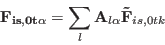
It is not always necessary to displace all the atoms in the primitive
cell, since the use of symmetries can reduce the amount of work
needed. This is done as follows. We displace one atom in the primitive
cell, let's call it 'one', and we calculate the forces induced by the
displacement on all the other atoms of the supercell. Then we pick up
one other atom of the primitive cell, atom 'two'. If there is a
symmetry operation  (not necessarily a point group symmetry
operation) such that, when is applyed to the crystal atom two is
sent into atom one and the whole crystal is invariant under such
transformation, then it is not necessary to displace atom two, and the
part of the force constant matrix associated with its displacement can
be calculated using
(not necessarily a point group symmetry
operation) such that, when is applyed to the crystal atom two is
sent into atom one and the whole crystal is invariant under such
transformation, then it is not necessary to displace atom two, and the
part of the force constant matrix associated with its displacement can
be calculated using
 |
(5) |
 is the
  matrix representing the point
group part of in Cartesian coordinates, and
matrix representing the point
group part of in Cartesian coordinates, and
 indicates the atom of the crystal where the atom in
is brought because of the action of the symmetry
operation . If there is no symmetry operation connecting atom two
to atom one then atom two is displaced and all the induced force field
is calculated. The procedure is repeated for all the atoms of the
primitive cell.
indicates the atom of the crystal where the atom in
is brought because of the action of the symmetry
operation . If there is no symmetry operation connecting atom two
to atom one then atom two is displaced and all the induced force field
is calculated. The procedure is repeated for all the atoms of the
primitive cell.
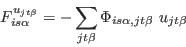
In principle each atom has to be displaced along the three Cartesian
directions. It is sometimes convenient to displace the atoms along
some special directions so as to maximize the number of symmetry
operations still present in the 'excited' supercell, in this way the
calculations of the forces are less expensive. This can always be
done, as long as one displaces the atoms along three linearly
independent directions. The forces induced by the displacements along
the three Cartesian directions is easily reconstructed by the linear
combination
 |
(6) |
 is the force induced on the atom
in
due to a displacement of the atom in
is the force induced on the atom
in
due to a displacement of the atom in
 along the direction
  , and
, and
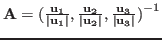 is the inverse of the matrix whose columns are the normalized displacements in
Cartesian coordinates.
is the inverse of the matrix whose columns are the normalized displacements in
Cartesian coordinates.
Using symmetries it is possible to reduce the number of displacements
even further: if applying a point group symmetry operation  to the
displacement vector
to the
displacement vector  one obtains a vector
  which
is linearly independent from , then the force field that
would be induced by the displacement can be calculated by
which
is linearly independent from , then the force field that
would be induced by the displacement can be calculated by
 |
(7) |
The force constant matrix is invariant under the point group symmetry
operations of the crystal. This is not automatically garanteed by the
procedure just described, because in general the crystal is not
harmonic, and therefore eqns.( 3, 4) are
only an approximation. So, the force constant matrix must be
symmetrized with respect to the point group operations of the crystal:
 |
(8) |
 of the nearest-neighbour distance is a good
compromise.
of the nearest-neighbour distance is a good
compromise.
As an example of the procedure just described let's consider the
h.c.p. crystal. There are two atoms in the primitive cell, so in
principles we would need six independent calculations. We will see
that the number of calculations needed is equal to two. In first place
one can easily recognize that only one atom needs to be displaced: if
we traslate the crystal from one atom to the other and we perform a
spatial inversion the crystal remains unchanged. Secondly, by applying
a clockwise rotation of  degrees, for example, to a displacement
in the
degrees, for example, to a displacement
in the  direction, one obtains an independent displacement. So only
one additional displacement along the
direction, one obtains an independent displacement. So only
one additional displacement along the  direction is needed.